


Page 71 - JSOM Winter 2019
P. 71
using multiple forms of information processing—visual, au-  Methods
              ditory, and kinetic. 12,13  The OPC and the Soldier note con-
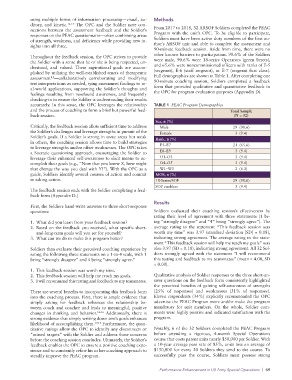
              nections between the assessment feedback and the Soldier’s   From 2017 to 2018, 32 ARSOF Soldiers completed the PEAC
              responses on the PEAC questionnaire—often confirming areas   Program with the unit’s OPC. To be eligible to participate,
              of strength, weakness, and deficiency while providing new in-  Soldiers must have been active duty members of the first au-
              sights into all three.                             thor’s ARSOF unit and able to complete the assessment and
                                                                 90-minute feedback session. Aside from time, there were no
              Throughout the feedback session, the OPC strives to provide   other known barriers to participation. 90.6% of the Soldiers
              the Soldier with a sense that he or she is being respected, un-  were  male, 90.6% were  18-series Operators  (green berets),
              derstood,  and valued.  These  aspirational  goals  are accom-  and 65.6% were noncommissioned officers with ranks of E-5
              plished by utilizing the well-established tenets of therapeutic   (sergeant), E-6 (staff sergeant), or E-7 (sergeant first class).
              assessment —collaboratively  corroborating  and  modifying   Full demographics are shown in Table 1. After completing one
                      8,9
              test interpretations as needed, tying assessment findings to re-  90-minute coaching session, Soldiers completed a feedback
              al-world applications, supporting the Soldier’s thoughts and   form that provided qualitative and quantitative feedback to
              feelings resulting from newfound awareness, and frequently   the OPC for program evaluation purposes (Appendix D).
              checking-in to ensure the Soldier is understanding their results
              accurately. In this sense, the OPC leverages the relationship   TABLE 1  PEAC Program Demographics
              and the process of coaching to form a brief but powerful feed-                    Total Sample
              back session.                                                                       (N = 32)
                                                                 Sex, n (%)
              Critically, the feedback session allots sufficient time to address   Male          29  (90.6)
              the Soldier’s challenges and leverage strengths in pursuit of the   Female          3  (9.4)
              Soldier’s goals. If a Soldier is strong in some areas but weak   Rank, n (%)
              in others, the coaching session allows time to build strategies
              to leverage strengths and/or offset weaknesses. The OPC takes   E5–E7              21  (65.6)
              a Socratic questioning approach, encouraging the Soldier to   E8–E9                 3  (9.4)
              leverage their enhanced self-awareness to elicit means to ac-  O1–O3                3  (9.4)
              complish their goals (e.g., “Now that you know X, how might   O4–O5                 3  (9.4)
              that change the way you deal with Y?”). With the OPC as a   W1–W3                   2  (6.3)
              guide, Soldiers identify several courses of action and commit   MOS, n (%)
              to taking action.                                  18-Series/SOF                   29  (90.6)
                                                                 SOF enablers                     3  (9.4)
              The feedback session ends with the Soldier completing a feed-
              back form (Appendix D.)
                                                                 Results
              First, the Soldiers hand-write answers to three short-response
              questions:                                         Soldiers  evaluated  their  coaching  session’s  effectiveness  by
                                                                 rating their level of agreement with three statements (1 be-
              1.  What did you learn from your feedback session?  ing “strongly disagree” and “4” being “strongly agree”). The
              2.  Based on the feedback you received, what specific short-  average rating to the statement “This feedback session was
                and-long-term goals will you set for yourself?   worth my time” was 3.97 (standard deviation [SD] = 0.18),
              3.  What can we do to make this program better?    indicating strong agreement. The average rating to the state-
                                                                 ment “This feedback session will help me reach my goals” was
              Soldiers then evaluate their perceived coaching experience by   also 3.97 (SD = 0.18), indicating strong agreement. All 32 Sol-
              rating the following three statements on a 1-to-4 scale, with 1   diers strongly agreed with the statement “I will recommend
              being “strongly disagree” and 4 being “strongly agree.”  this testing and feedback to my teammates” (mean = 4.00, SD
                                                                 = 0.00).
              1.  This feedback session was worth my time.
              2.  This feedback session will help me reach my goals.  Qualitative analysis of Soldier responses to the three short-an-
              3.  I will recommend this testing and feedback to my teammates.  swer questions on the feedback form consistently highlighted
                                                                 the perceived benefits of gaining self-awareness of strengths
              There are several benefits to incorporating this feedback form   (25% of  responses)  and  weaknesses  (31% of  responses).
              into the coaching process. First, there is ample evidence that   Eleven respondents (34%) explicitly recommended the OPC
              simply asking for feedback enhances the relationship be-  advertise the PEAC Program more and/or make the program
              tween coach and coachee and leads to meaningful, positive   mandatory for unit members. On the whole, Soldier com-
              changes in thinking and behavior. 14–16  Additionally, there is   ments were highly positive and indicated satisfaction with the
              strong evidence that simply writing down one’s goals enhances   program.
              likelihood of accomplishing them. 17,18  Furthermore, the quan-
              titative ratings allow the OPC to identify any disconnects or   Notably, 6 of the 32 Soldiers completed the PEAC Program
              “missed targets” with the Soldier and address those concerns   before attending a rigorous, 4-month Special Operations
              before the coaching session concludes. Ultimately, the Soldier’s   course that costs parent units nearly $50,000 per Soldier. With
              feedback enables the OPC to ensure a positive coaching expe-  a 10-year average pass rate of 85%, units lose an average of
              rience and to constantly refine his or her coaching approach to   $150,000 for every 20 Soldiers they send to the course. To
              steadily improve the PEAC program.                 successfully pass the course, Soldiers must possess strong

                                                                   Performance Enhancement in US Army Special Operations  |  69

