


Page 70 - JSOM Winter 2019
P. 70
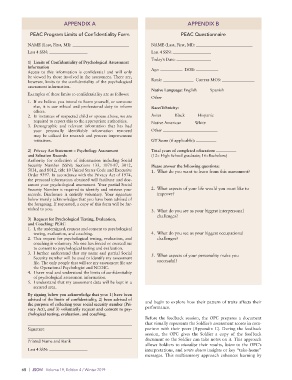
APPENDIX A                                          APPENDIX B

             PEAC Program Limits of Confidentiality Form                    PEAC Questionnaire

             NAME (Last, First, MI): ____________________________  NAME (Last, First, MI): ____________________________
            Last 4 SSN: ___________________                    Last 4 SSN: ___________________
                                                               Today’s Date: _________________
             1)  Limits of Confidentiality of Psychological Assessment
             Information                                       Age: ___________  DOB: ___________
             Access to this information is confidential and will only
             be viewed by those involved in the assessment. There are,   Rank: _______________  Current MOS: ________________
             however, limits to the confidentiality of the psychological
             assessment information.
                                                               Native Language: English _____  Spanish _____
             Examples of these limits to confidentiality are as follows:
                                                               Other ___________________________
             1.  If we believe you intend to harm yourself, or someone
               else, it is our ethical and professional duty to inform   Race/Ethnicity:
               others.
             2.  In instances of suspected child or spouse abuse, we are   Asian _____  Black  _____  Hispanic _____
               required to report this to the appropriate authorities.  Native American _____  White _____
             3.  Demographic and relevant information that has had
               your personally identifiable information removed   Other ___________________________
               may be utilized for research and process improvement
               initiatives.                                    GT Score (if applicable): __________
             2)  Privacy Act Statement – Psychology Assessment    Total years of completed education: __________
            and Selection Records                              (12= High School graduate; 16=Bachelors)
            Authority for collection of information including Social
            Security Number (SSN): Sections 133, 1071-87, 3012,   Please answer the following questions:
            5031, and 8012, title 10 United States Code and Executive   1.  What do you want to learn from this assessment?
            Order 9397. In accordance with the Privacy Act of 1974,
            the personal information obtained will facilitate and doc-
            ument your psychological assessment. Your partial Social
            Security Number is required to identify and retrieve your   2.  What aspects of your life would you most like to
            records. Disclosure is entirely voluntary. Your signature   improve?
            below merely acknowledges that you have been advised of
            the foregoing. If requested, a copy of this form will be fur-
            nished to you.                                      3.  What do you see as your biggest interpersonal
                                                                  challenges?
             3)  Request for Psychological Testing, Evaluation,
            and Coaching: PEAC
             1.  I, the undersigned, request and consent to psychological
               testing, evaluation, and coaching.               4.  What do you see as your biggest occupational
             2.  This request for psychological testing, evaluation, and   challenges?
               coaching is voluntary. No one has forced or coerced me
               to consent to psychological testing and evaluation.
             3.  I further understand that my name and partial Social   5.  What aspects of your personality make you
               Security number will be used to identify my assessment
               file. The only people that will see my assessment file are   successful?
               the Operational Psychologist and NCOIC.
             4.  I have read and understand the limits of confidentiality
               of psychological assessment information.
             5.  I understand that my assessment data will be kept in a
               secured area.
            By signing below you acknowledge that you: 1) have been
            advised of the limits of confidentiality, 2) been advised of   and begin to explore how their pattern of traits affects their
            the purpose of collecting your social security number (Pri-
            vacy Act), and 3) voluntarily request and consent to psy-  performance.
            chological testing, evaluation, and coaching.
                                                             Before the feedback  session, the OPC prepares  a document
                                                             that visually represents the Soldier’s assessment scores in com-
            Signature                                        parison with their peers (Appendix C). During the feedback
                                                             session, the OPC gives the Soldier a copy of the feedback
                                                             document so the Soldier can take notes on it. This approach
            Printed Name and Rank
                                                             allows Soldiers to visualize their results, listen to the OPC’s
            Last 4 SSN: ___________________                  interpretations, and write down insights or key “take-home”
                                                             messages. This multisensory approach enhances learning by


          68  |  JSOM   Volume 19, Edition 4 / Winter 2019

