


Page 76 - JSOM Winter 2019
P. 76
The Potential Use of the Abdominal Aortic Junctional Tourniquet
                                                                                                     ®
                                            in a Military Population

                            A Review of Requirement, Effectiveness, and Usability


                                                                                          1
                          Charles Handford, MBChB (hons), MRCS, DMCC, PGCME, RAMC *;
                                       Paul Parker, FIMC, FRCSEd (Orth), RAMC  2


          ABSTRACT
          Uncontrolled hemorrhage is the leading cause of preventable   personnel in combat situations could use the device. This re-
          prehospital death on the battlefield; 20% is junctional. This is   port examines the potential uses of the AAJT and its potential
          a challenge to manage in the forward and prehospital military   place within the current operating environment.
          environment. With the widespread use of body armor, periph-
          eral tourniquets and continued asymmetric warfare this con-  The AAJT
          sistent figure is unlikely to reduce. Resuscitative endovascular
          balloon occlusion of the aorta (REBOA) is an often-quoted   The AAJT is an external compression device developed and
          potential solution; however, this invasive strategy requires a   manufactured by Compression Works and can be used for
          high skill level alongside a significant failure and complication   junctional bleeding in the groin or axilla. Due to its ability to
          rate. The Abdominal Aortic Junctional Tourniquet  (AAJT) is   provide compression at the aortic bifurcation, it can be used
                                                 ®
          a noninvasive potential adjunct for the management of hem-  for pelvic bleeding. Eighty-five percent of all pelvic bleeding is
          orrhage below the level of the aortic bifurcation with pub-  venous, and REBOA does not affect the valveless inferior vena
          lished case reports of successful use in prehospital blast and   cava (IVC), the additional IVC compression provided by the
          gunshot wounds. When placed at the level of the aortic bi-  AAJT is likely to be beneficial.
          furcation, alongside a pelvic binder, it can be used to control
          pelvic hemorrhage, buying time until definitive management.   The AAJT is applied and buckled around the waist with the
          Importantly it has a low training burden and is easy to use.   inflatable bladder over the region of the umbilicus, the belt is
          The AAJT has potential use as a prehospital device in the ex-  tightened, and the windlass is turned (Figure 1). The bladder
          sanguinating patient, those in traumatic cardiac arrest, as a   is then inflated using a hand pump until the pressure indica-
          bridging device, and as fluid conserving device in resource-lim-  tor shows green, indicating a pressure of between 250 and
          ited environments. The evidence surrounding the AAJT is re-  300mmHg. Overinflation is prevented by a “bleed-off” valve
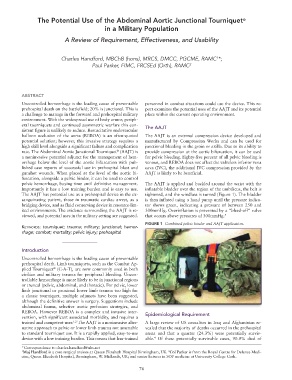
          viewed, and potential uses in the military setting are suggested.  that occurs above pressures of 300mmHg. 3
                                                             FIGURE 1  Combined pelvic binder and AAJT application.
          Keywords: tourniquet; trauma; military; junctional; hemor-
          rhage; combat; mortality; pelvic injury; prehospital


          Introduction
          Uncontrolled hemorrhage is the leading cause of preventable
          prehospital death. Limb tourniquets, such as the Combat Ap-
                       ®
          plied Tourniquet  (C-A-T), are now commonly used in both
          civilian and military trauma for peripheral bleeding. Uncon-
          trollable hemorrhage is more likely to be in junctional regions
          or truncal (pelvic, abdominal, and thoracic). For pelvic, lower
          limb junctional or proximal lower limb trauma too high for
          a classic tourniquet, multiple adjuncts have been suggested,
          although the definitive answer is surgery. Suggestions include
          abdominal foams, selective aortic perfusion strategies, and
          REBOA. However REBOA is a complex and invasive inter-  Epidemiological Requirement
          vention, with significant associated morbidity, and requires a
                               1,2
          trained and competent user.  The AAJT is a noninvasive alter-  A large review of US casualties in Iraq and Afghanistan re-
          native approach to pelvic or lower limb trauma not amenable   vealed that the majority of deaths occurred in the prehospital
          to standard tourniquet use. It is a rapidly applied, easy-to-use   arena and that a quarter  (24.3%) were potentially surviv-
          device with a low training burden. This means that less-trained   able.  Of these potentially survivable cases, 90.9% died of
                                                                 4
          *Correspondence to charles.handford@nhs.net
          1 Maj Handford is a core surgical trainee at Queen Elizabeth Hospital Birmingham, UK.  Col Parker is from the Royal Centre for Defence Medi-
                                                                       2
          cine, Queen Elizabeth Hospital, Birmingham, W. Midlands, UK; and senior lecturer in SOF medicine at University College Cork.
                                                           74

