


Page 109 - JSOM Fall 2019
P. 109
An Ongoing Series


                                                          Scabies


                                                              1
                                       Elena M. Crecelius, MD *; Mark W. Burnett, MD  2


              Introduction
              There are few things that make you feel itchy all over more so
              than hearing that someone around you has scabies. The mite
              Sarcoptes scabiei variety hominis is the cause of this extremely
              itchy skin infection. These tiny parasites are present worldwide
              but most commonly cause infection in tropical resource-poor
              regions. Scabies can occur in people of all socioeconomic lev-
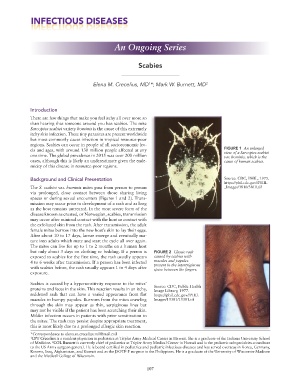
              els and ages, with around 130 million people affected at any                    FIGURE 1  An enlarged
              one time. The global prevalence in 2015 was over 200 million                    view of a Sarcoptes scabiei
                                                                                              var. hominis, which is the
              cases, although this is likely an underestimate given the ende-                 cause of human scabies.
              micity of this disease in resource-poor regions.

              Background and Clinical Presentation                                            Source: CDC, PHIL, 1975.
                                                                                              https://phil.cdc.gov//PHIL
              The S. scabiei var. hominis mites pass from person to person                    _Images/3810/3810.tif
              via prolonged, close contact between those sharing living
              spaces or during sexual encounters (Figures 1 and 2). Trans-
              mission may occur prior to development of a rash and as long
              as the host remains untreated. In the most severe form of the
              disease known as crusted, or Norwegian, scabies, transmission
              may occur after minimal contact with the host or contact with
              the exfoliated skin from the rash. After transmission, the adult
              female mites burrow into the new host’s skin to lay their eggs.
              After about 10 to 17 days, larvae emerge and eventually ma-
              ture into adults which mate and start the cycle all over again.
              The mites can live for up to 1 to 2 months on a human host
              but only about 3 days on clothing or bedding. If a person is   FIGURE 2  Classic rash
              exposed to scabies for the first time, the rash usually appears   caused by scabies with
              4 to 6 weeks after transmission. If a person has been infected   macules and papules
              with scabies before, the rash usually appears 1 to 4 days after   present in the intertriginous
                                                                 space between the fingers.
              exposure.
              Scabies is caused by a hypersensitivity response to the mites’
              proteins and feces in the skin. This reaction results in an itchy,   Source: CDC, Public Health
                                                                 Image Library, 1977.
              reddened rash that can have a varied appearance from flat   https://phil.cdc.gov//PHIL_
              macules to bumpy papules. Burrows from the mites crawling   Images/15381/15381.tif
              through the skin may appear as thin, serpiginous lines but
              may not be visible if the patient has been scratching their skin.
              Milder infection occurs in patients with prior sensitization to
              the mites. The rash may persist despite appropriate treatment,
              this is most likely due to a prolonged allergic skin reaction.
              *Correspondence to elena.m.crecelius.mil@mail.mil
              1 CPT Crecelius is a resident physician in pediatrics at Tripler Army Medical Center in Hawaii. She is a graduate of the Indiana University School
              of Medicine.  COL Burnett is currently chief of pediatrics at Tripler Army Medical Center in Hawaii and is the pediatric subspecialties consultant
                       2
              to the US Army surgeon general. He is board certified in pediatrics and pediatric infectious diseases and has served overseas in Korea, Germany,
              Kosovo, Iraq, Afghanistan, and Kuwait and as the JSOTF-P surgeon in the Philippines. He is a graduate of the University of Wisconsin-Madison
              and the Medical College of Wisconsin.
                                                              107

