


Page 72 - JSOM Summer 2019
P. 72
junctional  or  limb  tourniquets  or  current  standard  of  care    For the first 5 minutes after the hemicorporectomy, all exsan-
          (i.e., CG).                                        guinated blood was collected in a catchment bag, including
                                                             blood from the dismembered half of the animal. The MAP was
                                                             maintained to a goal of 60mmHg using volume infusions per
          Materials and Methods
                                                             IACUC protocol. After 5 minutes, the first blood-catchment
          This was an Institutional Animal Care and Use Committee   bag was removed, weighed, and a 500mL pressurized bolus of
          (IACUC)-approved, prospective, interventional trial using a   Hextend (BioTime, https://www.biotimeinc.com) was infused.
          porcine model. The animals were randomly assigned to either   MAPs were recorded every minute for the first 5 minutes and
          the AAJT arm or CG arm of the study. Veterinarians induced   then every 5 minutes until the animal expired or the 60-minute
          and maintained anesthesia at all times, according to the IA-  predefined end point was reached. At 60 minutes, the second
          CUC-approved protocol. After induction and orotracheal in-  blood-catchment bag was removed and weighed. Dressings
          tubation, peak airway pressures were obtained. Pressures were   and gauze were also weighed before and after the procedure to
          taken before placing the AAJT and again with the AAJT in   determine additional blood loss, and this amount was added
          place (but before wound creation). Neuromuscular blockade   to total blood loss. Total normal saline given and time of ini-
          was maintained throughout the trial using a long-acting, non-  tial hemostasis were recorded. The primary outcome measure
          depolarizing neuromuscular blocking agent.         was survival at 60 minutes. Secondary outcomes were time
                                                             to initial hemostasis, MAP, blood loss at 5 minutes, and total
          Before hemicorporectomy, the weight of the animal was re-  blood loss.
          corded and a carotid arterial catheter was placed to measure
          mean arterial pressure (MAP). The internal jugular vein was   Results
          cannulated and used for medication infusion and resuscita-
          tion, which included both crystalloid and Hextend, based on   A total of six animals were used in the study. Given the initial
          MAP. MAP was measured throughout the trial, which had an   results of the study, researchers and veterinarians believed that
          end point of 60 minutes.                           additional animal use could not be justified.

          For the hemicorporectomy, a blade lever device was used to   Mean pre-intervention weight was similar for the AAJT and
          reliably produce a wound through the bilateral femoral heads,   CG groups. Mean initial MAP was slightly higher for the
          transversely across the pelvis approximately 2.2cm distal to   AAJT group, indicating that this group would be somewhat
          the navel. This wound resulted in a transection of the internal   disadvantaged  pre-intervention.  Medians, means,  and stan-
          and external iliac arteries and veins bilaterally with complete   dard deviations of important outcome variables are provided
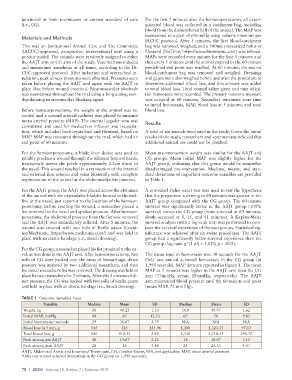
          segmentation of the animal at the abdominal/pelvic junction.  in Table 1.
          For the AAJT group, the AAJT was placed across the abdomen   A one-sided Fisher exact test was used to test the hypothesis
          of the animal with the expandable bladder located in the mid-  that the proportion surviving to 60 minutes was greater in the
          line at the navel, just superior to the location of the hemicor-  AAJT group compared  with the  CG group. The  60- minute
          porectomy. Before creating the wound, a researcher placed a   survival was significantly better in the AAJT group (100%
          fist proximal to the navel and applied pressure. After hemicor-  survival) versus the CG group (none survived at 60 minutes;
          porectomy, the abdominal pressure from the fist was removed   death occurred at 8, 15, and 41 minutes). A Kaplan-Meier
          and the AAJT was immediately inflated. After 5 minutes, the   survival analysis (with a log-rank test) was performed to com-
          wound was covered with two rolls of Kerlix gauze (Covid-  pare the survival experience of the two groups. Statistical sig-
          ien/Medtronic, https://www.medtronic.com/) and was held in   nificance was achieved after six swine procedures. The AAJT
          place with an elastic bandage (i.e., Israeli dressing).  group had a significantly better survival experience than the
                                                             CG group (log-rank χ  [1 df] = 5.052; p = .025).
                                                                              2
          For the CG group, a researcher placed his fist proximal to the na-
          vel, as was done in the AAJT arm. After hemicorporectomy, two   The mean time to hemostasis was 30 seconds for the AAJT.
          rolls of CG were packed over the areas of hemorrhage, direct   Only one animal achieved hemostasis in the CG group (at
          pressure was initiated by two additional researchers, and then   1,980 seconds). MAP data are reported in Figure 1. The mean
          the initial researcher’s fist was removed. The dressing was held in   MAP at 5 minutes was higher in the AAJT arm than the CG
          place by two researchers for 3 minutes. After this 3 minutes of di-  arm  (77mmHg  versus  18mmHg,  respectively).  The  AAJT
          rect pressure, the CG was backed with two rolls of Kerlix gauze   arm maintained blood pressure until the 60-minute end point
          and held in place with an elastic bandage (i.e., Israeli dressing).  (mean MAP, 73 mm Hg).

          TABLE 1  Outcome Variables Data
                   Variable          Median       Mean          SD         Median       Mean          SD
           Weight, kg                  50         49.23        1.33         50.9        49.97        1.62
           Initial MAP, mmHg           88           87         12.53         67          70          9.85
           Initial hemostasis,  seconds    29     30.67        3.79         N/A          N/A         N/A
                       a
           Blood loss in 5 min, g      545         525         155.96       1,300      1,323.33      97.13
           Total blood loss, g         920        918.33       2.89         2,550      2,718.33     390.72
           Peak airway, pre AAJT       20         19.67        2.52          18         18.67        1.15
           Peak airway, post AAJT      28           26         3.46          25         25.33        4.51
          AAJT, Abdominal Aortic and Junctional Tourniquet, CG, Combat Gauze; N/A, not applicable; MAP, mean arterial pressure.
          a Only one animal achieved hemostasis in the CG group (at 1,980 seconds).


          70  |  JSOM   Volume 19, Edition 2 / Summer 2019

