


Page 121 - JSOM Summer 2019
P. 121
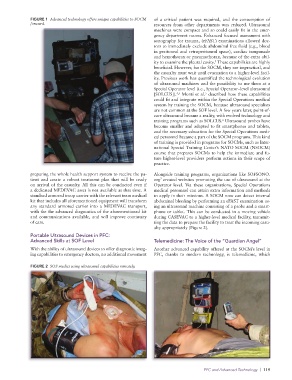
FIGURE 1  Advanced technology offers unique capabilities to SOCM   of a critical patient was required, and the consumption of
              forward.                                           resources from other departments was reduced. Ultrasound
                                                                 machines were compact and so could easily fit in the emer-
                                                                 gency department rooms. Enhanced focused assessment with
                                                                 sonography for trauma, (eFAST) examinations allowed doc-
                                                                 tors to immediately exclude abdominal free fluid (e.g., blood
                                                                 in peritoneal and retroperitoneal space), cardiac tamponade
                                                                 and hemothorax or pneumothorax, because of the extra abil-
                                                                 ity to examine the pleural cavity.  These capabilities are highly
                                                                                          3
                                                                 beneficial. However, for the SOCM, they are impractical, and
                                                                 the casualty must wait until evacuation to a higher-level facil-
                                                                 ity. Previous work has quantified the technological evolution
                                                                 of ultrasound machines and the possibility to use them at a
                                                                 Special Operator level (i.e., Special Operator–level ultrasound
                                                                 [SOLCUS]).  Monti et al.  described how these capabilities
                                                                          4,5
                                                                                      5
                                                                 could fit and integrate within the Special Operations medical
                                                                 system by training the SOCM, because ultrasound specialists
                                                                 are not common at the SOF level. A few years later, point-of-
                                                                 care ultrasound became a reality, with evolved technology and
                                                                 training programs such as SOLCUS.  Ultrasound probes have
                                                                                             6
                                                                 become smaller and adapted to fit smartphones and tablets,
                                                                 and the necessary education for the Special Operations medi-
                                                                 cal personnel became a part of the SOCM programs. This kind
                                                                 of training is provided in programs for SOCMs, such as Inter-
                                                                 national Special Training Center’s NATO SOCM (NSOCM)
                                                                 course that prepares SOCMs to help the immediate and fu-
                                                                 ture higher-level providers perform actions in their scope of
                                                                 practice.

              preparing the whole health support system to receive the pa-  Alongside training programs, organizations like SOFSONO.
              tient and create a robust treatment plan that will be ready   org  created websites promoting the use of ultrasound at the
                                                                   7
              on arrival of the casualty. All this can be conducted even if   Operator level. Via these organizations, Special Operations
              a dedicated MEDEVAC asset is not available at that time. A   medical personnel can attain extra information and methods
              standard armored troop carrier with the relevant team medical   to apply in their missions. A SOCM now can detect internal
              kit that includes all aforementioned equipment will transform   abdominal bleeding by performing an eFAST examination us-
              any standard armored carrier into a MEDEVAC transport,   ing an ultrasound machine consisting of a probe and a smart-
              with the the advanced diagnostics of the aforementioned kit   phone or tablet. This can be conducted in a moving vehicle
              and communications available, and will improve continuity   during CASEVAC to a higher-level medical facility, transmit-
              of care.                                           ting the data to prepare the facility to treat the incoming casu-
                                                                 alty appropriately (Figure 2).
              Portable Ultrasound Devices in PFC:
              Advanced Skills at SOF Level                       Telemedicine: The Voice of the “Guardian Angel”
              With the ability of ultrasound devices to offer diagnostic imag-  Another advanced capability offered at the SOCM’s level in
              ing capabilities to emergency doctors, no additional movement   PFC, thanks to modern technology, is telemedicine, which

              FIGURE 2  SOF medics using ultrasound capabilities remotely.


                                                                                     PFC and Advanced Technology  |  119

