


Page 126 - JSOM Summer 2019
P. 126
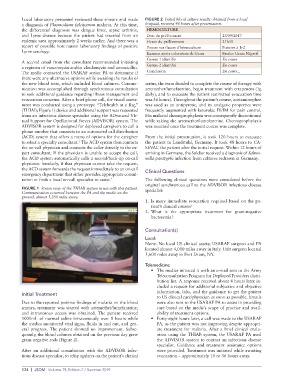
Local laboratory personnel reviewed these smears and made   FIGURE 2  Initial blood culture results obtained from a local
          a diagnosis of Plasmodium falciparum malaria. At this time,   hospital, received 48 hours after presentation.
          the differential diagnosis was dengue fever, septic arthritis,   HEMOCULTURE
          and Lyme disease because the patient had traveled from an   Date du prélèvement    23/09/2017
          endemic area approximately 2 weeks earlier. And there was a   Heure du prélèvement  21h30
          report of possible host nation laboratory findings of positive   Pousse sur flacon d'hémoculture  Positive à J+2
          Lyme serology.                                      Examen après coloration de Gram  Baciles Gram Négatif

                                                              Germe 1 identifié              En cours
          A second email from the consultant recommended initiating
          a regimen of vancomycin and/or clindamycin and amoxicillin.   Germe 2 identifié    En cours
          The medic contacted the USARAF senior PA to determine if   Conclusion              En cours...
          there were any alternative options while awaiting the results of
          the new blood tests, which included blood cultures. Commu-  status, the team decided to complete the course of therapy with
          nication was accomplished through synchronous consultation   artemether/lumefantrine, begin treatment with ertapenem (1g
          to seek additional guidance regarding illness management and   daily), and to evacuate the patient (estimated evacuation time
          evacuation concerns. After a brief phone call, the visual assess-  was 36 hours). Throughout the patient’s course, acetaminophen
          ment was conducted using a prototype “Telehealth in a Bag”   was used as an antipyretic, and its analgesic properties were
          (THIAB; Figure 1) device and additional support was requested   frequently augmented with ketorolac IV/IM for pain control.
          from an infectious disease specialist using the ADvanced VIr-  His malarial chemoprophylaxis was consequently discontinued
          tual Support for OpeRational Forces (ADVISOR) system. The   while taking the artemether/lumefantrine. Chemoprophylaxis
          ADVISOR system is designed for deployed caregivers to call a   was resumed once the treatment course was complete.
          phone number that connects to an automated call distribution
          (ACD) system that offers a menu of options for the caregiver   From the initial presentation, it took 120 hours to evacuate
          to select a specialty consultant.  The ACD system then contacts   the patient to Landstuhl, Germany. It took 48 hours to CA-
                                 1
          the on-call physician and connects the caller directly to the ex-  SEVAC the patient after the initial request. Within 12 hours of
          pert consultant. If the physician is unable to accept the call,   arriving in Germany, the Soldier received a diagnosis of Salmo-
          the ACD system automatically calls a second/back-up on-call   nella paratyphi infection from cultures redrawn in Germany.
          physician. Similarly, if that physician cannot take the request,
          the ACD system forwards the request immediately to an on-call   Clinical Questions
          emergency department that either provides appropriate consul-
          tation or finds a local on-call specialist to assist. 1  The following clinical questions were considered before the
                                                             original synchronous call to the ADVISOR infectious disease
          FIGURE 1  Screen view of the THIAB system in use with this patient.   specialist:
          Communication occurred between the PA and the medic on the
          ground, almost 5,200 miles away.
                                                             1.  Is more immediate evacuation required based on the pa-
                                                               tient’s clinical course?
                                                             2.  What is the appropriate treatment for gram-negative
                                                               bacteremia?

                                                             Consultation(s)

                                                             Local:
                                                             None. No local US clinical assets; USARAF surgeon and PA
                                                             located almost 4,000 miles away in Italy. Unit surgeon located
                                                             5,600 miles away in Fort Drum, NY.

                                                             Telemedicine:
                                                               •  The medics initiated it with an e-mail sent to the Army
                                                                  Teleconsultation Program for Deployed Providers distri-
                                                                  bution list. A response received about 4 hours later in-
                                                                  cluded a request for additional subjective and objective
                                                                  information, labs, and the guidance to get the patient
          Initial Treatment
                                                                  to US clinical care/physician as soon as possible. Emails
          Due to the reported positive findings of malaria on the blood   were also sent to the USARAF PA to assist in providing
          smears, treatment was started with artemether/lumefantrine,   care based on the medic’s scope of practice and avail-
          and intravenous access was obtained. The patient received   ability of treatment options.
          1000mL of normal saline intravenously over 8 hours while   •  Forty-eight hours later, a call was made to the USARAF
          the medics monitored vital signs, fluids in and out, and gen-  PA, as the patient was not improving despite appropri-
          eral progress. The patient showed no improvement. Subse-  ate treatment for malaria. After a brief clinical evalu-
          quently, the blood cultures obtained on the previous day grew   ation using the THIAB system, the USARAF PA used
          gram-negative rods (Figure 2).                          the ADVISOR system to contact an infectious disease
                                                                  specialist. Guidance and treatment assistance options
          After  an  additional consultation with the ADVISOR  infec-  were provided. Treatment was initiated while awaiting
          tious disease specialist, to relay updates on the patient’s clinical   evacuation – approximately 18 to 36 hours away.


          124  |  JSOM   Volume 19, Edition 2 / Summer 2019

