


Page 104 - JSOM Summer 2019
P. 104
mission-centric approach to sustaining the health and perfor-  TABLE 2  Potential Job Description for HPO-I
          mance of Warfighters, decrease rates of injuries, and accelerate   •  Engages community with a conceptual orientation that is both
          return to duty times. The HPO-I is a Warfighter who serves as   holistic (including all TFF domains: physical, nutritional, psy-
          an integrative performance/health consultant to the line com-  chology, social, motivation, medical and dental, environmental,
          mander and team members on performance, prevention, and   spiritual) and full-spectrum (performance, prevention, and reha-
          rehabilitation efforts and helps execute their HPO/TFF CBB.   bilitation)
          They act as advisors to leadership on organization-centric   •  Liaisons  between  unit,  installation,  and organization  resources
                                                               and support agencies
          health and performance trends. The HPO-I helps direct target-
          ing and integration of human performance (e.g., mental per-  •  Provides HPO and TFF health and performance advisory and li-
                                                               aison services that support the unique culture and mission of the
          formance specialist, athletic trainer, strength and conditioning   organization, its members, and the community
          specialist, performance dietician, etc.) and healthcare (e.g.   •  Works to preserve the mission of the operational and support
          clinical  psychologist,  physical  therapist,  social  worker,  reg-  communities and their Mission Essential Task Lists (METLs)
          istered dietician, etc.) assets. The HPO-I assists in providing   •  Aids human performance and health care teams in facilitating
          targeted education and training in collaboration with instal-  custom programming to enhance organizational effectiveness and
          lation  TFF/HPO  teams, based  on  organizational  trends  and   Servicemember performance at METLs.
          mission priorities.  We  envision the HPO-I at various stages   •  Informs  the  targeting  of  integrative  health  and  performance
          of expertise, education, and training—from an entry level   teams, resources, and efforts
          for enlisted (E4–E6), mid-level (E-7/8; O-3/4), and leadership   •  Executes health and performance trend analysis, to inform tar-
          level (E-9/O-5/6) depending on knowledge, skills, abilities, ed-  geting of service delivery, validate program impact, and support
          ucation, certifications, credentials, and experiences. Overall,   higher headquarters data feedback loop
          the HPO-I is available to complement a full-spectrum HPO   •  Blends technical and tactical expertise to facilitate the implemen-
          approach: they are key members of HPO/health teams. Table   tation of community-based TFF and HPO frameworks
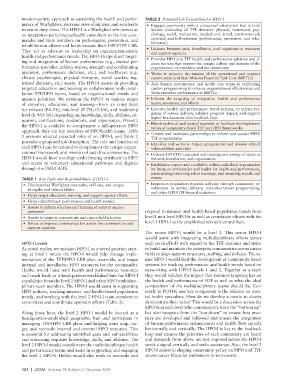
          1 presents selected expected roles of an HPO-I, and Table 2   •  Creates and maintains partnerships to inform and sustain HPO/
                                                               TFF programming
          provides a proposed job description. The role and function of
          each HPO-I can be tailored to complement the unique organi-  •  Identifies and works to reduce occupational and mission related
                                                               vulnerabilities and risks
          zational framework and mission of each line community. The   •  Delivers HPO/TFF education and training on a variety of topics to
          HPO-I would have a college credit bearing certificate in HPO   the unit, installation, and organization
          and  access  to voluntary  educational  pathways and  degrees   •  Establishes respect and credibility within embedded organization
          through the USU/CAHS.                                by being an ambassador and leader for health and performance,
                                                               participating/observing select trainings, and attending socials and
          TABLE 1  Key Tasks and Responsibilities of HPO-I     events
           •  Characterizes Warfighter core tasks, skill sets, and unique   •  Empowers population towards self-care through community in-
            strengths and vulnerabilities                      volvement in service delivery, train-the-trainers programming,
           •  Helps target education, training, and support agency efforts  and other HPO/TFF themed initiatives
           •  Helps identify/track performance and health metrics
           •  Assists to inform selection and training of support agency
            personnel                                        respond to mission and health-based population trends from
           •  Assists to improve assessments and career-field selection  level I unit level HPO-Is as well as coordinate efforts with the
           •  Strives to improve communication across line communities and   level 3 HPO-I at the established service’s central hub.
            support agencies
                                                             The senior HPO-I would be a level 3. This senior HPO-I
                                                             would assist with integrating multidisciplinary efforts across
          HPO-I Levels                                       each service/DoD with regard to the TFF domains and strive
          As noted earlier, we envision HPO-I as a tiered position start-  to build and maintain the enterprise communities across career
          ing at level 1 where the HPO-I would help manage imple-  fields to align support structures, staffing, and policies. The se-
          mentation of the TFF/HPO CBB plan, assemble, and target   nior HPO-I would lead the development of community-based
          internal and installation HPO resources for the commander.   systems for tracking performance and health trends based on
          He/she would liaise with health and performance resources   networking with HPO-I levels 1 and 2. Together as a team
          and reach back to a headquarters-established hub for HPO-I   they would validate the impact that resource targeting has on
          capabilities from the level 2 HPO-I and other HPO multidisci-  the health and performance of SOF as well as what the ideal
          plinary team members. The HPO-I would assist in supporting   composition of the multidisciplinary teams should be. Cur-
          HPO policies, tracking mission- and health-based population   rently in POTFF, one key component is the reliance on men-
          trends, and working with the level 2 HPO-I team members to   tal health specialists. How do we develop a metric to clearly
          consolidate and coordinate upstream efforts (Table 3).  demonstrate their value? This would be a discussion across the
                                                             HPO-Is at each level who communicate from the “bottom up”
          Along those lines, the level 2 HPO-I would be located at a   but also integrate from the “top-down” to ensure best prac-
          headquarters-established geographic hub  and participate in   tices are developed and followed and ensure the integration
          managing TFF/HPO CBB plans and helping units map, tar-  of human performance enhancement and health flow equally
          get, and reconcile internal and external HPO resources. This   horizontally and vertically. The HPO-I is key to the feedback
          is essential for addressing identified gaps and vulnerabilities   loop and ensures the priorities of each community are heard
          and enhancing requisite knowledge, skills, and abilities. The   and demands from above are not imposed unless the HPO-I
          level 2 HPO-I would complement the multidisciplinary health   sends a signal vertically and seeks assistance. Also, the level 3
          and performance teams and assist in supporting and engaging   HPO-I assists in shaping community policy on HPO and TFF
          the level 1 HPO-I. He/she would also work to reconcile and   across career lifecycles (enlistment to retirement).


          102  |  JSOM   Volume 19, Edition 2 / Summer 2019

