


Page 103 - JSOM Summer 2019
P. 103
change across  the Military Health System (MHS).  One key   TFF CBB, HPO-I profession and education, and HPO-centric
              function of the MHS is operational mission support, with an   education across the total force. These are described next.
              underlying goal of preserving the health and performance of
              the fighting force. The MHS has a clear opportunity to focus   HPO/TFF CBB
              on health and performance in a holistic way to enhance perfor-  HPO/TFF CBB is a process for helping each operational com-
              mance and long-term life quality over the military lifecycle. In   munity  formally  analyze  their  METLs  to  identify  and  map
              2018, a report titled Providing for the Common Defense: The   SOF  capabilities and  occupational  risk factors  that  impact
              Assessment and Recommendations of the National Defense   health and performance. This community-based analysis re-
              Strategy Commission stated, “DoD will require rapid, sub-  quires quantifying a clear demand signal, which is essential for
              stantial improvements to its capabilities built on a foundation   developing performance and health metrics, tracking, and im-
              of compelling, relevant operational concepts.”  In addition,   proving the targeting and/or realigning of HPO resources and
                                                   6
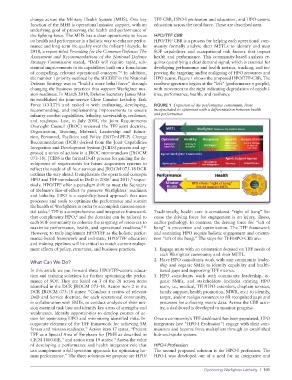
              the number 1 priority outlined by the SECDEF in the National   HPO teams. Figure 1 shows the proposed HPO/TFF-CBB. The
              Defense Strategy was to “build a more lethal force” through   rainbow spectrum begins at the “left” (performance = purple),
              changing the business practices that support Warfighter mis-  with movement to the right indicating degradation of capabil-
              sion readiness. In March 2018, Defense Secretary James Mat-  ities, performance, health, and resiliency.
              tis established the joint-service Close Combat Lethality Task
              Force (CCLTF) and tasked it with evaluating, developing,   FIGURE 1  Depiction of the performance continuum, from
              recommending, and implementing improvements to ensure   incapacitated to optimized with a differentiation between health
              infantry combat capabilities, lethality, survivability, resilience,   and performance.
              and readiness. Last, in July 2018, the Joint Requirements
              Oversight Council (JROC) reviewed the TFF joint doctrine,
              Organization,  Training, Materiel,  Leadership  and  Educa-
              tion, Personnel, Facilities and Policy (DOTmLPF-P) Change
              Recommendation (DCR) derived from the Joint Capabilities
              Integration and Development System (JCIDS) process and ap-
              proved a series of actions in a JROC memorandum (JROCM
              073-18). JCIDS is the formal DoD process for guiding the de-
              velopment of requirements for future acquisition systems to
              reflect the needs of all four services and JROCM 073-18 DCR
              outlines the way ahead. It emphasizes the operational concepts
              HPO and TFF introduced to DoD in 2006  and 2011,  respec-
                                              5
                                                       8
              tively. HPO/TFF offer a paradigm shift to meet the Secretary
              of Defense’s line-of-effort to preserve Warfighters’ readiness
              and lethality. HPO is a capability-based approach that uses
              processes and tools to optimize the performance and sustain
              the health of Warfighters in order to accomplish mission essen-
              tial tasks.  TFF is a comprehensive and integrative framework   Traditionally, health care is considered “right of bang” be-
                     5
              that compliments HPO,  and the domains can be tailored to   cause the driving force for engagement is an injury, illness,
                                8
              each SOF community to enhance the targeting of resources to   and/or pathology. In contrast, the driving force for “left of
              maximize performance, health, and operational readiness. 8-11    bang” is prevention and optimization. The TFF framework
              However, to truly implement HPO/TFF as the holistic perfor-  and sustaining HPO require holistic engagement and orienta-
              mance-based framework and end-state, HPO/TFF education   tion “left of the bang.” The steps for TFF/HPO-CBB are:
              and training pipelines will be critical to match current realign-
              ment efforts of policy, structures, and business practices.  1.  Engage units with an orientation focused on TFF needs of
                                                                   each Warfighter community and their METL.
                                                                 2.  Have HPO consultants work with unit community leader-
              What Can We Do?
                                                                   ship and organic SMEs to identify capability and health-
              In this article we put forward three HPO/TFF-centric educa-  based gaps and supporting TFF metrics.
              tion and training solutions for further optimizing the perfor-  3.  HPO consultants work with community leadership, or-
              mance of SOF. They are based on 3 of the 28 action items   ganic SMEs, and stakeholders (includes existing HPO
              identified in the DCR JROCM 073-18. Action item 2 in the   team, i.e., medical, TFF/HPO extenders, chaplain services,
              DCR JROCM 073-18 states: “Conduct a review of relevant   family support, health promotion, MWR, etc.) to identify,
              DoD and Service doctrine, for each operational community;   target, and/or realign resources to fill recognized gaps and
              in collaboration with SMEs, to conduct analysis of their mis-  processes for collecting metric data. Across the CBB activ-
              sion essential task lists and identify key areas of strengths and   ity, a dashboard is developed to monitor progress.
              weaknesses. Identify opportunities to develop courses of ac-
              tion for optimizing HPO and minimizing identified risks. In-  Once a community’s TFF dashboard has been populated, HPO
              corporate elements of the TFF framework for achieving SM   integrators (see “HPO-I Profession”) engage with their com-
              fitness and mission readiness.” Action item 17 states, “Present   munities and become force multipliers through an established
              TFF as a Special Area of Emphasis for JPME as described in   hub-and-spoke system.
              CJCSI 1800.0lE,” and action item 19 states: “Assess the value
              of developing a performance and health integrator role that   HPO-I Profession
              can complement a full spectrum approach for optimizing hu-  The second proposed solution is the HPO-I profession. The
              man performance.” The three solutions we propose are HPO/  HPO-I was developed out of a need for an integrative and

                                                                                     Optimizing Warfighter Lethality  |  101

