


Page 42 - JSOM Winter 2018
P. 42
solution)—administered in large volumes as the initial resusci-
          tation fluid, followed at a later point in time by the transfusion
          of blood components as indicated by laboratory testing—be-
          came popularized for treating patients in hemorrhagic shock,
          despite the lack of evidence for the safety and efficacy of this
          change. 62,63  A quote from COL Andre Cap sums up the par-
          adox of asanguinous fluids being used as the preferred fluid
          for initial resuscitation of patients in hemorrhagic shock: “The
          historic role of crystalloid and colloid solutions in trauma re-
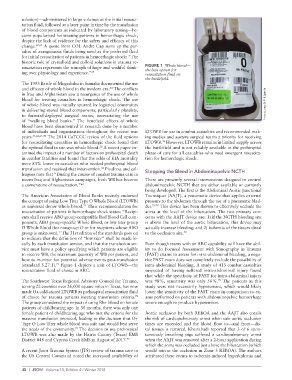
          suscitation represents the triumph of hope and wishful think-  FIGURE 1  Whole blood—
          ing over physiology and experience.” 63            the best option for
                                                             resuscitation fluid on
                                                             the battlefield.
          The 1993 Battle of Mogadishu in Somalia documented the use
          and efficacy of whole blood in the modern era.  The conflicts
                                              64
          in Iraq and Afghanistan saw a resurgence of the use of whole
          blood for treating casualties in hemorrhagic shock. The use
          of whole blood was initially spurred by logistical constraints                                       Photo courtesy Dr Phil Spinella.
          in delivering stored blood components, particularly platelets,
          to forward-deployed surgical teams, necessitating  the use
          of “walking blood banks.” The beneficial effects  of whole
          blood have been documented in research done by a number
          of  individuals and  organizations  throughout the  recent  war   LTOWB for use in combat casualties and recommended mak-
          years. 52,63,65-70  The 2014 CoTCCC review of the fluid options   ing medics and austere surgical teams a priority for receiving
          for resuscitating casualties in hemorrhagic shock found that   LTOWB.  However, LTOWB remains in limited supply across
                                                                    74
          the optimal fluid to use was whole blood.  A recent paper ex-  the battlefield and is not reliably available in the prehospital
                                          50
          amined the impact of a number of factors on prehospital death   phase of care for all casualties who need emergent resuscita-
          in combat fatalities and found that the odds of KIA mortality   tion for hemorrhagic shock.
          were 83% lower in casualties who needed prehospital blood
          transfusion and received that intervention.  Pivalizza and col-  Stopping the Bleed in Abdominopelvic NCTH
                                           30
          leagues note that “During the course of combat trauma care in
          recent Iraq and Afghanistan campaigns, fresh WB has become   There are presently several interventions designed to control
          a cornerstone of resuscitation.” 62                abdominopelvic NCTH that are either available or currently
                                                             being developed. The first is the Abdominal Aortic Junctional
          The American Association of Blood Banks recently endorsed   Tourniquet (AAJT), a pneumatic device that applies external
          the concept of using Low Titer Type O Whole Blood (LTOWB)   pressure to the abdomen through the use of a pneumatic blad-
          as universal donor whole blood.  Their recommendation for   der. 75-78  This device has been shown to effectively occlude the
                                   71
          resuscitation of patients in hemorrhagic shock states: “Recipi-  aorta at the level of the bifurcation. The two primary con-
          ents shall receive ABO group-compatible Red Blood Cell com-  cerns with the AAJT device are: 1) if the NCTH bleeding site
          ponents, ABO group-specific Whole Blood, or low titer group   is above the level of the aortic bifurcation, this device may
          O Whole Blood (for nongroup O or for recipients whose ABO   actually increase bleeding; and 2) ischemia of the tissues distal
          group is unknown).” The 31st edition of the standards goes on   to the occlusion site. 78
          to indicate that the definition of “low titer” shall be made lo-
          cally by each transfusion service, and that the transfusion ser-  Even though teams with an ARC capability will have the abil-
          vice must have a policy specifying which patients are eligible   ity to do Focused Assessment with Sonography in Trauma
          to receive WB, the maximum quantity of WB per patient, and   (FAST) exams to assess for intra-abdominal bleeding, a nega-
          how to monitor for potential adverse events post-transfusion   tive FAST exam does not completely exclude the possibility of
          (standard 5.27.1).  Figure 1 depicts a unit of LTOWB—the   intra-abdominal bleeding. A study of 413 combat casualties
                        71
          resuscitation fluid of choice in ARC.              suspected of having suffered intra-abdominal injury found
                                                             that while the specificity of FAST for intra-abdominal injury
          The Southwest Texas Regional Advisory Council for Trauma,   was 98%, sensitivity was only 56%.  The patients in this
                                                                                           79
          serving 22 counties over 26,000 square miles in Texas, has now   study were not necessarily hypotensive, which would likely
          made O+ cold-stored LTOWB its prehospital resuscitation fluid   lower the sensitivity of the FAST exam in comparison to ex-
          of choice for trauma patients meeting transfusion criteria.    ams performed on patients with abdominopelvic hemorrhage
                                                         72
          The group considered the impact of using Rh+ blood on female   severe enough to produce hypotension.
          patients of childbearing age. In 30 months, there was only one
          female patient of childbearing age who met the criteria for the   Aortic occlusion by both REBOA and the AAJT also entails
          massive transfusion protocol, leading to the decision that O+   the risk of cardiopulmonary arrest when safe aortic occlusion
          Type O Low Titer whole blood was safe and would best serve   times  are  exceeded  and  the  blood  flow  to—and  from—dis-
          the needs of the community.  The decision to use prehospital   tal tissues is restored. Kheirabadi reported that 3 of 6 spon-
                                72
          LTOWB was also made by the Harris County (Texas) EMS   taneously  breathing  pigs  suffered  a  cardiopulmonary  arrest
          District #48 and Cypress Creek EMS in August of 2017. 73  when the AAJT was removed after a 2-hour application during
                                                             which the aorta was occluded just above the bifurcation (which
          A recent Joint Trauma System (JTS) review of trauma care in   would mirror the occlusion in Zone 3 REBOA). The authors
          the US Central Command noted the increased availability of   attributed these events to ischemia-induced hyperkalemia and


          40  |  JSOM   Volume 18, Edition 4 / Winter 2018

