


Page 37 - JSOM Winter 2018
P. 37
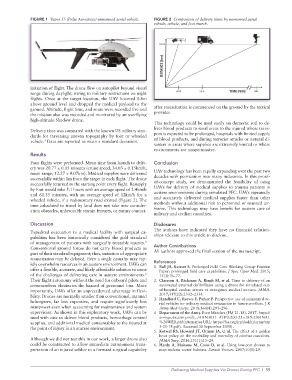
FIGURE 1  Vapor 55 (Pulse Aerospace) unmanned aerial vehicle.  FIGURE 2  Comparison of delivery times by unmanned aerial
                                                                 vehicle, vehicle, and foot march.


              initiation of flight. The drone flew on autopilot beyond visual
              range during daylight, owing to military restrictions on night
              flights. Once at the target location, the UAV hovered 0.6m
              above ground level and dropped the medical payload to the
              ground. Altitude, flight time, and route were recorded live and   after resuscitation is commenced on the ground by the tactical
              the mission also was recorded and monitored by an overflying   provider.
              high- altitude Shadow drone.
                                                                 This technology could be used easily on domestic soil to de-
                                                                 liver blood products to rural areas to the injured where trans-
              Delivery time was compared with the known US military stan-
              dards for traversing uneven topography by foot or wheeled   port is expected to be prolonged, hospitals with limited supply
                   4
              vehicle.  Data are reported as mean ± standard deviation.  of blood products, and during terrorist attacks or natural di-
                                                                 sasters in areas where supplies are extremely limited or where
                                                                 environments are nonpermissive.
              Results
              Four flights were performed. Mean time from launch to deliv-  Conclusion
              ery was 20.77 ± 0.05 minutes (cruise speed, 34.03 ± 0.15km/h;
              mean range, 12.27 ± 0.07km). Medical supplies were delivered   UAV technology has been rapidly expanding over the past two
              successfully within 1m from the target in each flight. The drone   decades with permeation into many industries. In this proof-
              successfully returned to the starting point every flight. Resupply   of-concept study, we demonstrated the feasibility of using
              by foot would take 5.1 hours with an average speed of 2.4km/h   UAVs for delivery of medical supplies to trauma patients in
              and 61.35 minutes, with an average speed of 12km/h for a   austere environments during simulated PFC. UAVs repeatedly
              wheeled vehicle, if a rudimentary road existed (Figure 2). The   and accurately delivered medical supplies faster than other
              time calculated to travel by land does not take into consider-  methods without additional risk to personnel or manned air-
              ation obstacles, unfavorable terrain features, or enemy contact.  frame. This technology may have benefit for austere care of
                                                                 military and civilian casualties.
              Discussion                                         Disclosures
                                                                 The authors have indicated they have no financial relation-
              Expedited  evacuation  to  a  medical  facility  with  surgical  ca-
              pabilities has been historically considered the gold standard   ships relevant to this article to disclose.
              of management of patients with surgically treatable injuries.
                                                             5
              Conventional ground forces do not carry blood products as   Author Contributions
              part of their standard equipment; thus, initiation of appropriate   All authors approved the final version of the manuscript.
              resuscitation may be delayed. Even a single casualty may rap-
              idly overwhelm resources in an austere environment. UAVs can   References
                                                                 1.  Ball JA, Keenan S. Prolonged Field Care Working Group Position
              offer a flexible, accurate, and likely affordable solution to some   Paper: prolonged field care capabilities. J Spec Oper Med. 2015;
                                                             6
              of the challenges of delivering care in austere environments.    15(3):76–77.
              Their flight autonomy without the need for onboard pilots and   2.  Claesson A, Bäckman A, Ringh M, et al. Time to delivery of an
              crewmembers eliminates the hazard of personnel loss. More   automated external defibrillator using a drone for simulated out-
              importantly, UAVs offer an unprecedented advantage in flexi-  of-hospital cardiac arrests vs emergency medical services. JAMA.
              bility. Drones are normally smaller than conventional, manned   2017;317(22):2332–2334.
              helicopters, far less expensive, and require significantly less   3.  Handford C, Reeves F, Parker P. Prospective use of unmanned ae-
                                                                   rial vehicles for military medical evacuation in future conflicts. J R
              manpower even when accounting for maintenance and system   Army Med Corps. 2018;164(4):293–296.
              supervision. As shown in this exploratory work, UAVs can be   4  Department of the Army. Foot Marches (FM 21-18). 2017. https://
              used with ease to deliver blood products, hemorrhage control   armypubs.army.mil/.../ARN3051_ATP%203-21x18%20FINAL
              supplies, and additional medical consumables to the injured at   %20WEB.pdf (alternative URL: https://fas.org/irp/doddir/army/atp
              the point of injury in an austere environment.       3-21-18.pdf). Accessed 30 September 2018).
                                                                 5.  Kotwal RS, Howard JT, Orman JA, et al. The effect of a golden
                                                                   hour policy on the morbidity and mortality of combat casualties.
              Although we did not test this in our work, a larger drone also   JAMA Surg. 2016;151(1):15–24.
              could be constructed to allow immediate autonomous trans-  6.  Hardy A, Makame M, Cross D, et al. Using low-cost drones to
              portation of an injured soldier to a forward surgical capability   map malaria vector habitats. Parasit Vectors. 2017;10(1):29.


                                                                        Delivering Medical Supplies Via Drones During PFC  |  35

