


Page 45 - JSOM Winter 2018
P. 45
primary resuscitation fluid. There were no access complica-  care necessarily involves challenging existing dogma and im-
              tions.  This report contains the notable finding that 18 of their   plementing changes to the previous standards. 105
                  84
              20 casualties had an initial SBP below 90mmHg and that all
              survived their initial laparotomy, however, since this care was   Preventing Hemodynamic Decompensation
              provided to foreign nationals who were subsequently trans-  in NCTH
              ferred to host nation medical treatment facilities, there was no
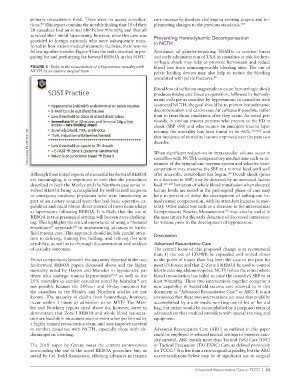
              follow-up after transfer. Figure 4 lists the tasks involved in pre-  Avoidance of platelet-impairing NSAIDs in combat forces
              paring for and performing far-forward REBOA in this SOST.  and early administration of TXA in casualties at risk for hem-
                                                                 orrhagic shock may help to promote hemostasis and reduce
              FIGURE 4  Tasks in the resuscitation of a hypotensive casualty with   blood loss from noncompressible bleeding sites. The use of
              NCTH by an austere surgical team.                  pelvic binding devices may also help to reduce the bleeding
                                                                 associated with pelvic fractures. 36

                                                                 Blood loss of sufficient magnitude to cause hemorrhagic shock
                                                                 produces inadequate tissue oxygenation, followed by hemody-
                                                                 namic collapse as manifest by hypotension. In casualties with
                                                                 suspected NCTH, the goal should be to prevent hemodynamic
                                                                 decompensation and cardiovascular collapse if possible, rather
                                                                 than to treat those conditions after they occur. As noted pre-
                                                                 viously, in civilian trauma patients who present to the ED in
                                                                 shock (SBP <90) and who require an emergent trauma lapa-
             Photo courtesy Maj Marc Northern.                   that incidence of mortality has not improved over the past two
                                                                 rotomy, the mortality has been found to be 46%,
                                                                                                              and
                                                                                                         13,14,22
                                                                 decades.
                                                                 When significant reductions in intravascular volume occur in
                                                                 casualties with NCTH, compensatory mechanisms such as ac-
                                                                 tivation of the sympathetic nervous system and selective vaso-
                                                                 constriction may preserve the SBP at a normal level until well
              Although these initial reports of successful far-forward  REBOA   after anaerobic metabolism has begun.  Occult shock (prior
                                                                                               106
              are encouraging, it is important to note that the procedures   to a decrease in SBP) may be detected by an increased lactate
              described in both the Manley and the Northern case series in-  level. 107-109  Initiation of whole blood transfusion when elevated
              volved REBOA being accomplished by well-trained surgeons   lactate levels are noted in the prehospital phase of care may
              or emergency medicine physicians who were functioning as   help to prevent or delay the development of subsequent he-
              part of an austere surgical team that had basic operative ca-  modynamic compensation, with its attendant increase in mor-
              pabilities and could obtain direct control of torso hemorrhage   tality. Other indicators such as a decrease in the intravascular
              at laparotomy following REBOA. It is likely that the use of   Compensatory Reserve Measurement  may also be useful in
                                                                                              110
                REBOA in true presurgical settings will be even more challeng-  the near future for the early detection of decreased intravascu-
              ing. This highlights the critical importance of using a “focused   lar volume prior to the development of hypotension.
              empiricism” approach  to implementing advances in battle-
                               104
              field trauma care. This approach should include careful atten-  Discussion
              tion to defining, training for, fielding, and refining this new
              capability, as well as to thorough documentation and analysis   Advanced Resuscitative Care
              of casualty outcomes.                              The central focus of this proposed change is to recommend
                                                                 that: 1) the use of LTOWB be expanded and moved closer
              Direct comparisons between the outcomes reported in the two   to the point of injury than has been the case in the past for
              far-forward REBOA papers discussed above and the higher   most US forces; and that 2) Zone 1 REBOA be used to control
              mortality noted by Harvin and Marsden in hypotensive pa-  life-threatening abdominopelvic NCTH when the initial whole
              tients who undergo trauma laparotomies 13,14  as well as the   blood resuscitation has failed to raise the casualty’s SBP to at
              25% mortality in combat casualties noted by Marsden  are   least 90mmHg. These two interventions together comprise a
                                                         14
              not possible because the 24-hour and 30-day outcomes for   new capability in battlefield trauma care referred to in this
              the casualties in the Manley and Northern studies are not   document as “Advanced Resuscitative Care” or ARC. It is not
              known.  The  majority  of deaths  from  hemorrhage,  however,   envisioned that these two interventions are ones that could be
              occur within 3 hours of admission to an MTF.  The Man-  accomplished by a unit medic working out of his or her aid
                                                    2
              ley and Northern reports cited above do, however, serve to   bag, but rather would be accomplished by a purposed team of
              demonstrate that Zone l REBOA and whole blood resuscita-  advanced combat medical providers with special training and
              tion are feasible in an austere environment when performed by   equipment.
              a highly trained resuscitation team, and may improve survival
              in  combat  casualties  with  NCTH,  especially  those  with  ab-  Advanced Resuscitative Care (ARC) as outlined in this paper
              dominopelvic bleeding.                             could be employed in selected tactical settings to improve casu-
                                                                 alty survival. ARC entails more than Tactical Field Care (TFC)
              The 2018 paper by Greene notes the current controversies   or Tactical Evacuation (TACEVAC) Care as defined previously
              surrounding the use of the novel REBOA procedure but, as   for TCCC.  It is less than a true surgical capability, but the ARC
                                                                         33
              noted by Col Todd Rasmussen, effecting advances in trauma   recommendations below may be of significant use to surgical
                                                                                 Advanced Resuscitative Care in TCCC  |  43

