


Page 126 - JSOM Winter 2018
P. 126
preformed yet unstable thrombus. Particular to the OpK9, re-  up to 85% of human trauma patients remain in a state of mi-
          main cognizant of external wounds and bleeding that remain   crocirculatory shock even after normalization of traditional
          hidden by the canine’s hair coat.                  macrohemodynamic parameters. 16,17

                                                             A Focused Assessment with Sonography in Trauma (FAST)
          Identifying Hemorrhage
                                                             examination is a valuable tool for quickly and reliably iden-
          Internal Hemorrhage                                tifying intracavitary hemorrhage in canines, as in humans. 18–20
          Identifying life-threatening, trauma-induced, internal hemor-  Point-of-care ultrasound is becoming increasingly more acces-
          rhage in canines is essentially the same as in humans. With-  sible at the point of injury on the battlefield and in the civilian
          out the use of advanced imaging modalities, early diagnosis   prehospital environment. 18–20  The technique for performing a
          of intracavitary hemorrhage  is often challenging, especially   FAST examination in canines is similar to that of humans; a
          when there are concurrent trauma- and shock-induced factors   brief description follows. 18,21
          such as altered mental status and extra-abdominal injuries
          (e.g., neurologic injuries). In the field, recognition of intracav-  1.  Place the canine in right (preferable due to cardiac notch)
          itary hemorrhage is primarily based on the history of blunt or   or  left lateral  recumbency. In  the  presence  of respiratory
          penetrating trauma along with physical examination findings   distress, scan the canine while it is standing.
          and alterations in vital signs indicative of hemorrhagic shock   Important:  Avoid  placing  a  critically  injured  canine  in
          (e.g., mental depression, tachycardia, prolonged capillary refill   dorsal recumbency, because of the increased risk for com-
          time, pale mucous membranes, poor pulse quality, and cold   promising respiratory function and hemodynamics. Addi-
          extremities) 10–12  (Table 1).                       tionally, FAST fluid scoring systems were only validated
                                                               with canines in lateral recumbency. 21
          TABLE 1  Operational Canine Vital Signs: Perfusion Parameters  2.  Shaving the hair coat is not required. To ensure adequate
                       HR ,                                    probe-to-skin contact, apply isopropyl alcohol and/or
                         a
                       per                     Pulse    SBP,    acoustic coupling gel to the hair coat before probe place-
           Stage of Shock  min  CRT, s  MM  Mentation Quality mmHg  ment. Note: Contact the manufacturer to ensure isopropyl
           Normal                       Bright,                alcohol will not damage the probe head.
           (at rest)   <120  <2   Pink  alert  Strong  >90   3.  Abdominal FAST (AFAST): involves scanning the abdomen
           Acute       >120  <1   Red  Normal   Fair  >90      at the following four sites (Figure 1):
           compensatory
           Early       >140  >2   Pale  Depressed  Weak  <90
           decompensatory
           Terminal    <80  Absent  Pale  Obtunded  Absent  Low
          CRT, capillary refill time; HR, heart rate; MM, mucous membrane; SBP,
          systolic blood pressure.
          a Exercise or other activity, pain, and stress will result in higher HR.
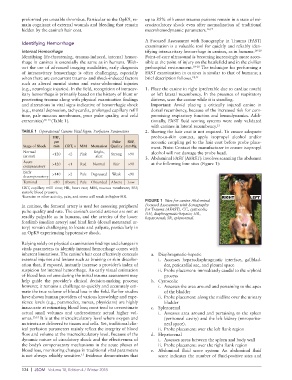
                                                             FIGURE 1  Sites for canine Abdominal
          In canines, the femoral artery is used for assessing peripheral   Focused Assessment with Sonography
          pulse quality and rate. The canine’s carotid arteries are not as   for Trauma (AFAST). CC, cystocolic;
                                                             DH, diaphragmatic-hepatic; HR,
          readily palpable as in humans, and the arteries of the lower   hepatorenal; SR, splenorenal.
          forelimb (median artery) and hind limb (dorsal metatarsal ar-
          tery) remain challenging to locate and palpate, particularly in
          an OpK9 experiencing hypotensive shock.

          Relying solely on physical examination findings and changes in
          vitals parameters to identify internal hemorrhage comes with
          inherent limitations. The canine’s hair coat effectively conceals   a.  Diaphragmatic-hepatic
          external injuries and lesions such as bruising or skin discolor-  i.  Accesses hepatodiaphragmatic interface, gallblad-
          ation that, if exposed, instantly increase a provider’s index of   der, pericardial sac, and pleural space
          suspicion for internal hemorrhage. An early visual estimation   ii.  Probe placement: immediately caudal to the xiphoid
          of blood loss volume during the initial trauma assessment may   process
          help guide the provider’s clinical decision-making process;   b.  Cystocolic
          however, it remains a challenge to quickly and accurately esti-  i.  Assesses the area around and pertaining to the apex
          mate the true volume of blood loss in the field. Earlier studies   of the bladder
          have shown human providers of various knowledge and expe-  ii.  Probe placement: along the midline over the urinary
          rience levels (e.g., paramedics, nurses, physicians) are highly   bladder
          inaccurate at estimating blood loss; most tend to overestimate   c.  Splenorenal
          actual small volumes and underestimate actual higher vol-  i.  Assesses area around and pertaining to the spleen
          umes. 13,14  It is at the microcirculatory level where oxygen and   (peritoneal cavity) and the left kidney (retroperito-
          nutrients are delivered to tissues and cells. Yet, traditional clin-  neal space).
          ical perfusion parameters mainly reflect the integrity of blood   ii.  Probe placement: over the left flank region
          flow and volume at the macrocirculatory level. Because of the   d.  Hepatorenal
          dynamic nature of circulatory shock and the effectiveness of   i.  Assesses areas between the spleen and body wall
          the body’s compensatory mechanisms in the acute phases of   ii.  Probe placement: over the right flank region
          blood loss, monitoring changes in traditional vital parameters   e.  Abdominal fluid score system: An abdominal fluid
          is not always reliably sensitive.  Evidence demonstrates that   score indicates the number of fluid-positive sites and
                                   15

          124  |  JSOM   Volume 18, Edition 4 / Winter 2018

