


Page 129 - JSOM Winter 2018
P. 129
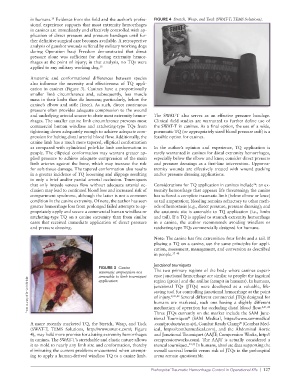
in humans.  Evidence from the field and the author’s profes-  FIGURE 4  Stretch, Wrap, and Tuck (SWAT-T; TEMS Solutions).
                      34
              sional experience supports that most extremity hemorrhages
              in canines are immediately and effectively controlled with ap-
              plication of direct pressure and pressure bandages until fur-
              ther definitive surgical care becomes available. A retrospective
              analysis of gunshot wounds suffered by military working dogs
              during Operation Iraqi Freedom demonstrated that direct
              pressure alone was sufficient for abating extremity hemor-
              rhages at the point of injury; in that analysis, no TQs were
              applied to any military working dog. 35
              Anatomic and conformational differences between species
              also influence the necessity and effectiveness of TQ appli-
              cation in canines (Figure  3). Canines have a proportionally
              smaller limb circumference and, subsequently, less muscle
              mass in their limbs than do humans; particularly, below the
              canine’s  elbow  and  stifle  (knee).  As  such,  direct  continuous
              pressure often provides adequate compression to the wound
              and underlying arterial source to abate most extremity hemor-  The SWAT-T also serves as an effective pressure bandage.
              rhages. The smaller canine limb circumference prevents most   Clinical field studies are warranted to further define use of
              commercial human windlass and ratcheting-type TQs from   the SWAT-T in canines. As a final option, the use of a wide,
              tightening down adequately enough to achieve adequate com-  pneumatic TQ (or appropriately sized blood pressure cuff) is a
              pression for halting distal arterial blood flow. Additionally, the   feasible option for canines.
              canine limb has a much more tapered, elliptical conformation
              as compared with cylindrical pole-like limb conformation in   In the author’s opinion and experience,  TQ application is
              people. The elliptical conformation may warrant greater ap-  rarely warranted in canines for distal extremity hemorrhages,
              plied pressure to achieve adequate compression of the main   especially below the elbow and knee; consider direct pressure
              limb arteries against the bone, which may increase the risk   and pressure dressings as a first-line intervention. Upper-ex-
              for soft-tissue damage. The tapered conformation also results   tremity wounds are effectively treated with wound packing
              in a greater incidence of TQ loosening and slippage resulting   and/or pressure dressing applications.
              in only a brief and/or partial arterial occlusion. Tourniquets
              that only impede venous flow without adequate arterial oc-  Considerations for TQ application in canines include : an ex-
                                                                                                          36
              clusion may lead to continued blood loss and increased risk of   tremity hemorrhage that appears life threatening; the canine
              compartment syndrome, although the latter is not a common   has suffered a complete traumatic limb (below elbow or knee)
              condition in the canine extremity. Of note, the author has seen   or tail amputation; bleeding remains refractory to other meth-
              greater hemorrhage loss from prolonged failed attempts to ap-  ods of hemostasis (e.g., direct pressure, pressure dressing); and
              propriately apply and secure a commercial human windlass or   the anatomic site is amenable to TQ application (i.e., limbs
              ratcheting-type TQ on a canine extremity than from similar   and tail). If a TQ is applied to staunch extremity hemorrhage
              cases that received immediate application of direct pressure   in a canine, the author recommends avoiding windlass or
              and pressure dressing.                             ratcheting-type TQs commercially designed for humans.

                                                                 Note: The canine has five extremities: four limbs and a tail. If
                                                                 placing a TQ on a canine, use the same principles for appli-
                                                                 cation, assessment, management, and conversion as described
                                                                 in people. 37–40

                                                                 Junctional tourniquets
                                          FIGURE 3  Canine       The two primary regions of the body where canines experi-
                                          traumatic amputation not
                                          amenable to limb tourniquet   ence junctional hemorrhage are similar to people: the inguinal
             Photo courtesy of Dr Kevin Winkler.                 junctional TQs (JTQs) were developed as a valuable, life-
                                                                 region (groin) and the axillae (armpit in humans). In humans,
                                          application.
                                                                 saving tool for controlling junctional hemorrhage at the point
                                                                 of injury.
                                                                            Several different commercial JTQs designed for
                                                                        2,41,42
                                                                 humans are marketed, each one having a slightly different
                                                                 mechanism of operation for occluding distal blood flow.
                                                                                                             2,41,42
                                                                 Three JTQs currently on the market include the SAM Junc-
                                                                 tional Tourniquet  (SAM Medical, https://www.sammedical
                                                                               ®
              A more recently marketed TQ, the Stretch, Wrap, and Tuck   .com/products/sam-sjt), Combat Ready Clamp  (Combat Med-
                                                                                                    ®
              (SWAT-T; TEMS Solutions,  http://www.swat-t.com/; Figure   ical, https://combatmedical.com), and the Abdominal Aortic
              4), may hold more promise for abating extremity hemorrhages   and Junctional Tourniquet (AAJT; Compression Works, http://
              in canines. The SWAT-T’s stretchable and elastic nature allows   compressionworks.com). The AAJT is actually considered a
              it to mold to nearly any limb size and conformation, thereby   truncal tourniquet. 42,43  In humans, absolute data supporting the
              eliminating the current problems encountered when attempt-  overall survival benefit versus risk of JTQs in the prehospital
              ing to apply a human-derived windlass TQ to a canine limb.   arena remain questionable.
                                                               Prehospital Traumatic Hemorrhage Control in Operational K9s  |  127

