


Page 128 - JSOM Winter 2018
P. 128
®
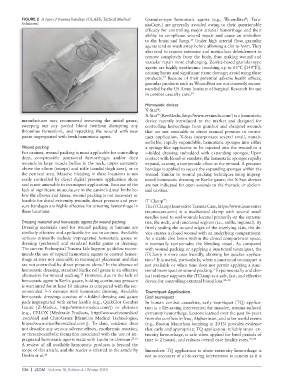
          FIGURE 2  A type of trauma bandage (OLAES; Tactical Medical   Granular-type hemostatic agents (e.g., WoundStat ; Trau-
          Solutions).                                        maCure,) are generally avoided owing to their questionable
                                                             efficacy for controlling major arterial hemorrhage and their
                                                             ability to complicate wound repair and cause an embolism
                                                             to the brain and lungs.  Under high arterial flow, granular
                                                                                27
                                                             agents tend to wash away before allowing a clot to form. They
                                                             also tend to require extensive and meticulous debridement to
                                                             remove completely from the body, thus making wound and
                                                             vascular repair more challenging. Zeolite-based granular-type
                                                             agents are highly exothermic (reaching up to 65°C [149°F]),
                                                             causing burns and significant tissue damage; avoid using these
                                                             products.  Because of their potential adverse health effects,
                                                                    27
                                                             granular products such as WoundStat are not currently recom-
                                                             mended by the US Army Institute of Surgical Research for use
                                                             in combat casualty care. 24
                                                             Hemostatic devices
                                                             X-Stat :
                                                                  ®
                                                             X-Stat  (RevMedx, http://www.revmedx.com/) is a hemostatic
                                                                  ®
          manufacturer  may  recommend  removing  the  initial  gauze,   device recently introduced to the market and designed for
          sweeping  out  any pooled  blood  (without  disrupting  any   controlling hemorrhage from gunshot and shrapnel wounds
          thrombus formation), and repacking the wound with new   that are not amenable to direct manual pressure or tourni-
          gauze impregnated with fresh hemostatic agent.     quet application. X-Stat incorporates several small, nonab-
                                                             sorbable, rapidly expandable, hemostatic sponges into either
          Wound packing                                      a syringe-like applicator to be injected into the wound or a
          For canines, wound packing is most applicable for controlling   z-folded dressing embedded with expanding sponges. Upon
          deep, compressible junctional hemorrhages and/or deep   contact with blood or exudate, the hemostatic sponges rapidly
          wounds in large muscle bellies in the neck, upper extremity   expand, causing a tamponade effect in the wound. A pressure
          above the elbow (triceps) and stifle (caudal thigh area), or in   bandage is applied to secure the expanding sponges within the
          the perineal area. Massive bleeding in these locations is not   wound. Similar to wound packing techniques using impreg-
          easily controlled by direct digital pressure application alone   nated hemostatic dressing or Kerlix gauze, the X-Stat devices
          and is not amenable to tourniquet application. Because of the   are not indicated for open wounds to the thoracic or abdom-
          lack of significant musculature in the canine’s distal limbs be-  inal cavities.
          low the elbows and knees, wound packing is not necessary or
          feasible for distal extremity wounds; direct pressure and pres-  iT Clamp :
                                                                    ™
          sure bandages are highly effective for arresting hemorrhage in   The iTClamp (Innovative Trauma Care, https://www.innovative
          these locations.                                   traumacare.com) is a mechanical clamp with several small
                                                             needles used to seal wounds located primarily on the extremi-
          Dressing material and hemostatic agents for wound packing:  ties, the neck, and junctional regions (i.e., axilla, inguinal). By
          Dressing materials used for wound packing in humans are   firmly sealing the wound edges of the overlying skin, the de-
          similarly effective and applicable for use in canines. Available   vice creates a closed wound with an underlying compartment.
          options  primarily  include  impregnated  hemostatic  gauze  or   As a stable clot forms within the closed compartment space,
          dressing (preferred) and standard Kerlix gauze or dressing.   it eventually tamponades the bleeding vessel. As compared
          The current Prehospital Trauma Life Support guideline recom-  with wound packing or applying a junctional tourniquet, the
          mends the use of topical hemostatic agents to control hemor-    iTClamp is more user friendly, allowing for quicker applica-
          rhage at sites not amenable to tourniquet placement and that   tion.  It is useful, particularly, when a junctional tourniquet is
                                                                 2
          are not controlled by direct pressure alone.  In the absence of   not available or when time does not permit applying a junc-
                                            8
          hemostatic dressing, standard Kerlix roll gauze is an effective   tional tourniquet or wound packing.  Experimentally and clin-
                                                                                         9
          alternative for wound packing.  However, due to the lack of   ical evidence supports the iTClamp as a safe, fast, and effective
                                  23
          hemostatic agent in Kerlix gauze, holding continuous pressure   device for controlling external blood loss. 28–30
          is warranted for at least 10 minutes as compared with the rec-
          ommended 3–5 minutes with hemostatic dressing. Available   Tourniquet Application
          hemostatic dressings consists of z-folded dressing and gauze   Limb tourniquets
          pads impregnated with either kaolin (e.g., QuikClot Combat   In human combat casualties, early tourniquet (TQ) applica-
          Gauze [Z-Medica, http://www.z-medica.com/]) or chitosan   tion is a life-saving intervention for massive, trauma-induced
          (e.g., CELOX [Medtrade Products, http://www.celoxmedical   extremity hemorrhage. Lessons learned over the past 16 years
          .com/na/] and ChitoGauze [HemCon Medical Technologies,   from the conflicts in Iraq, Afghanistan, and other world events
          https://www.tricolbiomedical.com]). To date, evidence does   (e.g., Boston Marathon bombing in 2013) provides evidence
          not describe any serious adverse effects, exothermic reaction,   that early and appropriate TQ application: reliably stops  ex-
          or thromboembolic formation associated with the use of im-  tremity hemorrhage, is safe when applied for brief periods of
          pregnated hemostatic agents made with kaolin or chitosan. 24,25    time (< 2 hours), and reduces overall case fatality rates. 31–33
          A review of all available hemostatic products is beyond the
          scope of this article, and the reader is referred to the article by   Immediate TQ application to abate extremity hemorrhage is
          Devlin et al. 26                                   not as necessary of a life-saving intervention in canines as it is


          126  |  JSOM   Volume 18, Edition 4 / Winter 2018

