


Page 18 - JSOM Fall 2018
P. 18
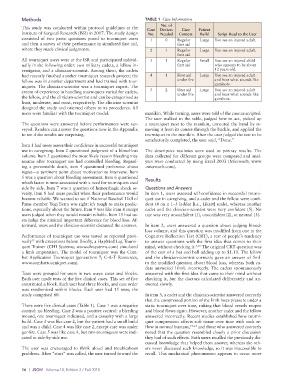
Methods TABLE 1 Case Information
No. of
This study was conducted within protocol guidelines at the Case Devices Care Patient
Institute of Surgical Research (ISR) in 2017. The study design No. Needed Context Build Script Read to the User
consisted of two parts: questions posed to tourniquet users 1 0 Regular Large You see an injured adult.
and then a survey of their performance in simulated first aid, first aid
where they made clinical judgments. 2 1 Regular Large You see an injured adult.
first aid
All tourniquet users were at the ISR and participated individ 3 1 Regular Small You see an injured child
ually in the following order: two military cadets, a fellow in first aid who appears to be about
vestigator, and a clinicianscientist. Among them, the cadets 12 years old.
had recently finished another tourniquet research project; the 4 1 First aid Large You see an injured adult
fellow was in another department and had trained with tour under fire and hear what sounds like
niquets. The clinicianscientist was a tourniquet expert. The gunshots.
extent of experience in handling tourniquets varied for cadets, 5 2 First aid Large You see an injured adult
under fire
and hear what sounds like
the fellow, and the clinicianscientist and can be categorized as gunshots.
least, moderate, and most, respectively. The clinicianscientist
designed the study and oriented others to its procedures. All
users were familiar with the tourniquet model. manikin. While turning, users were told of the case as scripted.
The user walked to the table, judged how to act, picked up
The questions were answered before performances were sur a tourniquet next to the manikin, unrouted the band by re
veyed. Readers can answer the questions now in the Appendix moving it from its course through the buckle, and applied the
to see if the results are surprising. tourniquet to the manikin. After the user judged the test to be
satisfactorily completed, the user said, “Done.”
Item 1 had users assess their confidence in successful tourniquet
use in caregiving. Item 2 questioned judgment of a bloodloss The descriptive statistics were used to portray results. The
volume. Item 3 questioned the most likely reason bleeding may data collected for different groups were compared and anal
resume after tourniquet use had controlled bleeding. Regard yses were conducted by using Excel 2003 (Microsoft; www
ing a preventable death, item 4 questioned preference about .microsoft.com).
regret—a pertinent point about motivation to intervene. Item
5 was a question about bleeding assessment. Item 6 questioned Results
which factor is most associated with a need for tourniquets used
side by side. Item 7 was a question of hemorrhagic shock se Questions and Answers
verity. Item 8 had users predict when their performance would In item 1, users assessed selfconfidence in successful tourni
become reliable. We wanted to see if National Baseball Hall of quet use in caregiving, and a cadet and the fellow were confi
Fame member Yogi Berra was right: it’s tough to make predic dent (4 on a 1–5 ladder [i.e., Likert] scale), whereas another
tions, especially about the future. Item 9 was like item 8 except cadet and the clinicianscientist were very confident (5). No
users judged when they would remain reliable. Item 10 had us one was very unconfident (1), unconfident (2), or neutral (3).
ers judge the minimal important difference for blood loss. Af
terward, users and the clinicianscientist discussed the answers. In item 2, users answered a question about judging blood
loss volume, and this question was modified from one in the
Performance of tourniquet use was tested as reported previ Cognitive Reflection Test (CRT), a test of people’s tendency
ously with exceptions below. Briefly, a HapMed Leg Tourni to answer questions with the first idea that comes to their
15
quet Trainer (CHI Systems; www.chisystems.com) simulated mind, without checking it. 3,16 The original CRT question was
a limb amputation. The model of tourniquet was the Com of the cost of a bat and ball adding up to $1.10. The fellow
bat Application Tourniquet (generation 7; CAT Resources, and the clinicianscientist correctly gave an answer of 5mL
www.combattourniquet.com). to the modified question about blood loss, whereas both ca
dets answered 10mL incorrectly. The cadets spontaneously
Tests were grouped for users in two ways: cases and blocks. answered with the first idea that came to their mind without
Each user made tests of the five clinical cases. This set of five checking it, but the doctors calculated deliberately and an
constituted a block. Each user had three blocks, and case order swered slowly.
was randomized within blocks. Each user had 15 tests; the
study comprised 60. In item 3, a cadet and the clinicianscientist answered correctly
that the compressed portion of the limb loses pressure under a
There were five clinical cases (Table 1). Case 1 was a negative static tourniquet over time, risking that blood vessels reopen
control: no bleeding. Case 2 was a positive control: a bleeding and blood flows again. However, another cadet and the fellow
wound, one tourniquet indicated, and a casualty with a large answered incorrectly. Recent studies established how tourni
build. Case 3 was like case 2, but the patient had a small build quet compression affects soft tissue over time with such re
and was a child. Case 4 was like case 2, except care was under flow in normal humans, 17–23 and those who answered correctly
gunfire. Case 5 was like case 4, but two tourniquets were indi noted that the question resembled closely a prior discussion
cated in sidebyside use. they had of such effects. Both users recalled the previously dis
cussed knowledge that helped them answer, whereas the oth
The user was encouraged to think aloud and troubleshoot ers never discussed such knowledge, so it was inaccessible to
problems. After “start” was called, the user turned toward the recall. This mechanical phenomenon appears to occur more
16 | JSOM Volume 18, Edition 3 / Fall 2018

