


Page 29 - JSOM Summer 2018
P. 29
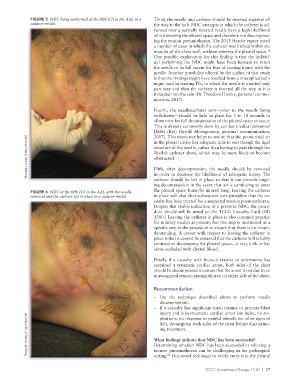
FIGURE 5  NDC being performed at the fifth ICS in the AAL in a   Third, the needle and catheter should be inserted together all
              cadaver model.                                     the way to the hub. NDC attempts in which the catheter is ad-
                                                                 vanced over a partially inserted needle have a high likelihood
                                                                 of not entering the pleural space and therefore not decompress-
                                                                 ing the tension pneumothorax. The 2013 Harcke report noted
                                                                 a number of cases in which the catheter was kinked within the
                                                                 muscles of the chest wall, without entering the pleural space.
                                                                                                               18
                                                                 One possible explanation for this finding is that the individ-
                                                                 ual performing the NDC might have been hesitant to insert
                                                                 the needle to its full extent for fear of causing injury with the
                                                                 needle. Another possibility offered by the author of that study
                                                                 is that the findings might have resulted from a misapplied tech-
                                                                 nique used in starting IVs, in which the needle is inserted only
                                                                 part way and then the catheter is inserted all the way as it is
                                                                 threaded into the vein (Dr Theodore Harcke, personal commu-
                                                                 nication, 2017).

                                                                 Fourth,  the needle/catheter  unit—prior to  the needle  being
                                                                 withdrawn—should be held in place for 5 to 10 seconds to
                                                                 allow time for full decompression of the pleural space to occur.
                                                                 This is already commonly done by combat medical personnel
                                                                 [MSG (Ret) Harold Montgomery, personal communication,
                                                                 2017). This maneuver helps to ensure that the pressurized air
            Photograph courtesy of Maj Andrew Hall.              structure of the needle, rather than having to pass through the
                                                                 in the pleural cavity has adequate time to exit though the rigid

                                                                 flexible catheter alone, which may be more likely to become
                                                                 obstructed.

                                                                 Fifth, after decompression, the needle should be removed
                                                                 in order to decrease the likelihood of iatrogenic injury. The
                                                                 catheter should be left in place so that it can provide ongo-
                                                                 ing decompression in the event that air is continuing to enter
                                                                 the pleural space from the injured lung. Leaving the catheter
              FIGURE 6  NDC at the fifth ICS in the AAL with the needle
              removed and the catheter left in place in a cadaver model.  in place will also alert subsequent care providers that the ca-
                                                                 sualty has been treated for a suspected tension pneumothorax.
                                                                 De spite this visible indication of a previous NDC, the proce-
                                                                 dure should still be noted on the TCCC Casualty Card (DD
                                                                 1380.) Leaving the catheter in place is also common practice
                                                                 for military medics at present, but this step is mentioned as a
                                                                 specific step in the procedure to ensure that there is no misun-
                                                                 derstanding. A caveat with respect to leaving the catheter in
                                                                 place is that it cannot be assumed that the catheter will reliably
                                                                 continue to decompress the pleural space—it may kink or be-
                                                                 come occluded with clotted blood.

                                                                 Finally, if a casualty with thoracic trauma or polytrauma has
                                                                 sustained a traumatic cardiac arrest, both sides of the chest
                                                                 should be decompressed to ensure that the arrest is not due to an
                                                                 unrecognized tension pneumothorax on either side of the chest.


                                                                 Recommendation:
                                                                 –  Use the technique described above to perform needle
                                                                   decompression.
                                                                 –  If a casualty has significant torso trauma or primary blast
                                                                   injury and is in traumatic cardiac arrest (no pulse, no res-
            Photograph courtesy of Maj Andrew Hall.              What findings indicate that NDC has been successful?
                                                                   pirations, no response to painful stimuli, no other signs of
                                                                   life), decompress both sides of the chest before discontinu-
                                                                   ing treatment.


                                                                 Determining whether NDC has been successful at relieving a
                                                                 tension pneumothorax can be challenging in the prehospital
                                                                 setting.  One novel technique to verify entry into the pleural
                                                                      83
                                                                                      TCCC Guidelines Change 17-02  |  27

