


Page 83 - JSOM Spring 2018
P. 83
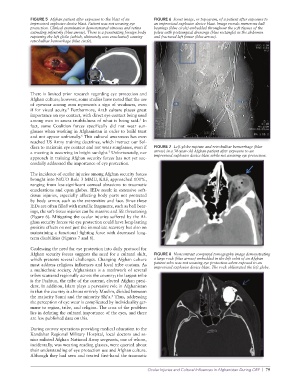
FIGURE 5  Afghan patient after exposure to the blast of an   FIGURE 6  Scout image, or topogram, of a patient after exposure to
              improvised explosive device blast. Patient was not wearing eye   an improvised explosive device blast. Image reveals numerous ball
              protection. Clinical examination demonstrated vitreous and retina   bearings (blue circle) embedded throughout the soft tissues of the
              extruding inferiorly (blue arrow). There is a penetrating foreign body   pelvis with postsurgical dressings (blue rectangle) in the abdomen
              rupturing the left globe (which, ultimately, was enucleated) causing   and fractured left femur (blue arrow).
              retrobulbar hemorrhage (blue circle).


              There is limited prior research regarding eye protection and
              Afghan culture; however, some studies have noted that the use
              of eyewear among men represents a sign of weakness, even
                             4
              if for visual acuity.  Furthermore, Arab culture places great
              importance on eye contact, with direct eye contact being used
                                                           5
              among men to assess truthfulness of what is being said.  In
              fact,  some  Coalition  forces  specifically  did  not  wear  sun-
              glasses when working in Afghanistan in order to build trust
                                   6
              and not appear unfriendly.  This cultural awareness has even
              reached US Army training doctrines, which instruct our Sol-
              diers to maintain eye contact and not wear sunglasses, even if   FIGURE 7  Left globe rupture and retrobulbar hemorrhage (blue
              a meeting is occurring in bright sunlight.  Unfortunately, our   arrow) in a 30-year-old Afghan patient after exposure to an
                                              7
              approach in training Afghan security forces has not yet suc-  improvised explosive device blast while not wearing eye protection.
              cessfully addressed the importance of eye protection.
              The incidence of ocular injuries among Afghan security forces
              brought into NATO Role 3 MMU, KAF, approached 100%,
              ranging from less-significant corneal abrasions to traumatic
              enucleations and open globes. IEDs result in extensive soft-
              tissue injuries, especially affecting body parts not protected
              by body armor, such as the extremities and face. Since these
              IEDs are often filled with metallic fragments, such as ball bear-
              ings, the soft-tissue injuries can be massive and life threatening
              (Figure 6). Mitigating the ocular injuries suffered by the Af-
              ghan security forces via eye protection could have long-lasting
              positive effects on not just the immediate recovery but also on
              maintaining a functional fighting force with decreased long-
              term disabilities (Figures 7 and 8).
              Coalescing the need for eye protection into daily protocol for
              Afghan security forces suggests the need for a cultural shift,   FIGURE 8  Noncontrast computed tomography image demonstrating
              which presents several challenges. Changing Afghan culture   a large rock (blue arrow) embedded in the left orbit of an Afghan
              must address religious influences and local tribe custom. As   patient who was not wearing eye protection when exposed to an
              a multiethnic society, Afghanistan is a meshwork of several   improvised explosive device blast. The rock obliterated the left globe.
              tribes scattered regionally across the country; the largest tribe
              is the Pashtun, the tribe of the current, elected Afghan presi-
              dent. In addition, Islam plays a pervasive role in Afghanistan
              in that the country is almost entirely Muslim, divided between
              the majority Sunni and the minority Shi’a.  Thus, addressing
                                               8
              the perception of eye wear is complicated by individuality ger-
              mane to region, tribe, and religion. The crux of the problem
              lies in defining the cultural importance of the eyes, and there
              are few published data on this.

              During convoy operations providing medical education to the
              Kandahar Regional Military Hospital, local doctors and se-
              nior enlisted Afghan National Army sergeants, one of whom,
              incidentally, was wearing reading glasses, were queried about
              their understanding of eye protection use and Afghan culture.
              Although they had seen and treated first-hand the traumatic

                                                              Ocular Injuries and Cultural Influences in Afghanistan During OEF  |  79

