


Page 69 - JSOM Spring 2018
P. 69
hemorrhage and intracranial hemorrhage. 113, 126  One was the   chart reviews (Table 4). One study ultimately was not included.
              nested CRASH-2 intracranial bleeding study that did not dis-  A broad range of TXA doses was reported, from 10mg/kg to
              cuss the timing of TXA administration.  One was the original   259mg/kg (Table 5). The most common nonweight-based regi-
                                           129
              CRASH-2 publication in Lancet.  One looked at the timing   men was 1g IV. Four observational studies reported potential
                                       134
              of TXA administration after arrival to hospital, however was   adverse effects with TXA administration. All four studies were
              unable to report the time of initial injury.  The other excluded   in  patient  cohorts  undergoing  major  cardiovascular  surgery
                                             96
              articles did not comment on the timing of TXA administration.  (i.e., coronary artery bypass grafting, aortic valve replacement,
                                                                 and/or cardiopulmonary bypass). Relatively large TXA doses
              We drew two conclusions from these studies: (1) The only   were used in each series (24mg/kg, >100mg/kg, 100mg/kg, and
              prospective RCT data that compare timing of TXA admin-  61–259mg/kg), suggesting an increased risk for convulsive sei-
              istration to patient outcomes were from the CRASH-2 study,   zures in patients who underwent cardiovascular surgery.
              suggesting that early treatment with TXA (within 3 hours of
              injury [ideally, within 1 hour]) significantly reduced the risk of   We drew the following conclusions from these studies: (1)
              death due to bleeding; and (2) implementation of TXA pro-  there is insufficient evidence to provide guidance on the mini-
              tocols by military and civilian prehospital systems has been   mal, maximal, or optimal dosing of TXA in major trauma or
              described and is effective in administering TXA within 3 hours   hemorrhagic shock; (2) TXA has been used in reported doses
              of injury.                                         of between 5mg/kg and 259mg/kg; (3) there is no evidence of
                                                                 harm with multiple or repeat doses of TXA; (4) a few studies
              All the included review articles, editorials, and perspective   have demonstrated potential benefit of serial dosing of TXA
              publications refer to the primary data from the Roberts et al.   in operative settings; and (5) based on retrospective, observa-
              exploratory analysis of the CRASH-2 trial. 132     tional case series, TXA used in patients undergoing cardiovas-
                                                                 cular surgery who are placed on cardiopulmonary bypass and
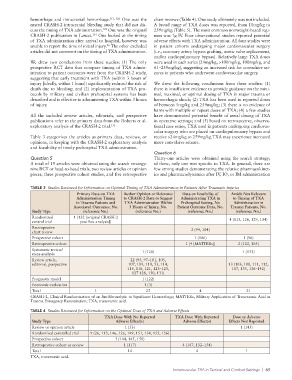
              Table 3 categorizes the articles as primary data, reviews, or   receive >24mg/kg to 259mg/kg TXA may experience increased
              opinions, in keeping with the CRASH-2 exploratory analysis   more convulsive seizure.
              and feasibility of timely prehospital TXA administration.
                                                                 Question 6
              Question 5                                         Thirty-one articles were obtained using the search strategy;
              A total of 19 articles were obtained using the search strategy:   of these, only one was specific to TXA. In general, there are
              nine RCT or head-to-head trials, two review articles or opinion   few strong studies demonstrating the relative pharmacokinet-
              pieces, three prospective cohort studies, and five retrospective   ics and pharmacodynamics after IV, IO, or IM administration


              TABLE 3  Studies Reviewed for Information on Optimal Timing of TXA Administration in Patients After Traumatic Injuries
                                 Primary Data on TXA   Author Opinion or Reference   Data on Feasibility of   Article Not Relevant
                                 Administration Timing   to CRASH-2 Data to Suggest   Administrating TXA in   to Timing of TXA
                                 in Trauma Patients and   TXA Administration Within   Prehospital Setting, No   Administration in
                               Associated Outcomes, No.   3 Hours of Injury, No.   Patient Outcome Data, No.   Trauma Patients, No.
              Study Type           (reference No.)       (reference No.)       (reference No.)    (reference No.)
              Randomized       1 (132 [original CRASH-2                                         4 (113, 126, 129, 134)
              control trial       post hoc analysis])
              Retrospective                                                     2 (94, 104)
              chart review
              Prospective cohort                                                 1 (106)              1 (96)
              Retrospective cohort                                            1 (4 [MATTERs])      2 (102, 105)
              Systematic review/
              meta-analysis                                 1 (120)                                  1 (133)
              Review article,                          22 (95, 97–101, 105,
              editorial, perspective                  107, 109, 110, 53, 114,                  13 (103, 108, 111, 112,
                                                      115, 118, 121, 123–125,                    117, 135, 136–142)
                                                       127 128, 130, 131)
              Prognostic model                              1 (122)
              Economic evaluation                            1 (3)
              Total                     1                    25                    4                   21
              CRASH-2, Clinical Randomization of an Antifibrinolytic in Significant Hemorrhage; MATTERs, Military Application of Tranexamic Acid in
              Trauma Emergency Resuscitation; TXA, tranexamic acid.
              TABLE 4  Studies Reviewed for Information on the Optimal Dose of TXA and Adverse Effects
                                            TXA Dose With No Reported    TXA Dose With Reported   Dose or Adverse
              Study Type                         Adverse Effect(s)           Adverse Effect(s)  Effects Not Reported
              Review or opinion article              1 (53)                                         1 (143)
              Randomized controlled trial  9 (26, 113, 146, 126, 149, 151, 134, 155, 156)
              Prospective cohort                 3 (144, 145, 150)
              Retrospective cohort or review        1 (117)                 4 (147, 152–154)
              Total                                   14                          4                   1
              TXA, tranexamic acid.

                                                                        Intramuscular TXA in Tactical and Combat Settings  |  65

