


Page 144 - Journal of Special Operations Medicine - Fall 2017
P. 144
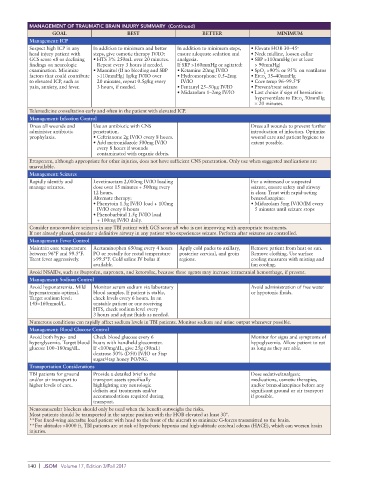
MANAGEMENT OF TRAUMATIC BRAIN INJURY SUMMARY  (Continued)
                  GOAL                     BEST                    BETTER                   MINIMUM
           Management: ICP
           Suspect high ICP in any   In addition to minimum and better   In addition to minimum steps,   • Elevate HOB 30–45 o
           head injury patient with   steps, give osmotic therapy IV/IO:   ensure adequate sedation and   • Neck midline, loosen collar
           GCS score ≤8 or declining   • HTS 3% 250mL over 20 minutes.   analgesia.   • SBP >110mmHg (or at least
           findings on neurologic   Repeat every 3 hours if needed.  If SBP >160mmHg or agitated:  > 90mmHg)
           examination. Minimize   • Mannitol (If no bleeding and SBP   • Ketamine 20mg IV/IO   • SpO  >90% or 95% on ventilator
                                                                                       2
           factors that could contribute   >110mmHg) 1g/kg IV/IO over    • Hydromorphone 0.5–2mg    • Etco  35–40mmHg
                                                                                        2
           to elevated ICP, such as   20 minutes, repeat 0.5g/kg every    IV/IO    • Core temp 96–99.5°F
           pain, anxiety, and fever.  3 hours, if needed.  • Fentanyl 25–50μg IV/IO  • Prevent/treat seizure
                                                           • Midazolam 1–2mg IV/IO  • Last choice if sign of herniation:
                                                                                    hyperventilate to Etco  30mmHg
                                                                                                    2
                                                                                    × 20 minutes.
           Telemedicine consultation early and often in the patient with elevated ICP.
           Management: Infection Control
           Dress all wounds and   Use an antibiotic with CNS                       Dress all wounds to prevent further
           administer antibiotic   penetration.                                    introduction of infection. Optimize
           prophylaxis.         • Ceftriaxone 2g IV/IO every 8 hours.              wound care and patient hygiene to
                                • Add metronidazole 500mg IV/IO                    extent possible.
                                 every 8 hours if wounds
                                 contaminated with organic debris.
           Ertapenem, although appropriate for other injuries, does not have sufficient CNS penetration. Only use when suggested medications are
           unavailable.
           Management: Seizures
           Rapidly identify and   Levetiracetam 2,000mg IV/IO loading              For a witnessed or suspected
           manage seizures.     dose over 15 minutes + 500mg every                 seizure, ensure safety and airway
                                12 hours.                                          is clear. Treat with rapid-acting
                                Alternate therapy:                                 benzodiazepine:
                                • Phenytoin 1.5g IV/IO load + 100mg                • Midazolam 5mg IV/IO/IM every
                                 IV/IO every 8 hours                                5 minutes until seizure stops
                                • Phenobarbital 1.5g IV/IO load
                                 + 100mg IV/IO daily.
           Consider nonconvulsive seizures in any TBI patient with GCS score ≤8 who is not improving with appropriate treatments.
           If not already placed, consider a definitive airway in any patient who experiences seizure. Perform after seizures are controlled.
           Management: Fever Control
           Maintain core temperature   Acetaminophen 650mg every 4 hours   Apply cold packs to axillary,   Remove patient from heat or sun.
           between 96°F and 99.5°F.   PO or rectally for rectal temperature   posterior cervical, and groin   Remove clothing. Use surface
           Treat fever aggressively.  >99.5°F. Cold saline IV bolus if   regions.  cooling measures with misting and
                                available.                                         fan cooling.
           Avoid NSAIDs, such as ibuprofen, naproxen, and ketorolac, because these agents may increase intracranial hemorrhage, if present.
           Management: Sodium Control
           Avoid hyponatremia. Mild   Monitor serum sodium via laboratory          Avoid administration of free water
           hypernatremia optimal.   blood samples. If patient is stable,           or hypotonic fluids.
           Target sodium level:   check levels every 6 hours. In an
           145–160mmol/L.       unstable patient or one receiving
                                HTS, check sodium level every
                                3 hours and adjust fluids as needed.
           Numerous conditions can rapidly affect sodium levels in TBI patients. Monitor sodium and urine output whenever possible.
           Management: Blood Glucose Control
           Avoid both hypo- and   Check blood glucose every 6                      Monitor for signs and symptoms of
           hyperglycemia. Target blood  hours with handheld glucometer.            hypoglycemia. Allow patient to eat
           glucose 100–180mg/dL.  If <100mg/dL, give 25g (50mL)                    as long as they are able.
                                dextrose 50% (D50) IV/IO or 5tsp
                                sugar/4tsp honey PO/NG.
           Transportation Considerations
           TBI patients for ground   Provide a detailed brief to the               Dose sedative/analgesic
           and/or air transport to   transport assets specifically                 medications, osmotic therapies,
           higher levels of care.  highlighting any neurologic                     and/or benzodiazepines before any
                                deficits and treatments and/or                     significant ground or air transport
                                accommodations required during                     if possible.
                                transport.
           Neuromuscular blockers should only be used when the benefit outweighs the risks.
           Most patients should be transported in the supine position with the HOB elevated at least 30°.
           **For fixed-wing aircrafts: load patient with head to the front of the aircraft to minimize G-forces transmitted to the brain.
           **For altitudes >8000 ft, TBI patients are at risk of hypobaric hypoxia and high-altitude cerebral edema (HACE), which can worsen brain
           injuries.


          140  |  JSOM   Volume 17, Edition 3/Fall 2017

