


Page 143 - Journal of Special Operations Medicine - Fall 2017
P. 143
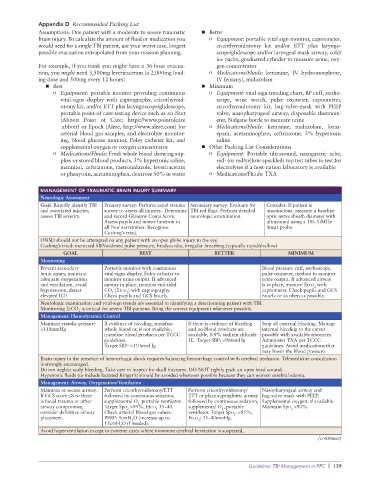
Appendix D  Recommended Packing List
              Assumptions: One patient with a moderate to severe traumatic   ■ ➤ Better
              brain injury. To calculate the amount of fluid or medication you   ➤ o Equipment: portable vital sign monitor, capnometer,
              would need for a single TBI patient, use your worst case, longest   cricothyroidotomy kit and/or ETT plus laryngo-
              possible evacuation extrapolated from your mission planning.  scope/glidescope and/or laryngeal mask airway, cold/
                                                                        ice packs, graduated cylinder to measure urine, oxy-
              For example, if you think you might have a 36-hour evacua-  gen concentrator
              tion, you might need 3,500mg levetiracetam (a 2,000mg load-  ➤ o Medications/Fluids: ketamine, IV hydromorphone,
              ing dose and 500mg every 12 hours)                        IV fentanyl, midazolam
                ■ ➤ Best                                           ■ ➤ Minimum
                   ➤ o Equipment: portable monitor providing continuous   ➤ o Equipment: vital-sign trending chart, BP cuff, stetho-
                     vital-signs display with capnography, cricothyroid-  scope, wrist watch, pulse oximeter, capnometer,
                     otomy kit, and/or ETT plus laryngoscope/glidescope,   cricothyroidotomy  kit,  bag-valve-mask  with  PEEP
                     portable point-of care-testing device such as an iStat   valve, nasopharyngeal airway, disposable thermom-
                     (Abbott Point of Care;  https://www.pointofcare    eter, Nalgene bottle to measure urine
                     .abbott) or Epoch (Alere, http://www.alere.com) for   ➤ o Medications/Fluids:  ketamine, midazolam, loraz-
                     arterial blood gas samples, and electrolyte monitor-  epam, acetaminophen, ceftriaxone,  3% hypertonic
                     ing, blood glucose monitor, Foley catheter kit, and   saline
                     supplemental oxygen or oxygen concentrator    ■ ➤ Other Packing List Considerations
                   ➤ o Medications/Fluids: Fresh whole blood drawing sup-  ➤ o Equipment:  Portable  ultrasound,  nasogastric tube,
                     plies or stored blood products, 3% hypertonic saline,   red- (or red/yellow-speckled) top test tubes to test for
                     mannitol, ceftriaxone, metronidazole, levetiracetam   electrolytes if a host-nation laboratory is available
                     or phenytoin, acetaminophen, dextrose 50% in water   ➤ o Medications/Fluids: TXA

              MANAGEMENT OF TRAUMATIC BRAIN INJURY SUMMARY
              Neurologic Assessment
              Goal: Rapidly identify TBI   Primary survey: Perform rapid trauma  Secondary survey: Evaluate for   Consider: If patient is
              and associated injuries;   survey to assess all injuries.  Determine  TBI red flags. Perform detailed   unconscious, measure a baseline
              assess TBI severity.  and record Glasgow Coma Score.    neurologic examination.  optic nerve sheath diameter with
                                   Assess pupils and motor function in                  ultrasound using a 10(–5)MHz
                                   all four extremities. Recognize                      linear probe.
                                   Cushing’s triad.
              ONSD should not be attempted on any patient with an open globe injury to the eye.
              Cushing’s triad: increased SBP/widened pulse pressure, bradycardia, irregular breathing (typically rapid/shallow)
                      GOAL                     BEST                    BETTER                  MINIMUM
              Monitoring
              Prevent secondary    Portable monitor with continuous                    Blood pressure cuff, stethoscope,
              brain injury, maintain   vital-signs display, Foley catheter to          pulse oximeter, method to monitor
              adequate oxygenation   monitor urine output. If advanced                 urine output. If advanced airway
              and ventilation, avoid   airway in place, monitor end-tidal              is in place, monitor Etco  with
                                                                                                        2
              hypotension, detect    CO  (Etco ) with capnography.                     capnometer. Check pupils and GCS
                                          2
                                      2
              elevated ICP.        Check pupils and GCS hourly.                        hourly or as often as possible.
              Neurologic examination and vital-sign trends are essential to identifying a deteriorating patient with TBI.
              Monitoring EtCO  is critical for severe TBI patients. Bring the correct equipment whenever possible.
                           2
              Management: Hemodynamic Control
              Maintain systolic pressure   If evidence of bleeding, transfuse   If there is evidence of bleeding   Stop all external bleeding. Manage
              >110mmHg             whole blood or, if not available,   and no blood products are   internal bleeding to the extent
                                   transfuse blood products per TCCC   available, 0.9% sodium chloride  possible with available resources.
                                   guidelines.                 1L. Target SBP: >90mmHg  Administer TXA per TCCC
                                   Target SBP: >110mmHg                                guidelines. Avoid medications that
                                                                                       may lower the blood pressure.
              Brain injury in the presence of hemorrhagic shock requires balancing hemorrhage control with cerebral perfusion. Telemedicine consultation
              is strongly encouraged.
              Do not neglect scalp bleeding. Take care to inspect for skull fractures. DO NOT tightly pack an open head wound.
              Hypotonic fluids (to include lactated Ringer’s) should be avoided whenever possible because they can worsen cerebral edema.
              Management: Airway, Oxygenation/Ventilation
              Maintain or secure airway.   Perform cricothyroidotomy/ETT   Perform cricothyroidotomy/  Nasopharyngeal airway and
              If GCS score ≤8 or there   followed by continuous sedation,   ETT or place supraglottic airway  bag-valve-mask with PEEP.
              is facial trauma or other   supplemental O  portable ventilator.   followed by continuous sedation,  Supplemental oxygen, if available.
                                              2,
              airway compromise,   Target Spo  >95%, Etco  35–40.   supplemental O , portable   Maintain Spo  >90%.
                                                                         2
                                                    2
                                                                                                2
                                           2
              consider definitive airway   Check arterial blood gas values.   ventilator. Target Spo : >95%,
                                                                             2
              placement.           PEEP: 5cmH O (increase up to   Etco : 35–40mmHg.
                                            2
                                                                  2
                                   15cmH O if needed).
                                        2
              Avoid hyperventilation except in extreme cases where imminent cerebral herniation is suspected.
                                                                                                         (continues)
                                                                                  Guideline: TBI Management in PFC  |  139

