


Page 73 - Journal of Special Operations Medicine - Spring 2017
P. 73
IV access in pediatric patients. Interosseous (IO) access   even in comfortable ambient temperatures. The key to
              is an easily performed procedure that requires minimal   prehospital management of the pediatric  patient is to
              education and should be considered first line in a hypo-  optimize  their  airway,  breathing,  and  circulation  with
              volemic pediatric patient. Pediatric IO insertion requires   minimal interventions and to arrange swift and safe
              the same technique as adult IO insertion, so the skills   transport to the forward surgical team or CSH for de-
              learned for adults are applicable to the pediatric popula-  finitive treatments.
              tion, with only minor modifications. The preferred sites
              of insertion are the same as in adult patients and include   Common Combat Pediatric Injury Patterns
              the proximal tibia 2cm inferior to the tibial tuberosity,   and Management
              the distal tibia, the proximal humerus, and last, the ster-  During OIF and OEF, known causes of injuries were
              num. Care should be taken to ensure adequate spacing   generally  due  to high-energy  mechanisms  like  explo-
              from the end of the bone and to aim the needle slightly   sions, gunshot wounds, and motor vehicle accidents.
                                                                                                               1,2
              away from the joint to minimize the risk of injury to   Borgman et al.  reported that mechanisms of injury in
                                                                              1
              the growth plate of the bone. Anatomic and equipment   pediatric patients admitted to the intensive care unit
              factors cause an increased risk for injury to the pediatric   were blast (37%), penetrating (27%), blunt (23%), and
              lungs and mediastinum with the sternal approach and   burns (13%). Common injury patterns described include
              make that location a less desirable insertion site.  lower extremity injuries, head injuries, upper extrem-
                                                                 ity injuries, burns, abdominal wounds, face/head/neck
              Additional considerations for prehospital management   wounds, chest wounds, ophthalmic injuries, spinal in-
              of the pediatric trauma patient include cervical spine   juries, vascular injuries, and airway injuries (Table 2). 1,2
              immobilization, exposure, and temperature regulation.
              When preparing for transport, one should maintain an   Table 2  Pediatric Mechanism of Injury Comparison for OEF
              anatomically neutral alignment of the spinal cord and   and OIF
              airway that should also be tailored to the patient. Com-  Mechanism of Injury  OIF, %    OEF, %
              mercially available cervical collars may not accurately   Blast                40          35
              maintain positioning and they may interfere with air-  Blunt                   29          17
              way patency. In addition, and most medic bags are not
              stocked with properly sized pediatric cervical collars.   Burn                 10          14
              When necessary, use towels, a SAM splint (SAM Medi-  Penetrating               23          33
              cal Inc.; http://www.sammedical.com/), and/or sheets   OEF, Operation Enduring Freedom; OIF, Operation Iraqi Freedom.
              for  cervical  stabilization,  recognizing  that  each  child   Source: Borgman et al. 2
              will need varying amounts of padding to maintain neu-
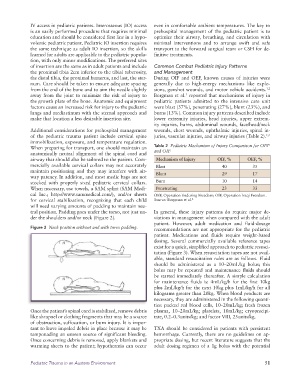
              tral position. Padding goes under the torso, not just un-  In general, these injury patterns do require major de-
              der the shoulders and/or neck (Figure 2).          viations in management when compared with the adult
                                                                 patient. However, adult medication and fluid-dosage
              Figure 2  Neck position without and with torso padding.  recommendations are not appropriate for the pediatric
                                                                 patient. Medications and fluids require weight-based
                                                                 dosing. Several commercially available reference tapes
                                                                 exist for a quick, simplified approach to pediatric resusci-
                                                                 tation (Figure 3). When resuscitation tapes are not avail-
                                                                 able, standard resuscitation rules are as follows. Fluid
                                                                 should be administered as a 10–20mL/kg bolus; this
                                                                 bolus may be repeated and maintenance fluids should
                                                                 be started immediately thereafter. A simple calculation
                                                                 for maintenance fluids is: 4mL/kg/h for the first 10kg
                                                                 plus 2mL/kg/h for the next 10kg plus 1mL/kg/h for all
                                                                 kilograms greater than 20kg. When blood products are
                                                                 necessary, they are administered in the following quanti-
                                                                 ties: packed red blood cells, 10–20mL/kg; fresh frozen
              Once the patient’s spinal cord is stabilized, remove debris   plasma, 10–20mL/kg; platelets, 10mL/kg; cryoprecipi-
              like shrapnel or clothing fragments that may be a source   tate, 0.2–0.3units/kg; and factor VIII, 25units/kg.
              of obstruction, suffocation, or burn injury. It is impor-
              tant to leave impaled debris in place because it may be   TXA should be considered in patients with persistent
              tamponading an unseen source of significant bleeding.   hemorrhage. Currently, there are no guidelines on ap-
              Once concerning debris is removed, apply blankets and   propriate dosing, but recent literature suggests that the
              warming sheets to the patient; hypothermia can occur   adult dosing regimen of a 1g bolus with the potential


              Pediatric Trauma in an Austere Environment                                                      51

