


Page 34 - Journal of Special Operations Medicine - Spring 2017
P. 34
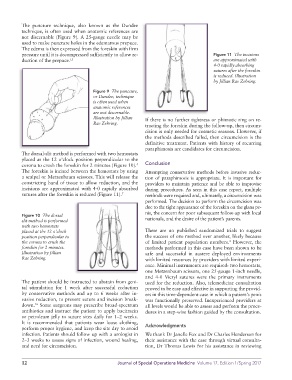
The puncture technique, also known as the Dundee
          technique, is often used when anatomic references are
          not discernable (Figure 9). A 25-gauge needle may be
          used to make puncture holes in the edematous prepuce.
          The edema is then expressed from the foreskin with firm
          pressure until it is decompressed sufficiently to allow re-                    Figure 11  The incisions
          duction of the prepuce. 15                                                     are approximated with
                                                                                         4-0 rapidly absorbing
                                                                                         sutures after the foreskin
                                                                                         is reduced. Illustration
                                                                                         by Jillian Rae Zehring.

                                        Figure 9  The puncture,
                                        or Dundee, technique
                                        is often used when
                                        anatomic references
                                        are not discernable.
                                        Illustration by Jillian   If there is no further tightness or phimotic ring on re-
                                        Rae Zehring.         tracting the foreskin during the follow-up, then circum-
                                                             cision is only needed for cosmetic reasons. However, if
                                                             the methods described failed, then circumcision is the
                                                             definitive treatment. Patients with history of recurring
                                                             paraphimosis are candidates for circumcision.
          The dorsal-slit method is performed with two hemostats
          placed at the 12 o’clock position perpendicular to the
          corona to crush the foreskin for 2 minutes (Figure 10).    Conclusion
                                                         4
          The foreskin is incised between the hemostats by using   Attempting conservative methods before invasive reduc-
          a scalpel or Metzenbaum scissors. This will release the   tion  of paraphimosis  is appropriate.  It  is important  for
          constricting band of tissue to allow reduction, and the   providers to maintain patience and be able to improvise
          incisions are approximated with 4-0 rapidly absorbed   during procedures. As seen in this case report, multiple
          sutures after the foreskin is reduced (Figure 11). 7  methods were required and, ultimately, a circumcision was
                                                             performed. The decision to perform the circumcision was
                                                             due to the tight appearance of the foreskin on the glans pe-
                                                             nis, the concern for poor subsequent follow-up with local
          Figure 10  The dorsal
          slit method is performed                           nationals, and the desire of the patient’s parents.
          with two hemostats
          placed at the 12 o’clock                           There  are no published randomized  trials to suggest
          position perpendicular to                          the success of one method over another, likely because
          the corona to crush the                            of limited patient population numbers.  However, the
                                                                                                2
          foreskin for 2 minutes.                            methods performed in this case have been shown to be
          Illustration by Jillian                            safe and successful in austere deployed environments
          Rae Zehring.                                       with limited resources by providers with limited experi-
                                                             ence. Minimal instruments are required: two hemostats,
                                                             one Metzenbaum scissors, one 25-gauge 1-inch needle,
                                                             and 4-0 Vicryl sutures were the primary instruments
          The patient should be instructed to abstain from geni-  used for the reduction. Also, telemedicine consultation
          tal stimulation for 1 week after successful reduction   proved to be easy and effective in supporting the provid-
          by conservative methods and up to 6 weeks after in-  ers in this time-dependent case in which a patient’s penis
          vasive reduction, to prevent suture and incision break-  was functionally preserved. Inexperienced providers at
          down.  Some surgeons may prescribe broad-spectrum   all levels would be able to assess and perform the proce-
               16
          antibiotics and instruct the patient to apply bacitracin   dures in a step-wise fashion guided by the consultation.
          or petroleum jelly to suture sites daily for 1–2 weeks.
          It  is  recommended  that  patients  wear  loose  clothing,   Acknowledgments
          perform proper hygiene, and keep the site dry to avoid
          infection. Patients should follow up with a urologist in   We thank Dr Janelle Fox and Dr Charles Henderson for
          2–3 weeks to assess signs of infection, wound healing,   their assistance with the case through virtual consulta-
          and need for circumcision.                         tion, Dr Thomas Lewis for his assistance in reviewing


          12                                      Journal of Special Operations Medicine  Volume 17, Edition 1/Spring 2017

