


Page 32 - Journal of Special Operations Medicine - Spring 2017
P. 32
there were  no operating room or surgical  specialists
          within the region. The only medical treatment provided
          was the insertion of a Foley catheter because the patient
          continued having difficulty urinating.

          This case and photographs of the patient were forwarded
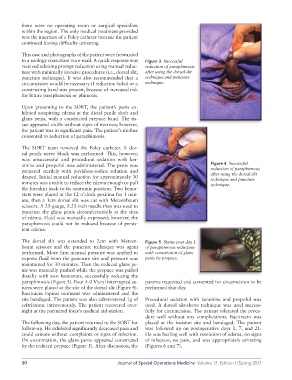
          to a urology consultant via e-mail. A quick response was   Figure 3  Successful
          received advising prompt reduction using manual reduc-  reduction of paraphimosis
          tion with minimally invasive procedures (i.e., dorsal slit,   after using the dorsal slit
          puncture technique). It was also recommended that a   technique and puncture
          circumcision would be necessary if reduction failed or a   technique.
          constricting band was present, because of increased risk
          for future paraphimosis or phimosis.

          Upon presenting to the SORT, the patient’s penis ex-
          hibited nonpitting edema at the distal penile shaft and
          glans penis, with a constricted prepuce band. The tis-
          sue appeared viable without signs of necrosis; however,
          the patient was in significant pain. The patient’s mother
          consented to reduction of paraphimosis.

          The SORT team removed the Foley catheter. A dor-
          sal penile nerve block was performed. This, however,
          was unsuccessful and procedural sedation with ket-
          amine and propofol was administered. The penis was                            Figure 4  Successful
          prepared sterilely with povidone-iodine solution and                          reduction of paraphimosis
                                                                                        after using the dorsal slit
          draped. Initial manual reduction for approximately 30                         technique and puncture
          minutes was unable to reduce the edema enough to pull                         technique.
          the foreskin back to its anatomic position. Two hemo-
          stats were placed at the 12 o’clock position for 1 min-
          ute, then a 1cm dorsal slit was cut with Metzenbaum
          scissors. A 25-gauge, 0.25-inch needle then was used to
          puncture the glans penis circumferentially at the sites
          of edema. Fluid was manually expressed; however, the
          paraphimosis could not be reduced because of persis-
          tent edema.

          The  dorsal  slit  was extended  to 2cm  with  Metzen-  Figure 5  Status post day 1
          baum scissors and the puncture technique was again   of paraphimosis reduction
          performed. More firm manual pressure was applied to   with constriction of glans
          express fluid from the puncture site and pressure was   penis by prepuce.
          maintained for 30 minutes. Then the reduced glans pe-
          nis was manually pushed while the prepuce was pulled
          distally with two hemostats, successfully reducing the
          paraphimosis (Figure 3). Four 4-0 Vicryl interrupted su-  parents requested and consented for circumcision to be
          tures were placed at the site of the dorsal slit (Figure 4).   performed that day.
          Bacitracin  topical  ointment  was  administered  and the
          site bandaged. The patient was also administered 1g of   Procedural sedation with ketamine and propofol was
          ceftriaxone intravenously. The patient recovered over-  used.  A  dorsal  slit-sleeve  technique  was  used  success-
          night at the partnered force’s medical aid station.  fully for circumcision. The patient tolerated the proce-
                                                             dure well without any complications. Bacitracin was
          The following day, the patient returned to the SORT for   placed at the incision site and bandaged. The patient
          follow-up. He exhibited significantly decreased pain and   was followed up on postoperative days 1, 7, and 21.
          could urinate without complaints or signs of infection.   He was healing well with resolution of edema, no signs
          On examination, the glans penis appeared constricted   of infection, no pain, and was appropriately urinating
          by the reduced prepuce (Figure 5). After discussion, the   (Figures 6 and 7).


          10                                      Journal of Special Operations Medicine  Volume 17, Edition 1/Spring 2017

