


Page 31 - Journal of Special Operations Medicine - Spring 2017
P. 31
Invasive Reduction of Paraphimosis in an Adolescent Male
                                While in a Deployed Austere Environment


                                    Christopher K. Pham, DO; Joseph Zehring, EMT-B;
                                               Cristóbal S. Berry-Cabán, PhD


              ABSTRACT

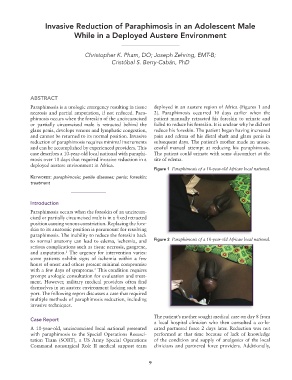
              Paraphimosis is a urologic emergency resulting in tissue     deployed in an austere region of Africa (Figures 1 and
              necrosis and partial amputation, if not reduced. Para-  2). Paraphimosis occurred 10 days earlier when the
              phimosis occurs when the foreskin of the uncircumcised   patient manually retracted his foreskin to urinate and
              or partially circumcised male is retracted behind the   failed to reduce his foreskin. It is unclear why he did not
              glans penis, develops venous and lymphatic congestion,   reduce his foreskin. The patient began having increased
              and cannot be returned to its normal position. Invasive   pain and edema of his distal shaft and glans penis in
              reduction of paraphimosis requires minimal instruments   subsequent days. The patient’s mother made an unsuc-
              and can be accomplished by experienced providers. This   cessful manual attempt at reducing his paraphimosis.
              case describes a 10-year-old local national with paraphi-  The patient could urinate with some discomfort at the
              mosis over 10 days that required invasive reduction in a   site of edema.
              deployed austere environment in Africa.
                                                                 Figure 1  Paraphimosis of a 10-year-old African local national.
              Keywords: paraphimosis; penile diseases; penis; foreskin;
              treatment


              Introduction
              Paraphimosis occurs when the foreskin of an uncircum-
              cised or partially circumcised male is in a fixed retracted
              position causing venous constriction. Replacing the fore-
              skin to its anatomic position is paramount for resolving
              paraphimosis. The inability to reduce the foreskin back
              to normal anatomy can lead to edema, ischemia, and   Figure 2  Paraphimosis of a 10-year-old African local national.
              serious complications such as tissue necrosis, gangrene,
              and amputation.  The urgency for intervention varies:
                            1
              some patients exhibit signs of ischemia within a few
              hours of onset and others present minimal compromise
              with a few days of symptoms.  This condition requires
                                        2
              prompt urologic consultation for evaluation and treat-
              ment. However, military medical providers often find
              themselves in an austere environment lacking such sup-
              port. The following report discusses a case that required
              multiple methods of paraphimosis reduction, including
              invasive techniques.

                                                                 The patient’s mother sought medical care on day 8 from
              Case Report
                                                                 a local hospital clinician who then consulted a co-lo-
              A 10-year-old, uncircumcised local national presented   cated partnered force 2 days later. Reduction was not
              with paraphimosis to the Special Operations Resusci-  performed at that time because of lack of knowledge
              tation Team  (SORT), a  US Army  Special  Operations   of the condition and supply of analgesics of the local
              Command nonsurgical Role II medical support team     clinicians and partnered  force  providers. Additionally,


                                                               9

