


Page 162 - Journal of Special Operations Medicine - Spring 2017
P. 162
™
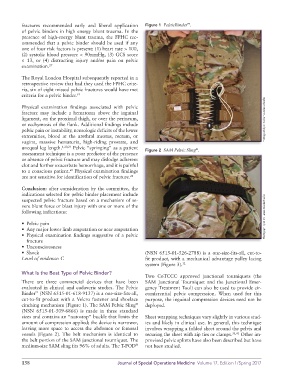
          fractures recommended early and liberal application   Figure 1  PelvicBinder .
          of pelvic binders in high energy blunt trauma. In the
          presence of high-energy blunt trauma, the FPHC rec-
          ommended that a pelvic binder should be used if any
          one of four risk factors is present: (1) heart rate > 100,
          (2) systolic blood pressure < 90mmHg, (3) GCS score
          ≤ 13, or (4) distracting injury and/or pain on pelvic
          examination. 27

          The Royal London Hospital subsequently reported in a
          retrospective review that had they used the FPHC crite-
          ria, six of eight missed pelvic fractures would have met
          criteria for a pelvic binder. 59

          Physical examination findings associated with pelvic
          fracture  may include a hematoma  above the inguinal
          ligament, on the proximal thigh, or over the perineum,                                              Photograph by Lt Col James Wiedenhoefer.
          or ecchymosis of the flank. Additional findings include
          pelvic pain or instability, neurologic deficits of the lower
          extremities,  blood at the urethral meatus,  rectum, or
          vagina, massive hematuria, high-riding prostate, and
          unequal leg length. 4,20,21  Pelvic “springing” as a patient   Figure 2  SAM Pelvic Sling .
                                                                                  ®
          assessment technique is a poor predictor of the presence
          or absence of pelvic fracture and may dislodge adherent
          clot and further exacerbate hemorrhage, and it is painful
          to a conscious patient.  Physical examination findings
                              60
          are not sensitive for identification of pelvic fracture. 20

          Conclusion: after consideration by the committee, the
          indications selected for pelvic binder placement include
          suspected pelvic fracture based on a mechanism of se-
          vere blunt force or blast injury with one or more of the
          following indications:                                                                              Photograph by Lt Col James Wiedenhoefer.

          •  Pelvic pain
          •  Any major lower limb amputation or near amputation
          •  Physical examination findings suggestive of a pelvic
            fracture
          •  Unconsciousness
          •  Shock                                           (NSN 6515-01-526-2788) is a one-size-fits-all, cut-to-
          Level of evidence: C                               fit product, with a mechanical advantage pulley lacing
                                                             system (Figure 3). 32

          What Is the Best Type of Pelvic Binder?
                                                             Two CoTCCC approved junctional tourniquets (the
          There are three commercial devices that have been   SAM Junctional Tourniquet and the Junctional Emer-
          evaluated in clinical and cadaveric studies. The Pelvic   gency Treatment Tool) can also be used to provide cir-
          Binder  (NSN 6515-01-618-9137) is a one-size-fits-all,   cumferential  pelvic  compression.  When used  for  this
                ™
          cut-to-fit product with a Velcro fastener and shoelace   purpose, the inguinal compression devices need not be
          cinching mechanism (Figure 1). The SAM Pelvic Sling    deployed.
                                                         ®
          (NSN 6515-01-509-6866) is made in three standard
          sizes and contains an “autostop” buckle that limits the   Sheet wrapping techniques vary slightly in various stud-
          amount of compression applied; the device is narrower,   ies and likely in clinical use. In general, this technique
          leaving more space to access the abdomen or femoral   involves wrapping a folded sheet around the pelvis and
          vessels  (Figure  2).  The  belt  mechanism  is  identical  to   securing the sheet with zip ties or clamps. 33,42  Other im-
          the belt portion of the SAM junctional tourniquet. The   provised pelvic splints have also been described but have
          medium-size SAM sling fits 96% of adults. The T-POD    not been studied.
                                                         ®


          138                                     Journal of Special Operations Medicine  Volume 17, Edition 1/Spring 2017

