


Page 93 - Journal of Special Operations Medicine - Winter 2016
P. 93
early phases of training. Reducing loads will decrease   Table 1  Summary of Symptoms and Signs, Etiology, Risk
              the amount of compression on the toes and reducing   Factors, Treatment, and Prevention of Rucksack Palsy and
              load-carriage distance will reduce repetitive stress on the   Digitalgia Paresthetica
              foot and lower leg. More gradual progression of loads   Rucksack palsy
              and distances may enable more gradual adaptation of   Symptoms   Paresthesia, cramping, pain, and/or
              lower-leg muscles to load, thus potentially reducing   and signs  weakness in the shoulder associated with
              risks of overuse and tarsal tunnel syndrome. Footwear          load carriage
              should be examined to assure that lacing is not too tight,     Symptoms may extend to neck, arms, hands
              the toe box is adequate (i.e., not squeezing the toes), and    Reduced pain after load is removed
              that the fit is correct.                                       Sensory deficits and muscle weakness
                                                                             remain after load is removed
                                                                             Scapular winging
              Once symptoms have been experienced, a specialty con-  Etiology  Traction or compression injury of the upper
              sultation by a physical therapist, podiatrist, or other        brachial plexus due to rucksack shoulder
              healthcare provider may be helpful to rule out entrap-         straps
              ment neuropathies such as tarsal tunnel syndrome that   Risk factors  Demonstrated: lower body mass index
              might be contributing to the problem.  If this is likely,      Hypothetical: heavy loads and/or longer
                                               39
              the medical provider will be able to provide initial           carriage distance
              conservative treatment for the syndrome and refer the   Treatment  Reduce shoulder compression
              Soldier for further diagnostic tests and possible tarsal       Physical therapy
              tunnel injections or decompression surgery if conserva-        More effective use of rucksack hip belt
              tive management does not fully resolve the problem. 39,41      Reduce rucksack load
              The provider will also be able to advise on conserva-          Improve shoulder straps (wider, more
                                                                             padding)
              tive management when the problem seems to be more
              related to nerve compression under the foot. Conserva-  Prevention  Commanders encourage removal of packs
              tive treatment will generally involve addressing inflam-       during short rests where operationally
                                                                             acceptable
              mation and initial relief  from loads and from heavy,          Use of rucksack hip belt
              repetitive ankle-muscle use, followed by exercises that        Periodic shoulder strap adjustments while
              mobilize the nerve tissue, and stretch and more gradu-         carrying load
              ally strengthen specific lower-leg and short foot muscles      Wider shoulder straps
              to reduce future risk of overuse injury and help maintain      Improved shoulder strap padding
                                                                             Strengthening of shoulder muscles
              foot stability and arch structure. 39,41  These approaches
              have potential to help alleviate nerve compression in   Digitalgia paresthetica
              both the tarsal tunnel and under the foot.         Symptoms    Paresthetica in the feet and/or toes that is
                                                                 and signs   associated with load carriage
                                                                 Etiology    Compression neuropathy of the foot
              Conclusion                                                     associated with repetitive foot trauma
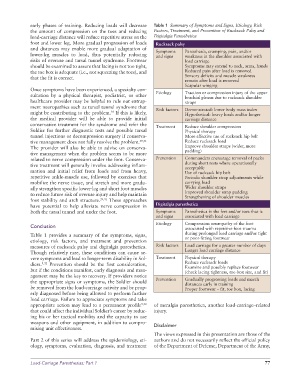
              Table 1 provides a summary of the symptoms, signs,             during prolonged load carriage and/or tight
                                                                             or poor-fitting footwear
              etiology, risk factors, and treatment and prevention
              measures of rucksack palsy and digitalgia paresthetica.   Risk factors  Load carriage for a greater number of days
              Though  relatively  rare,  these  conditions  can  cause  se-  Longer load carriage distance
              vere symptoms and lead to longer-term disability in Sol-  Treatment  Physical therapy
              diers. 9,32  Prevention should be the first consideration,     Reduce rucksack loads
                                                                             Examine and possibly replace footwear
              but if the conditions manifest, early diagnosis and man-       (check lacing tightness, toe-box size, and fit)
              agement may be the key to recovery. If providers notice
              the appropriate signs or symptoms, the Soldier should   Prevention  Gradually progressing loads and march
                                                                             distances early in training
              be removed from the load-carriage activity and be prop-        Proper footwear – fit, toe box, lacing
              erly diagnosed before being allowed to perform further
              load carriage. Failure to appreciate symptoms and take
              appropriate action may lead to a permanent profile 9,32    of meralgia paresthetica, another load-carriage–related
              that could affect the individual Soldier’s career by reduc-  injury.
              ing his or her tactical mobility and the capacity to use
              weapons and other equipment, in addition to compro-  Disclaimer
              mising unit effectiveness.
                                                                 The views expressed in this presentation are those of the
              Part 2 of this series will address the epidemiology, eti-  authors and do not necessarily reflect the official policy
              ology, symptoms, evaluation, diagnosis, and treatment   of the Department of Defense, Department of the Army,


              Load-Carriage Paresthesias: Part 1                                                              77

