


Page 88 - Journal of Special Operations Medicine - Winter 2016
P. 88
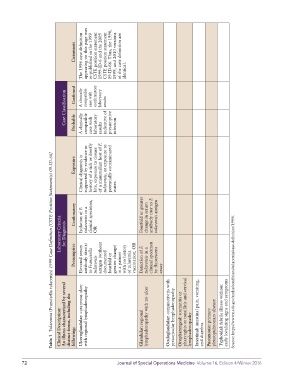
The 1996 case definition   re-published in the 1999  CSTE position statement  1999-ID-6 and the 2009  CSTE position statement   1999, and 2010 versions  of the case definition are   identical.

                                Comments  appearing on this page was   09-ID-66. Thus, the 1996,


                            Case Classification  Confirmed  Probable  A clinically  A clinically   compatible  compatible   case with   case with   confirmatory   laboratory   laboratory   results   results indicative of   presumptive   infection


                       Table 1  Tularemia (Francisella tularensis) 1999 Case Definition [CSTE Position Statement(s) 09-ID-66]
                                   Clinical diagnosis is   bite, exposure to tissues   water.
                                Exposure  supported by evidence or  history of a tick or deerfly   of a mammalian host of F.  tularensis, or exposure to  potentially contaminated


                          Laboratory Criteria    for Diagnosis  Confirmatory  Isolation of F.   tularensis in a   clinical specimen,   OR  Fourfold or greater   change in serum   antibody titer to F.   tularensis antigen


                                Presumptive  Elevated serum   antibody titer(s)   to Francisella   tularensis   antigen (without   documented   fourfold or   greater change)   in a patient   with no history   of tularemia   vaccination, OR  Detection of F.   tularensis in a   clinical specimen   by fluorescent   assay  Source: https://wwwn.cdc.gov/nndss/conditions/tularemia/case-definition/1999/.


                          Clinical Description: An illness characterized by several  distinct forms, including the   following: Ulceroglandular: cutaneous ulcer  with regional lymphadenopathy  Glandular: regional  lymphadenopathy with no ulcer  Oculoglandular: conjunctivitis with  preauricular lymphadenopathy  Oropharyngeal: stomatitis or  pharyngitis or tonsillitis and cervical   lymphadenopathy Intestinal: intestinal pain, vomiting,   and diarrhea  Pneumonic: primary  pleur


          72                                     Journal of Special Operations Medicine  Volume 16, Edition 4/Winter 2016

