


Page 91 - Journal of Special Operations Medicine - Winter 2016
P. 91
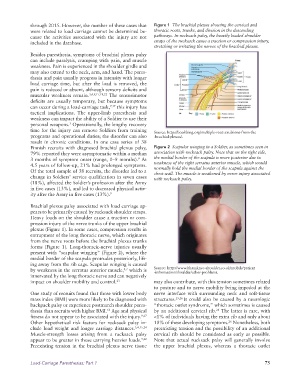
through 2015. However, the number of these cases that   Figure 1  The brachial plexus showing the cervical and
              were related to load carriage cannot be determined be-  thoracic roots, trunks, and division in the descending
              cause the activities associated with the injury are not   pathways. In rucksack palsy, the heavily loaded shoulder
              included in the database.                          straps of the rucksack cause a traction or compression injury,
                                                                 stretching or irritating the nerves of the brachial plexus.
              Besides paresthesia, symptoms of brachial plexus palsy
              can include paralysis, cramping with pain, and muscle
              weakness. Pain is experienced in the shoulder girdle and
              may also extend to the neck, arm, and hand. The pares-
              thesia and pain usually progress in intensity with longer
              load carriage time, but after the load is removed, the
              pain is reduced or absent, although sensory deficits and
              muscular weakness remain. 3,4,9,17,18,22  The sensorimotor
              deficits are usually temporary, but because symptoms
              can occur during a load-carriage task, 7,17  this injury has
              tactical implications. The upper-limb paresthesia and
              weakness can impact the ability of a Soldier to use their
              personal weapons.  Operationally, the lengthy recovery
                              3
              time for the injury can remove Soldiers from training   Source: http://bookbing.org/multiple-root-avulsions-from-the
              programs and operational duties; the disorder can also   -brachial-plexus/.
              result in chronic conditions. In one case series of 38
              Finnish recruits with diagnosed brachial plexus palsy,   Figure 2  Scapular winging in a Soldier, as sometimes seen in
              79% reported they were asymptomatic within a median   association with rucksack palsy. Note that on the right side,
              3 months of symptom onset (range, 0–9 months).  At   the medial border of the scapula is more posterior due to
                                                          9
              4.5 years of follow-up, 21% had prolonged symptoms.   weakness of the right serratus anterior muscle, which would
                                                                 normally hold the medial border of the scapula against the
              Of the total sample of 38 recruits, the disorder led to a   chest wall. The muscle is weakened by nerve injury associated
              change in Soldiers’ service qualification in seven cases   with rucksack palsy.
              (18%), affected the Soldier’s profession after the Army
              in five cases (13%), and led to decreased physical activ-
              ity after the Army in five cases (13%). 9

              Brachial plexus palsy associated with load carriage ap-
              pears to be primarily caused by rucksack shoulder straps.
              Heavy loads on the shoulder cause a traction or com-
              pression injury of the nerve trunks of the upper brachial
              plexus (Figure 1). In some cases, compression results in
              entrapment of the long thoracic nerve, which originates
              from the nerve roots before the brachial plexus trunks
              forms (Figure 1). Long-thoracic-nerve injuries usually
              present with “scapular winging” (Figure 2), where the
              medial border of the scapula protrudes posteriorly, lift-
              ing away from the rib cage. Scapular winging is caused
              by weakness in the serratus anterior muscle,  which is   Source: http://www.bhamknee-shoulder.co.uk/mobile/patient
                                                    3,7
                                                                 -information/shoulder/other-problems.
              innervated by the long thoracic nerve and can negatively
              impact on shoulder mobility and control. 23        may also contribute, with this tension sometimes related
                                                                 to posture and to nerve mobility being impeded at the
              One study of recruits found that those with lower body   nerve  interface  with  surrounding  neck  and soft-tissue
              mass index (BMI) were more likely to be diagnosed with   structures. 25,26  It could also be caused by a neurologic
              backpack palsy or experience postmarch shoulder pares-  “thoracic outlet syndrome,” which sometimes is caused
              thesia than recruits with higher BMI.  Age and physical   by an additional cervical rib.  The latter is rare, with
                                             18
                                                                                          26
              fitness do not appear to be associated with the injury. 9,17    <1% of individuals having the extra rib and only about
              Other hypothetical risk factors for rucksack palsy in-  10% of these developing symptoms.  Nonetheless, both
                                                                                               26
              clude load weight and longer carriage distances. 3,4,15,24    preexisting tension and the possibility of an additional
              Muscle-strength losses arising from a rucksack palsy   cervical rib should be considered as early as possible.
              appear to be greater in those carrying heavier loads. 9,22    Note that actual rucksack palsy will generally involve
              Preexisting tension in the brachial plexus nerve tissue   the  upper  brachial  plexus,  whereas  a  thoracic  outlet


              Load-Carriage Paresthesias: Part 1                                                              75

