


Page 105 - Journal of Special Operations Medicine - Winter 2016
P. 105
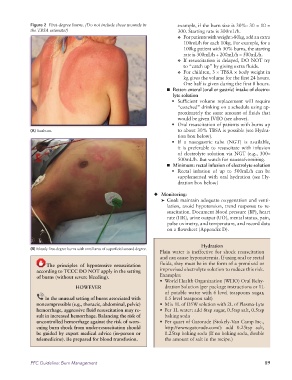
Figure 2  First-degree burns. (Do not include these wounds in   example, if the burn size is 30%: 30 × 10 =
              the TBSA estimate!)                                         300. Starting rate is 300mL/h.
                                                                          ❖  For patients with weight >80kg, add an extra
                                                                             100mL/h for each 10kg. For example, for a
                                                                             100kg patient with 30% burns, the starting
                                                                             rate is 300mL/h + 200mL/h = 500mL/h.
                                                                          ❖  If resuscitation is delayed, DO NOT try
                                                                             to “catch up” by giving extra fluids.
                                                                          ❖  For children, 3 × TBSA × body weight in
                                                                             kg gives the volume for the first 24 hours.
                                                                             One half is given during the first 8 hours.
                                                                      ■  Better: enteral (oral or gastric) intake of electro-
                                                                        lyte solution
                                                                        •  Sufficient volume replacement will require
                                                                          “coached” drinking on a schedule using ap-
                                                                          proximately the same amount of fluids that
                                                                          would be given IV/IO (see above).
                                                                        •  Oral resuscitation of patients with burns up
              (A) Sunburn.                                                to about 30% TBSA is possible (see Hydra-
                                                                          tion box below).
                                                                        •  If a nasogastric tube (NGT) is available,
                                                                          it is preferable to resuscitate with infusion
                                                                          of electrolyte solution via NGT (e.g., 300–
                                                                          500mL/h. But watch for nausea/vomiting.
                                                                      ■  Minimum: rectal infusion of electrolyte solution
                                                                        •  Rectal infusion of up to 500mL/h can be
                                                                          supplemented with oral hydration (see Hy-
                                                                          dration box below)

                                                                 ◆  Monitoring:
                                                                    ➤  Goal: maintain adequate oxygenation and venti-
                                                                      lation, avoid hypotension, trend response to re-
                                                                      suscitation. Document blood pressure (BP), heart
                                                                      rate (HR), urine output (UO), mental status, pain,
                                                                      pulse oximetry, and temperature, and record data
                                                                      on a flowsheet (Appendix D).


                                                                                    Hydration
              (B) Mostly first-degree burns with small area of superficial second degree.
                                                                   Plain water is ineffective for shock resuscitation
                                                                   and can cause hyponatremia. If using oral or rectal
                    The principles of hypotensive resuscitation    fluids, they must be in the form of a premixed or
                according to TCCC DO NOT apply in the setting      improvised electrolyte solution to reduce this risk.
                of burns (without severe bleeding).                Examples:
                                                                   •  World Health Organization (WHO) Oral Rehy-
                                HOWEVER                              dration Solution (per package instructions or 1L
                                                                     of potable water with 6 level teaspoons sugar,
                    In the unusual setting of burns associated with   0.5 level teaspoon salt)
                noncompressible (e.g., thoracic, abdominal, pelvic)   •  Mix 1L of D5W solution with 2L of Plasma-Lyte
                hemorrhage, aggressive fluid resuscitation may re-  •  Per 1L water: add 8tsp sugar, 0.5tsp salt, 0.5tsp
                sult in increased hemorrhage. Balancing the risk of   baking soda
                uncontrolled hemorrhage against the risk of wors-  •  Per quart of Gatorade (Stokely-Van Camp Inc.,
                ening burn shock from under-resuscitation should     http://www.gatorade.com/): add 0.25tsp salt,
                be guided by expert medical advice (in-person or     0.25tsp baking soda (If no baking soda, double
                telemedicine). Be prepared for blood transfusion.    the amount of salt in the recipe.)


              PFC Guideline: Burn Management                                                                  89

