


Page 103 - Journal of Special Operations Medicine - Winter 2016
P. 103
Management of Burn Wounds Under Prolonged Field Care


                       Leopoldo C. Cancio, MD; Doug Powell, MD; Britton Adams, NREMT-P, ATP;
                  Kenneth Bull, MD; Alexander Keller, MD; Jennifer Gurney, MD; Jeremy Pamplin, MD;
                                         Stacy Shackelford, MD; Sean Keenan, MD


                 his Role 1, prolonged field care (PFC) guideline is in-  ■  Patients with smoke inhalation injury may
              Ttended to be used after Tactical Combat Casualty Care    present with a range of symptoms in terms of
              (TCCC) Guidelines, when evacuation to higher level of     severity.
              care is not immediately possible. A provider of PFC must   ■  Patients with severely symptomatic smoke inha-
              first and foremost be an expert in TCCC. This Clinical    lation injury (e.g., respiratory distress, stridor)
              Practice Guideline (CPG) is meant to provide medical pro-  require immediate definitive airway (cuffed tube
              fessionals who encounter burns in austere environments    in trachea) because they are at risk of immediate
              with evidence-based guidance. Recommendations follow      airway loss. Oxygenate and ventilate.
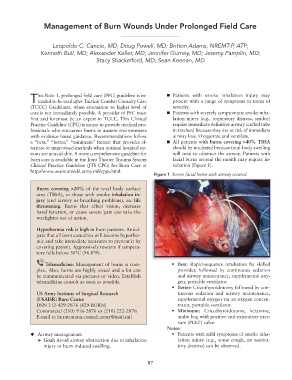
              a “best,” “better,” “minimum” format that provides al-  ■  All patients with burns covering >40% TBSA
              ternate or improvised methods when optimal hospital op-   should be intubated because total-body swelling
              tions are unavailable. A more comprehensive guideline for   will tend to obstruct the airway. Patients with
              burn care is available in the Joint Theater Trauma System   facial burns around the mouth may require in-
              Clinical Practice Guideline (JTS CPG) for Burn Care at    tubation (Figure 1).
              http://www.usaisr.amedd.army.mil/cpgs.html.
                                                                 Figure 1  Severe facial burns with airway secured.


                Burns covering >20% of the total body surface
                area (TBSA), or those with smoke inhalation in-
                jury (and airway or breathing problems), are life
                threatening. Burns that affect vision, decrease
                hand function, or cause severe pain can take the
                warfighter out of action.

                Hypothermia risk is high in burn patients. Antici-
                pate that all burn casualties will become hypother-
                mic and take immediate measures to prevent it by
                covering patient. Aggressively rewarm if tempera-
                ture falls below 36°C (96.8°F).

                    Telemedicine: Management of burns is com-           •  Best:  Rapid-sequence  intubation  by skilled
                plex. Also, burns are highly visual and a lot can         provider,  followed  by  continuous  sedation
                be communicated via pictures or video. Establish          and airway maintenance, supplemental oxy-
                telemedicine consult as soon as possible.                 gen, portable ventilator.
                                                                        •  Better: Cricothyroidotomy followed by con-
                US Army Institute of Surgical Research                    tinuous  sedation  and airway  maintenance,
                (USAISR) Burn Center                                      supplemental oxygen via an oxygen concen-
                DSN 312-429-2876 (429-BURN)                               trator, portable ventilator.
                Commercial (210) 916-2876 or (210) 222-2876             •  Minimum:  Cricothyroidotomy,  ketamine,
                E-mail to burntrauma.consult.army@mail.mil                ambu bag with positive end-expiratory pres-
                                                                          sure (PEEP) valve.
                                                                      Notes:
              ◆  Airway management:                                     •  Patients with mild symptoms of smoke inha-
                 ➤  Goal: Avoid airway obstruction due to inhalation      lation injury (e.g., some cough, no respira-
                   injury or burn-induced swelling.                       tory distress) can be observed.


                                                              87

