


Page 77 - Journal of Special Operations Medicine - Summer 2016
P. 77
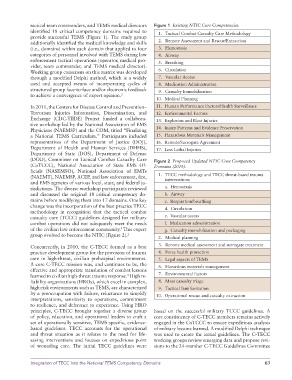
tactical team commanders, and TEMS medical directors   Figure 1  Existing NTIC Core Competencies.
              identified 18 critical competency domains required to   1.  Tactical Combat Casualty Care Methodology
              provide successful TEMS (Figure 1). The study group
              additionally identified the medical knowledge and skills   2.  Remote Assessment and Rescue/Extraction
              (i.e., domains) within each domain that applied to four   3.  Hemostasis
              categories of personnel involved with TEMS during law   4.  Airway
              enforcement tactical operations (operator, medical pro-  5.  Breathing
              vider, team commander, and TEMS medical director).
              Working group consensus on this matrix was developed   6.  Circulation
              through a modified Delphi method, which is a widely   7.  Vascular Access
              used and accepted means of incorporating  cycles of   8.  Medication Administration
              structured group face-to-face and/or electronic feedback   9.  Casualty Immobilization
              to achieve a convergence of expert opinion. 2
                                                                 10.  Medical Planning
              In 2011, the Centers for Disease Control and  Prevention–  11.  Human Performance Factors/Health Surveillance
              Terrorism Injuries Information, Dissemination, and   12.  Environmental Factors
              Exchange (CDC-TIIDE) Project funded a collabora-   13.  Explosion and Blast Injuries
              tive workshop led by the National Association of EMS
              Physicians (NAEMSP) and the COM, titled “Finalizing   14.  Injury Patterns and Evidence Preservation
              a National TEMS Curriculum.” Participants included   15.  Hazardous Materials Management
              representatives of the Department of Justice (DOJ),   16.  Remote/Surrogate Agreement
              Department of Health and Human Services (DHHS),    17.  Less Lethal Injuries
              Department  of  State  (DOS),  Department  of  Defense
              (DOD), Committee on Tactical Combat Casualty Care   Figure 2  Proposed Updated NTIC Core Competency
              (CoTCCC), National Association of State EMS Of-    Domains (2016).
              ficials (NASEMSO), National Association of EMTs
              (NAEMT), NAEMSP, ACEP, and law enforcement, fire,   1.  TECC methodology and TECC threat-based trauma
                                                                     interventions
              and EMS agencies of various local, state, and federal ju-
              risdictions. The diverse workshop participants reviewed   a.  Hemostasis
              and discussed the original 18 critical competency do-  b.  Airway
              mains before modifying them into 17 domains. One key   c.  Respiration/breathing
              change was the incorporation of the best practice TECC   d.  Circulation
              methodology in recognition that the tactical combat
              casualty care (TCCC) guidelines designed for military   e.  Vascular access
              combat operations did not adequately meet the needs    f.  Medication administration
              of the civilian law enforcement community. This expert   g.  Casualty immobilization and packaging
                                                   3
              group evolved to become the NTIC (Figure 2). 2      2.  Medical planning

              Concurrently, in 2010, the C-TECC formed as a best   3.  Remote medical assessment and surrogate treatment
              practice development group for the provision of trauma   4.  Force health protection
              care in high-threat, civilian prehospital environments.   5.  Legal aspects of TEMS
              A core C-TECC mission was, and continues to be, the   6.  Hazardous materials management
              effective and appropriate translation of combat lessons
              learned to civilian high-threat trauma response.  High re-  7.  Environmental factors
                                                      4
              liability organizations (HROs), which excel in complex,   8.  Mass casualty triage
              high-risk environments such as TEMS, are characterized   9.  Tactical familiarization
              by a preoccupation with failure, reluctance to simplify   10.  Operational rescue and casualty extraction
              interpretations,  sensitivity  to operations,  commitment
              to resilience, and deference to experience. Using HRO
              principles, C-TECC brought together a diverse group   based on the successful military TCCC guidelines. A
              of policy, education, and operational leaders to craft a   core constituency of C-TECC members remains actively
              set of operationally sensitive, TEMS-specific, evidence-  engaged in the CoTCCC to ensure expeditious analysis
              based guidelines. TECC accounts for the operational   of military lessons learned. A modified Delphi technique
              and threat situation as it relates to the need for life-  was used to create the initial guidelines. The C-TECC
              saving interventions and focuses on expeditious point   working groups review emerging data and propose revi-
              of wounding care. The initial TECC guidelines were   sions to the 24-member C-TECC Guidelines Committee


              Integration of TECC Into the National TEMS Competency Domains                                   63

