


Page 72 - Journal of Special Operations Medicine - Summer 2016
P. 72
exercise in either normal or hot, humid conditions, ulti-
          mately impairing cognitive ability.  Additionally, when a
                                       12
          troop member suffers from fatigue because of a physical
          or cognitive heat-related illness, an estimated four mem-
          bers of the squadron are needed to carry him/her any dis-                 Figure 1  Arctic Ease .
                                                                                                    ®
          tance.  Therefore, the prevention of heat illness among
               9
          military troop members seems prudent in ameliorating
          battlefield mishaps and improving field performance.
          Cooling devices have been introduced to help reduce
          the occurrence of heat illness. Various cooling devices
          are often applied to the head and neck regions based
          on the concept that brain temperature can be controlled
          through active cooling of that region. 10,12–14  Local cooling
          of the carotid arteries during high-intensity exercise has
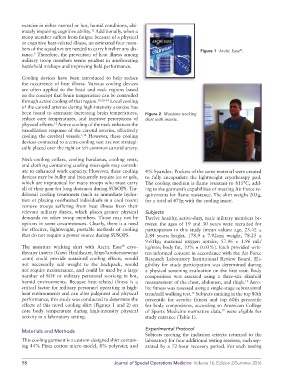
          been found to attenuate increasing brain temperatures,   Figure 2  Moisture wicking
          reduce core temperatures, and improve perceptions of   shirt with inserts.
          physical efforts. Active cooling of the neck enhances the
                       12
          vasodilation response of the carotid arteries, effectively
          cooling the cerebral vessels. 2,14  However, these cooling
          devices connected to a core-cooling vest are not strategi-
          cally placed over the right or left common carotid artery.

          Neck-cooling collars, cooling bandanas, cooling vests,
          and clothing containing cooling microgels may contrib-
          ute to enhanced work capacity. However, these cooling   4% Spandex. Pockets of the same material were created
          devices may be bulky and frequently require ice or gels,   to fully encapsulate the lightweight cryotherapy pad.
          which are impractical for many troops who must carry   The cooling medium is flame resistant to 815°C, add-
          all of their gear for long distances during SUSOPS. Tra-  ing to the garment’s capabilities of meeting Air Force re-
          ditional cooling treatments (such as immediate hydra-  quirements for flame resistance. The shirt weighs 203g,
          tion or placing overheated individuals in a cool room)   for a total of 471g with the cooling insert.
          remove troops suffering from heat illness from their
          relevant military duties, which places greater physical   Subjects
          demands on other troop members. Those may not be   Twelve healthy, active-duty, male military members be-
          options in some circumstances. Clearly, there is a need   tween the ages of 19 and 30 years were recruited for
          for effective, lightweight, portable methods of cooling   participation in this study (mean values: age, 25.42 ±
          that do not require a power source during SUSOPS.  2.84 years; height, 178.9  ± 7.92cm; weight, 78.25  ±
                                                             9.61kg; maximal oxygen uptake, 57.96  ± 1.96 mL/
          The  moisture  wicking shirt  with  Arctic  Ease  cryo-  kg/min; body fat, 10% ± 0.03%). Each provided writ-
                                                   ®
          therapy inserts (Gawi Healthcare, http://arcticeasewrap   ten informed consent in accordance with the Air Force
          .com)  could  provide  sustained  cooling  effects,  would   Research Laboratory Institutional Review Board. Eli-
          not necessarily add weight to the backpack, would   gibility for study participation was determined during
          not require maintenance, and could be used by a large   a physical screening evaluation on the first visit. Body
          number of SOF or military personnel working in hot,   composition was assessed using a three-site skinfold
          humid environments. Because heat-related illness is a   measurement of the chest, abdomen, and thigh.  Aero-
                                                                                                      15
          critical factor for military personnel operating in high-  bic fitness was assessed using a single-stage submaximal
          heat environments and can alter judgment and physical   treadmill walking test.  Subjects ranking in the top 80th
                                                                                16
          performance, this study was conducted to determine the   percentile for aerobic fitness and top 60th percentile
          effects of this novel cooling shirt (Figures 1 and 2) on   for body composition, according to American College
          core body temperature during high-intensity physical   of Sports Medicine normative data,  were eligible for
                                                                                             17
          activity in a laboratory setting.                  study entrance (Table 1).

          Materials and Methods                              Experimental Protocol
                                                             Subjects meeting the inclusion criteria returned to the
          This cooling garment is a custom-designed shirt contain-  laboratory for four additional testing sessions, each sep-
          ing 44% Pima cotton micro model, 8% polyester, and   arated by a 72-hour recovery period. For each  testing


          58                                    Journal of Special Operations Medicine  Volume 16, Edition 2/Summer 2016

