


Page 39 - Journal of Special Operations Medicine - Summer 2016
P. 39
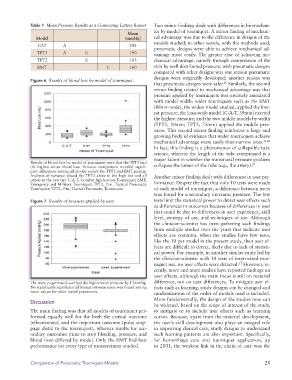
Table 1  Mean Pressure Results as a Connecting Letters Report  Two minor findings dealt with differences in biomechan-
                                                      Mean       ics by model of tourniquet. A minor finding of mechani-
                Model                                (mmHg)      cal advantage was due to the difference in designs of the
                 CAT       A                          202        models studied; in other words, with the methods used,
                                                                 pneumatic designs were able to achieve mechanical ad-
                TPT3       A        B                 190        vantage more easily. The greater ease of achieving me-
                TPT2                B                 183        chanical advantage, namely through compression of the
                EMT                          C        160        skin by well-distributed pressure, with pneumatic designs
                                                                 compared with other designs was one reason pneumatic
                                                                 designs were  originally  developed;  another  reason  was
              Figure 6  Results of blood loss by model of tourniquet.
                                                                 that pneumatic designs were safer.  Similarly, the second
                                                                                             26
                                                                 minor finding related to mechanical advantage was that
                                                                 pressure applied by tourniquets was inversely associated
                                                                 with model width: wider tourniquets such as the EMT
                                                                 (88mm wide), the widest model studied, applied the low-
                                                                 est pressure; the least-wide model (C-A-T, 39mm) exerted
                                                                 the highest pressure; and the two middle models by width
                                                                 (TPT2, 50mm; TPT3, 75mm) applied the middle pres-
                                                                 sures. This second minor finding reinforces a large and
                                                                 growing body of evidence that wider tourniquets achieve
                                                                 mechanical advantage more easily than narrow ones. 14,26
                                                                 In fact, this finding is a phenomenon of collapsible tube
                                                                 science, wherein the length of the tube compressed is a
                                                                 major factor in whether the transmural pressure gradient
              Results of blood loss by model of tourniquet were that the TPT3 had                        27
              the highest mean blood loss. Pairwise comparison revealed signifi-  collapses the lumen of the tube (e.g., the artery).
              cant differences among all models except the TPT2 and EMT pairing.
              Analysis of variance placed the TPT3 alone in the high tier and all   Another minor finding dealt with differences in user per-
              others in the low tier. C-A-T, Combat Application Tourniquet; EMT,
              Emergency and Military Tourniquet; TPT2, 2-in. Tactical Pneumatic   formance. Despite the fact that only 10 tests were made
              Tourniquet; TPT3, 3-in. Tactical Pneumatic Tourniquet.  of each model of tourniquet, a difference between users
                                                                 was found for a secondary outcome, pressure. The few
              Figure 7  Results of pressure applied by user.     tests limit the statistical power to detect user effects such
                                                                 as differences in outcomes because of differences in user
                                                                 that could be due to differences in user experience, skill
                                                                 level, strategy of use, and techniques of use. Although
                                                                 the clinician-scientist has been gathering such findings
                                                                 from multiple studies over the years that indicate user
                                                                 effects are common, when the studies have few tests,
                                                                 like the 10 per model in the present study, then user ef-
                                                                 fects are difficult to detect, likely due to lack of statisti-
                                                                 cal power. For example, in another similar study led by
                                                                 the clinician-scientist with 10 tests of improvised tour-
                                                                 niquet use, no user effects were detected.  However, re-
                                                                                                    23
                                                                 cently, more and more studies have reported findings on
                                                                 user effects, although the main focus is still on materiel
              The more-experienced user had the higher mean pressure by 13mmHg.   difference, not on user differences. To mitigate user ef-
              No statistically significant difference between users was found among   fects such as learning, study designs can be changed and
              mean values for other tested parameters.           randomization of the order of models used is included.
                                                                 More fundamentally, the design of the studies now can
              Discussion
                                                                 be widened, based on the scope of interest of the study,
              The main finding was that all models of tourniquet per-  to mitigate or to include user effects such as learning
              formed equally well for the both the critical outcome   curves. Because, apart from the materiel development,
              (effectiveness) and the important outcome (pulse stop-  the user’s skill development also plays an integral role
              page distal to the tourniquet), whereas results for sec-  in improving clinical care, study designs to understand
              ondary outcomes (time to stop bleeding, pressure, and   such learning patterns are also important. Specifically,
              blood loss) differed by model. Only the EMT had best   for hemorrhage care and tourniquet application, up
              performance for every type of measurement studied.  to 2001, the weakest link in the chain of care was the


              Comparison of Pneumatic Tourniquet Models                                                       25

