


Page 36 - Journal of Special Operations Medicine - Summer 2016
P. 36
Data were gathered  from February  to August 2014.   cover  is  snapped  into  the  receiving  hook  and  excess
          The three pneumatic tourniquet models tested were the   slack in the outer cover is pulled and secured down onto
          Emergency and Military Tourniquet (EMT; Delfi Medi-  itself upon its surfaces of self-adhering hooks and loops.
          cal Innovations, http://www.delfimedical.com) and two   The tourniquet is then inflated by squeezing the infla-
          Tactical Pneumatic Tourniquet (TPT) models differing   tion bulb repeatedly. Opening the pressure valve deflates
          in width: 2 in. (50.8mm; TPT2) and 3 in. (76.2mm;   the bladder. At the time of assessment, the TPTs were
          TPT3) (Alphapointe, https://www.alphapointe.org).  not registered with the FDA (Figure 2).

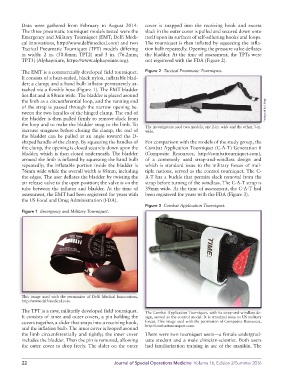
          The EMT is a commercially developed field tourniquet.   Figure 2  Tactical Pneumatic Tourniquet.
          It consists of a heat-sealed, black nylon, inflatable blad-
          der; a clamp; and a hand bulb inflator permanently at-
          tached via a flexible hose (Figure 1). The EMT bladder
          lies flat and is 88mm wide. The bladder is placed around
          the limb as a circumferential loop, and the running end
          of the strap is passed through the narrow opening be-
          tween the two handles of the hinged clamp. The end of                                                Photograph by J. Kragh
          the bladder is then pulled firmly to remove slack from
          the loop and to make the bladder snug to the limb. To   The investigators used two models, one 2-in. wide and the other, 3-in.
          increase snugness before closing the clamp, the end of   wide.
          the bladder can be pulled at an angle toward the D-
          shaped handle of the clamp. By squeezing the handles of   For comparison with the models of the study group, the
          the clamp, the opening is closed securely down upon the   Combat Application Tourniquet (C-A-T) Generation 6
          bladder, which is then closed underneath. The bladder   (Composite Resources,  http://combattourniquet.com),
          around the limb is inflated by squeezing the hand bulb   of a commonly used strap-and-windlass design and
          repeatedly; the inflatable portion inside the bladder is   which is standard issue to the military forces of mul-
          76mm wide while the overall width is 88mm, including   tiple nations, served as the control tourniquet. The C-
          the edges. The user deflates the bladder by twisting the   A-T has a buckle that permits slack removal from the
          air release valve to the open position; the valve is on the   strap before turning of the windlass. The C-A-T strap is
          tube between the inflator and bladder. At the time of   39mm wide. At the time of assessment, the C-A-T had
          assessment, the EMT had been registered for years with   been registered for years with the FDA (Figure 3).
          the US Food and Drug Administration (FDA).
                                                             Figure 3  Combat Application Tourniquet.
          Figure 1  Emergency and Military Tourniquet.


          This image used with the permission of Delfi Medical Innovations,
          http://www.delfimedical.com.
          The TPT is a new, militarily developed field tourniquet.   The Combat Application Tourniquet, with its strap-and-windlass de-
          It consists of inner and outer covers, a pin holding the   sign, served as the control model. It is standard issue to US military
          covers together, a slider that snaps into a receiving hook,   forces. This image used with the permission of Composite Resources,
          and the inflation bulb. The inner cover is looped around   http://combattourniquet.com.
          the limb circumferentially and tightly; the inner cover   There were two tourniquet users—a female undergrad-
          includes the bladder. Then the pin is removed, allowing   uate student and a male clinician-scientist. Both users
          the outer cover to drop freely. The slider on the outer   had familiarization training in use of the manikin. The


          22                                    Journal of Special Operations Medicine  Volume 16, Edition 2/Summer 2016

