


Page 24 - Journal of Special Operations Medicine - Summer 2016
P. 24
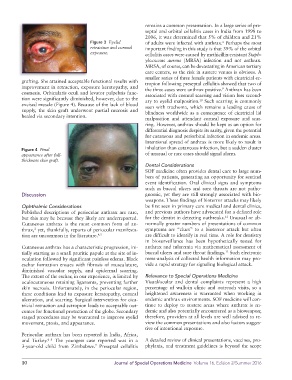
remains a common presentation. In a large series of pre-
                                                             septal and orbital cellulitis cases in India from 1998 to
                                                             2006, it was determined that 5% of children and 21%
                                      Figure 3  Eyelid       of adults were infected with anthrax.  Perhaps the most
                                                                                             6
                                      retraction and corneal   important finding in this study is that 39% of the orbital
                                      exposure.              cellulitis cases were caused by methicillin-resistant Staph-
                                                             ylococcus aureus (MRSA) infection and not anthrax.
                                                             MRSA, of course, can be devastating in American tertiary
                                                             care centers, so the risk in austere venues is obvious. A
                                                             smaller series of three female patients with cicatricial ec-
          grafting. She attained acceptable functional results with   tropion following preseptal cellulitis showed that two of
          improvement in retraction, exposure keratopathy, and   the three cases were anthrax positive.  Anthrax has been
                                                                                             9
          cosmesis. Orbicularis oculi and levator palpebris func-  associated with corneal scarring and vision loss second-
          tion were significantly diminished, however, due to the   ary to eyelid malposition.  Such scarring is commonly
                                                                                   10
          excised muscle (Figure 4). Because of the lack of blood   seen with trachoma, which remains a leading cause of
          supply, the skin graft underwent partial necrosis and   blindness worldwide as a consequence of cicatricial lid
          healed via secondary intention.                    malposition and attendant corneal exposure and scar-
                                                             ring. However, anthrax should be kept as an option for
                                                             differential diagnosis despite its rarity, given the potential
                                                             for cutaneous and periorbital infection in endemic areas.
                                                             Intentional spread of anthrax is more likely to result in
          Figure 4  Final                                    inhalation than cutaneous infection, but a sudden cluster
          appearance after full-                             of unusual or rare cases should signal alarm.
          thickness skin graft.
                                                             Dental Considerations
                                                             SOF medicine often provides dental care to large num-
                                                             bers of patients, generating an opportunity for sentinel
                                                             event identification. Oral clinical signs and symptoms
                                                             such as buccal ulcers and sore throats are not patho-
          Discussion                                         gnomic, yet they are still strongly associated with bio-
                                                             weapons. These findings of bioterror attacks may likely
          Ophthalmic Considerations                          be first seen in primary care medical and dental clinics,
          Published  descriptions  of  periocular  anthrax  are  rare,   and previous authors have advocated for a defined role
          but this may be because they likely are underreported.   for the dentist in detecting outbreaks.  Unusual or ab-
                                                                                              11
          Cutaneous  anthrax  is  the  most  common  form  of  an-  normally greater numbers of presentations of common
          thrax,  yet, thankfully, reports of periocular manifesta-  symptoms are “clues” to a bioterror attack but often
               2
          tion are uncommon in the literature. 4,5           are difficult to identify in real time. A role for dentistry
                                                             in biosurveillance has been hypothetically tested for
          Cutaneous anthrax has a characteristic progression, ini-  anthrax and tularemia via mathematical assessment of
          tially starting as a small pruritic papule at the site of in-  buccal ulcers and sore throat findings.  Such electronic
                                                                                              12
          oculation followed by significant painless edema. Black   meta-analysis of collected health information may pro-
          eschar formation ensues with fibrosis of musculature,   vide a rapid strategy for signaling biological attack.
          diminished vascular  supply, and epidermal scarring.
          The extent of the eschar, in our experience, is limited by   Relevance to Special Operations Medicine
            oculocutaneous retaining ligaments, preventing further   Visual/ocular and dental complaints represent a high
          skin necrosis. Unfortunately, in the periocular region,   percentage of walk-in clinic and outreach visits, so a
          these conditions lead to exposure keratopathy, corneal   heightened  awareness  is warranted  when  working  in
          ulceration, and scarring. Surgical intervention for cica-  endemic anthrax environments. SOF medicine will con-
          tricial retraction and ectropion leads to acceptable out-  tinue to deploy to austere areas where anthrax is en-
          comes for functional protection of the globe. Secondary   demic and also potentially encountered as a bioweapon;
          staged procedures may be warranted to improve eyelid   therefore, providers at all levels are well advised to re-
          movement, ptosis, and appearance.                  view the common presentations and also factors sugges-
                                                             tive of intentional exposure.
          Periocular anthrax has been reported in India, Africa,
          and  Turkey.   The  youngest  case  reported  was  in  a   A detailed review of clinical presentations, vaccines, pro-
                     6–8
          3-year-old child from Zimbabwe.  Preseptal cellulitis   phylaxis, and treatment guidelines is beyond the scope
                                        7

          10                                    Journal of Special Operations Medicine  Volume 16, Edition 2/Summer 2016

