


Page 23 - Journal of Special Operations Medicine - Summer 2016
P. 23
Case Report of an Anthrax Presentation
                                 Relevant to Special Operations Medicine


                                  Stephen Winkler, MD; Robert W. Enzenauer, MD, MPH;
                         James W. Karesh, MD; Nshimyimana Pasteur, MD; Derek L. Eisnor, MD;
                                  Rex B. Painter, DDS; Christopher J. Calvano, MD, PhD


              ABSTRACT

              Special Operations Forces (SOF) medical personnel   Clinical Case
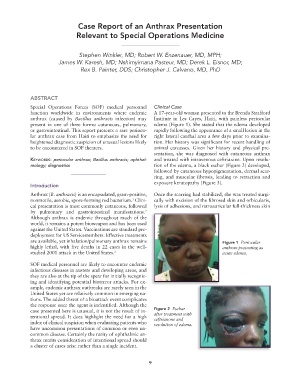
              function worldwide in environments  where endemic   A 17-year-old woman presented to the Brenda Strafford
              anthrax (caused by  Bacillus anthracis infection) may   Institute in Les Cayes, Haiti, with painless periocular
              present in one of three forms: cutaneous, pulmonary,   edema (Figure 1). She stated that the edema developed
              or gastrointestinal. This report presents a rare periocu-  rapidly following the appearance of a small lesion in the
              lar anthrax case from Haiti to emphasize the need for   right lateral canthal area a few days prior to examina-
              heightened diagnostic suspicion of unusual lesions likely   tion. Her history was significant for recent handling of
              to be encountered in SOF theaters.                 animal carcasses. Given her history and physical pre-
                                                                 sentation, she was diagnosed with cutaneous anthrax
              Keywords: periocular anthrax; Bacillus anthracis; ophthal-  and treated with intravenous ceftriaxine. Upon resolu-
              mology; diagnostics                                tion of the edema, a black eschar (Figure 2) developed,
                                                                 followed by cutaneous hypopigmentation, dermal scar-
                                                                 ring, and muscular fibrosis, leading to retraction and
                                                                 exposure keratopathy (Figure 3).
              Introduction
              Anthrax (B. anthracis) is an encapsulated, gram-positive,   Once the scarring had stabilized, she was treated surgi-
              nonmotile, aerobic, spore-forming rod bacterium.  Clini-  cally with excision of the fibrosed skin and orbicularis,
                                                        1
              cal presentation is most commonly cutaneous, followed   lysis of adhesions, and retroauricular full-thickness skin
              by pulmonary and gastrointestinal manifestations.
                                                             2
              Although anthrax  is endemic throughout much of the
              world, it remains a potent bioweapon and has been used
              against the United States. Vaccinations are standard pre-
              deployment for US Servicemembers. Effective treatments
              are available, yet inhalation/pulmonary anthrax remains                        Figure 1  Periocular
              highly lethal, with five deaths in 22 cases in the well-                       anthrax presenting as
              studied 2001 attack in the United States. 3                                    acute edema.

              SOF medical personnel are likely to encounter endemic
              infectious diseases in austere and developing areas, and
              they are also at the tip of the spear for initially recogniz-
              ing and identifying potential bioterror attacks. For ex-
              ample, endemic anthrax outbreaks are rarely seen in the
              United States yet are relatively common in emerging na-
              tions. The added threat of a bioattack event complicates
              the response once the agent is indentified. Although the
              case presented here is unusual, it is not the result of in-  Figure 2  Eschar
                                                                 after treatment with
              tentional spread. It does highlight the need for a high   ceftriaxone and
              index of clinical suspicion when evaluating patients who   resolution of edema.
              have uncommon presentations of common or even un-
              common disease. Certainly the rarity of ophthalmic an-
              thrax merits consideration of intentional spread should
              a cluster of cases arise rather than a single incident.


                                                               9

