


Page 68 - Journal of Special Operations Medicine - Spring 2016
P. 68
surgical elements in western Afghanistan from 17 Feb-  SPSS Statistics, version 22 (IBM Corp.; http://www.ibm
          ruary 2012 through 15 August 2012. However, due to   .com). Vital signs were compared using a Pearson corre-
          mission requirements, one of the sites was only able   lation to compare individuals over time. Data are given
          to participate until 12 April 2012. All patients treated   as mean ± standard deviation unless otherwise indi-
          at the three facilities were included; however, patients   cated. A p-value of less than .05 was considered statisti-
          without a NATO 9-line or MIST report were excluded   cally significant. Triage accuracy was determined using
          from subsequent analysis. This study was approved as a   a kappa statistic. Interpretation of the kappa statistic (k)
          performance improvement project by the Human Pro-  was made using the method of Landis and Koch. 5
          tections Administrator for the Joint Combat Casualty
          Research Team.
                                                             Results
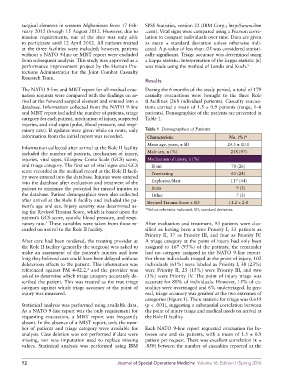
          The NATO 9-line and MIST report for all medical evac-  During the 6 months of the study period, a total of 179
          uation requests were compared with the findings on ar-  casualty evacuations were brought to the three Role
          rival at the forward surgical element and entered into a   II facilities (268 individual patients). Casualty evacua-
          database. Information collected from the NATO 9-line   tions carried a mean of 1.5 ± 0.9 patients (range, 1–6
          and MIST report included the number of patients, triage   patients). Demographics of the patients are presented in
          category for each patient, mechanism of injury, suspected   Table 1.
          injuries, and vital signs (pulse, blood pressure, and respi-
          ratory rate). If updates were given while en route, only   Table 1  Demographics of Patients
          information from the initial report was recorded.   Characteristic                    No. (%)*
                                                              Mean age, years, ± SD            24.5 ± 10.1
          Information collected after arrival at the Role II facility
          included the number of patients, mechanism of injury,   Male sex, n (%)               258 (97)
          injuries, vital signs, Glasgow Coma Scale (GCS) score,   Mechanism of injury, n (%)
          and triage category. The first set of vital signs and GCS     Blunt                    70 (26)
          score recorded in the medical record at the Role II facil-    Penetrating              65 (24)
          ity were entered into the database. Injuries were entered
          into the database after evaluation and treatment of the     Explosion/blast           117 (44)
          patient to minimize the potential for missed injuries in     Burn                        9 (3)
          the database. Patient demographics were also collected     Other                         7 (3)
          after arrival at the Role II facility and included the pa-  Revised Trauma Score ± SD  11.2 ± 2.0
          tient’s age and sex. Injury severity was determined us-
          ing the Revised Trauma Score, which is based upon the   *Unless otherwise indicated. SD, standard deviation.
          patient’s GCS score, systolic blood pressure, and respi-
          ratory rate.  These variables were taken from those re-  After evaluation and treatment, 93 patients were clas-
                    3
          corded on arrival to the Role II facility.         sified as having been a true Priority I, 33 patients as
                                                             Priority II, 37 as Priority III, and four as Priority IV.
          After care had been rendered, the treating provider at   A triage category at the point of injury had only been
          the Role II facility (generally the surgeon) was asked to   assigned to 167 (93%) of the patients; the remainder
          make an assessment of the patient’s injuries and how   had no category assigned in the NATO 9-line report.
          long they believed care could have been delayed without   For those individuals triaged at the point of injury, 102
          deleterious effects to the patient. This information was   individuals (61%) were labeled as Priority I, 38 (23%)
          referenced against FM 4-02.2,  and the provider was   were  Priority II, 25  (15%) were Priority  III, and two
                                     4
          asked to determine which triage category accurately de-  (1%) were Priority IV. The point of injury triage was
          scribed the patient. This was treated as the true triage   accurate for 80% of individuals. However, 15% of ca-
          category against which triage accuracy at the point of   sualties were overtriaged and 6% undertriaged. In gen-
          injury was measured.                               eral, triage accuracy was greatest at the two extremes of
                                                             categories (Figure 1). The k statistic for triage was 0.619
          Statistical analysis was performed using available data.   (p < .001), suggesting a substantial correlation between
          As a NATO 9-line report was the only requirement for   the point of injury triage and medical needs on arrival at
          requesting  evacuation,  a  MIST report  was  frequently   the Role II facility.
          absent. In the absence of a MIST report, only the num-
          ber  of  patients  and  triage  category  were  available  for   Each NATO 9-line report requested evacuation for be-
          analysis. Case deletion was not performed if data were   tween one and six patients, with a mean of 1.5 ± 0.9
          missing, nor was imputation used to replace missing   patient per request. There was excellent correlation (k =
            values.  Statistical  analysis  was  performed  using  IBM   .850) between the number of casualties reported at the


          52                                      Journal of Special Operations Medicine  Volume 16, Edition 1/Spring 2016

