


Page 155 - Journal of Special Operations Medicine - Winter 2015
P. 155
next 18 months. Since March 2013, the FBI has hosted   every shift. Another challenge is how hospital emer-
              response workshops for more than 64,000 police com-  gency and surgical services will receive victims of active
              manders from more than 4,000 agencies.  The FBI’s 56   shooter incidents in areas of the country where trauma
                                                 6
              field offices hosted active shooter workshops for more   systems are resource or geographically challenged.
              than  1,800  police  agencies.  More  than  1,000  leaders
              of public safety agencies at all levels of government at-  Changes of this magnitude require considerable support
              tended tabletop exercises in active shooter response.   from public safety and health system authorities and
              Within the FBI itself, first aid training emphasizing hem-  other community leaders. As the sentinel events at Col-
              orrhage control has been extended to all 13,000 special   umbine, Fort Hood, Tucson, Sandy Hook, and Aurora
              agents. Similar programs by police organizations, such   each recede from the memory of the public and of gov-
              as the Major Cities Chiefs Police Association and oth-  ernment officials, there is a tendency to assign decreased
              ers, have reached many tens of thousands more officers. 7  priority to these low probability-high consequence in-
                                                                 cidents.  This  attitude  is  understandable,  as  the  daily
                                                                 challenges of routine operations demand continued at-
                These violent acts occur in communities          tention. However, it is important to remain mindful of
                of all sizes throughout the country and          the continued presence of the threat of intentional mass
                appear to be increasing in frequency.            casualty attacks in the U.S.

                                                                 Since Columbine in 1999, active shooter incidents have
              The initiatives taken by the law enforcement community   become more frequent. In the eight-year period after
              have encouraged similar work in the emergency medical   Columbine, an average of five active shooter events oc-
              and fire rescue services. In September 2013, following   curred per year. Since 2009, that figure has increased
              collaboration with leaders of public safety agencies and   threefold.  A recent study by the Texas State University
                                                                         10
              professional organizations, the U.S. Fire Administration   (TSU), San Marcos, conducted in concert with the De-
              released detailed operational guidance for local develop-  partment of Justice, was based on police reports, public
              ment of fire service and emergency medical and rescue   records, and media reports for 2000–2012.  The in-
                                                                                                        11
              services  active  shooter  response  plans.   Following  the   creased frequency of incidents seen in this study is not
                                                8
              Boston Marathon bombing in April 2013, this project   explained by changes in case definition or solely on the
              expanded its scope to include similar contingencies.   basis of increased case reporting. Characteristics of ac-
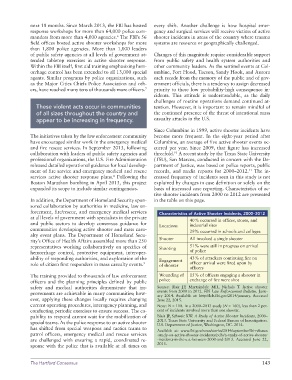
                                                                 tive shooter incidents from 2000 to 2012 are presented
              In addition, the Department of Homeland Security spon-  in the table on this page.
              sored collaboration by authorities in medicine, law en-
              forcement, fire/rescue, and emergency medical services   Characteristics of Active Shooter Incidents, 2000–2012
              at all levels of government with specialists in the private      40% occurred in offices, stores, and
              and public sectors to develop consensus guidance for   Locations  industrial sites
              communities developing active shooter and mass casu-             29% occurred in schools and colleges
              alty event plans. The Department of Homeland Secu-
              rity’s Office of Health Affairs assembled more than 250   Shooter  All involved a single shooter
              representatives working collaboratively on specifics of   Shooting  51% were still in progress on arrival
              hemorrhage control, protective equipment, interoper-             of police
              ability of responding authorities, and exploration of the   Engagement   43% of attackers continuing fire on
              role of citizen first responders in mass casualty events. 9  of shooter  officer arrival were fired upon by
                                                                               officers
              The training provided to thousands of law enforcement   Wounding of   15% of officers engaging a shooter in
              officers and the planning principles defined by public   police  exchange of fire were shot
              safety and medical authorities demonstrate that im-  Source: Blair JP, Martaindale MH, Nichols T. Active shooter
              provements are achievable in many communities; how-  events from 2000 to 2012. FBI Law Enforcement Bulletin. Janu-
                                                                  ary 2014. Available at: http://leb.fbi.gov/2014/january. Accessed
              ever, applying these changes locally requires changing   June 22, 2015.
              current operating procedures, interagency planning, and   Note: N = 110. In a 2000–2013 study (N = 160), less than 2 per-
              conducting periodic exercises to ensure success. The ca-  cent of incidents involved more than one shooter.
              pability to respond cannot wait for the mobilization of   Blair JP, Schweit KW. A Study of Active Shooter Incidents, 2000–
              special teams. As the police response to an active shooter   2013. Texas State University and Federal Bureau of Investigation.
                                                                  U.S. Department of Justice, Washington, DC. 2014.
              has shifted from special weapons and tactics teams to   Available at: www.fbi.gov/news/stories/2014/september/fbi-releases
              patrol officers, emergency medical and rescue services   -study-on-active-shooter-incidents/pdfs/a-study-of-active-shooter
              are challenged with ensuring a rapid, coordinated re-  -incidents-in-the-u.s.-between-2000-and-2013. Accessed June 22,
              sponse with the police that is available at all times on   2015.


              The Hartford Consensus                                                                         143

