


Page 159 - Journal of Special Operations Medicine - Winter 2015
P. 159
reviewed  the  impact  of  conducted  energy  weapons   no one else was injured, provided care to those who
              programs,  and described the fundamental principles   were injured, and ultimately ensured that the only loss
                      2
              of civilian-sector tactical EMS.  Other writers have de-  of life that day was that of the suspect. Even in times of
                                        3
              scribed attempts to prevent in-custody death by involve-  utmost crisis, LEOs are capable not only of performing
              ment of the medical examiner   and attempts to codify   traditional duties but also of providing care to individu-
                                        4
              the role of the law enforcement agency members as med-  als around them. Because of the dynamic nature of an
              ical first responders. 5                           incident like that one, with two distinct scenes, continu-
                                                                 ing gunfights, multiple IEDs, and multiple business and
              Hemorrhage Control and the                         residential occupancies at risk, the scene is simply in-
              Law Enforcement Officer                            accessible to non-law enforcement responders such as
              It would be optimal to have a trauma surgeon at the side   EMS and fire and rescue services. Had there been more
              of every officer at the time of wounding, but that clearly   injuries, care would have been the responsibility of the
              is not feasible. Law enforcement physicians have been   DPD officers there. What remains clear is that the care
              instrumental in pushing medical techniques previously   described in the Hartford Consensus represents the best
              thought to be used only by certified medical providers   response in the unique nexus of the roles of law enforce-
              out to individuals with mere basic training. The transla-  ment, trauma surgery, and public health.
              tion of these skills from medical textbooks to wide ap-
              plicability and their implementation by non-traditional
              responders have saved and will continue to save lives.   DALLAS POLICE DEPARTMENT
              Based on principles established in the Tactical Combat   DOWNED OFFICER KIT CONTENTS
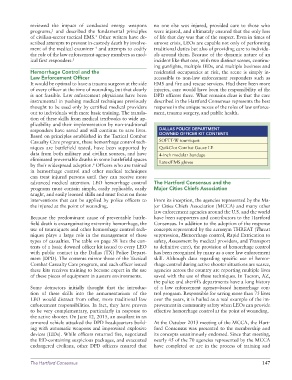
              Casualty Care program, these hemorrhage control tech-  SOFTT-W tourniquet
              niques are battlefield tested, have been supported by   QuikClot Combat Gauze LE
              data from both military and civilian sources, and have   4-inch modular bandage
              eliminated preventable deaths in some battlefield spaces   Latex/EMS gloves
              by their widespread adoption.  Officers who are trained
                                       6
              in hemorrhage control and other medical techniques
              can treat injured persons until they can receive more
              advanced medical attention. LEO hemorrhage control   The Hartford Consensus and the
              programs must contain simple, easily replicable, easily   Major Cities Chiefs Association
              taught, and easily learned skills and must focus on those
              interventions that can be applied by police officers to   From its inception, the agencies represented by the Ma-
              the injured at the point of wounding.              jor Cities Chiefs Association (MCCA) and many other
                                                                 law enforcement agencies around the U.S. and the world
              Because the predominant cause of preventable battle-  have been supporters and contributors to the Hartford
              field death is exsanguinating extremity hemorrhage, the   Consensus. In addition to the adoption of the response
              use of tourniquets and other hemorrhage control tech-  concepts represented by the acronym THREAT (Threat
              niques plays  a large  role in the  management  of these   suppression, Hemorrhage control, Rapid Extrication to
              types of casualties. The table on page 58 lists the con-  safety, Assessment by medical providers, and Transport
              tents of a basic downed officer kit issued to every LEO   to definitive care), the provision of hemorrhage control
              with public contact in the Dallas (TX) Police Depart-  has been recognized by many as a core law enforcement
              ment (DPD). The contents mirror those of the Tactical   skill. Although data regarding specific use of hemor-
              Combat Casualty Care program, and each officer issued   rhage control during active shooter situations are scarce,
              these kits receives training to become expert in the use   agencies across the country are reporting multiple lives
              of these pieces of equipment in austere environments.   saved with the use of these techniques. In Tucson, AZ,
                                                                 the police and sheriff’s departments have a long history
              Some detractors initially thought that the introduc-  of a law enforcement agency–based hemorrhage con-
              tion of these skills into the armamentarium of the   trol program. Responsible for saving more than 75 lives
              LEO would distract from other, more traditional law   over the years, it is hailed as a real example of the im-
              enforcement responsibilities. In fact, they have proven   provement in community safety when LEOs can provide
              to be very complementary, particularly in response to   effective hemorrhage control at the point of wounding.
              the active shooter. On June 12, 2015, an assailant in an
              armored vehicle attacked the DPD headquarters build-  At the October 2013 meeting of the MCCA, the Hart-
              ing with automatic weapons and improvised explosive   ford Consensus was presented to the membership and
              devices (IEDs). While officers returned fire, negotiated   its concepts unanimously endorsed. Since that meeting,
              the IED-containing suspicious packages, and evacuated   nearly 45 of the 70 agencies represented by the MCCA
              endangered civilians, other DPD officers ensured that   have  completed  or  are  in  the  process  of  training  and


              The Hartford Consensus                                                                         147

