


Page 164 - Journal of Special Operations Medicine - Winter 2015
P. 164
5.  Holcomb JB, McMullen NR, Pearse L, et al. Causes of death
            At this time, the U.S. military has more            in special operations forces in the global war on terror. Ann
                                                                Surg. 2007;245(6):986–991.
            experience with combat tourniquets                 6.  Walters TJ, Wenke JC, Greydanus DJ, Kauver DS, Baer DG.
            than any military force in history . . .            Laboratory Evaluation of Battlefield Tourniquets in Human
                                                                Volunteers. USAISR Report 2005–05. San Antonio, TX: U.S.
                                                                Army Institute of Surgical Research; 2005.
                                                               7.  Butler FK, Greydanus D, Holcomb J. Combat Evaluation of
          bringing about the highest casualty survival rate in his-  TCCC Techniques and Equipment: 2005. USAISR Report
          tory: our courageous combat medical personnel, who    2006–01. San Antonio, TX: U.S. Army Institute of Surgical
          perform amazing feats of medical care in the midst of the   Research; November 2006.
          battle; the helicopter evacuation crews, who willingly     8.  Kragh JF, Walters TJ, Baer DG, et al. Practical use of emer-
          risk their lives over and over to evacuate our casualties   gency tourniquets to stop bleeding in major limb trauma. J
                                                                Trauma. 2008;64(suppl 2):S38–S50.
          to safety; the superbly skilled surgical and intensive care     9.  Eastridge BJ, Mabry RL, Seguin P, et al. Prehospital death
          teams in our hospitals; the Critical Care Air Transport   on the battlefield (2001–2011): Implications for the future of
          Teams that fly desperately  ill casualties  thousands of   combat casualty care. J Trauma Acute Care Surg. 2012;73(6
          miles to higher levels of care; the rehabilitation special-  suppl 5):S431–S437.
          ists, who enable our casualties to maximize their recov-  10.  Holcomb JB, Stansbury LG, Champion HR, Wade C, Bellamy
                                                                RF. Understanding combat casualty care statistics. J Trauma.
          ery of life skills and function despite their injuries; and   2006;60(2):1–5.
          finally, the professionals at the Joint Trauma System,   11.  Kotwal RS, Montgomery HR, Kotwal BM, et al. Elimi-
          who work ceaselessly to provide oversight of the entire   nating preventable death on the  battlefield.  Arch Surgery.
          system and make it function smoothly. To all these men   2011;146(12):1350–1358.
          and women, our nation owes a great debt.           12.  Wedmore I, McManus JG, Pusateri AE, Holcomb JB. A spe-
                                                                cial report on the chitosan-based hemostatic dressing: expe-
                                                                rience in current combat operations. J Trauma. 2006;60(3):
          Because most combat fatalities occur in the prehospital   655–658.
          phase of care, our nation’s combat medical providers   13.  Rhee P, Brown C, Martin M, et al. QuikClot use in trauma
          play an especially important role in ensuring the high-  for hemorrhage control: case series of 103 documented uses.
                                                                J Trauma.  2008;64(4):1093–1099.
          est casualty-survival rate possible. The TCCC has given   14.  Kheirabadi B, Mace J, Terrazas I, et al. Safety evaluation of
          these individuals a vastly improved set of tools and skills   new hemostatic agents, smectite granules, and kaolin-combat
          to  better  accomplish  their  heroic  and  lifesaving  deeds   gauze in a vascular injury wound model in swine. J Trauma.
          on the battlefield, and tourniquets and hemostatic dress-  2010;68(2):269–278.
          ings are now a permanent fixture in their aid bags.  15.  Ran Y, Hadad E, Daher S, et al. QuikClot combat gauze for
                                                                hemorrhage control in military trauma: January 2009 Israel
                                                                Defense Force experience in the Gaza Strip—a preliminary re-
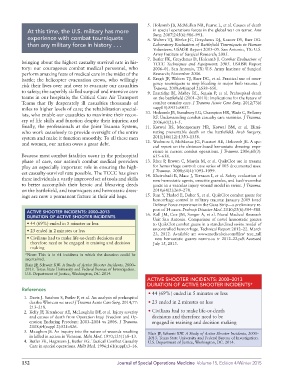
            ACTIVE SHOOTER INCIDENTS: 2000–2013                 port of 14 cases. Prehosp Disaster Med. 2010;25(6):584–588.
            DURATION OF ACTIVE SHOOTER INCIDENTS             16.  Rall JM, Cox JM, Songer A, et al. Naval Medical Research
                                                                Unit San Antonio. Comparison of novel hemostatic gauzes
            • 44 (69%) ended in 5 minutes or less               to QuikClot combat gauze in a standardized swine model of
            • 23 ended in 2 minutes or less                     uncontrolled hemorrhage. Technical Report 2012–22. March
                                                                23, 2012. Available at: www.medicalsci.com/files/ tccc_rall
            •  Civilians had to make life-or-death decisions and   _new_hemostatic_gauzes_namru-sa_tr_2012–22.pdf. Accessed
              therefore need to be engaged in training and decision   July 15, 2013.
              making
           *Note: This is in 64 incidents in which the duration could be
             ascertained.
           Blair JP, Schweit KW. A Study of Active Shooter Incidents, 2000–
           2013. Texas State University and Federal Bureau of Investigation.
           U.S. Department of Justice, Washington, DC. 2014.
                                                              ACTIVE SHOOTER INCIDENTS: 2000–2013
                                                              DURATION OF ACTIVE SHOOTER INCIDENTS*
          References
                                                              • 44 (69%) ended in 5 minutes or less
            1.  Davis J. Satahoo S, Butler F, et al. An analysis of prehospital
             deaths: Who can we save? J Trauma Acute Care Surg. 2014;77:   •  23 ended in 2 minutes or less
             213–218.
            2.  Kelly JF, Ritenhour AE, McLaughlin DF, et al. Injury severity   •  Civilians had to make life-or-death
             and causes of death from Operation Iraqi Freedom and Op-  decisions and therefore need to be
             eration Enduring Freedom: 2003–2004 vs 2006. J Trauma.   engaged in training and decision making
             2008;64(suppl 2):S21–S26.
            3.  Maughon JS. An inquiry into the nature of wounds resulting   Blair JP, Schweit KW. A Study of Active Shooter Incidents, 2000–
             in killed in action in Vietnam. Milit Med. 1970;135(1):8–13.  2013. Texas State University and Federal Bureau of Investigation.
            4.  Butler FK, Hagmann J, Butler EG. Tactical Combat Casualty   U.S. Department of Justice, Washington, DC. 2014.
             Care in special operations. Milit Med. 1996;161(suppl):3–16.


          152                                    Journal of Special Operations Medicine  Volume 15, Edition 4/Winter 2015

