


Page 168 - Journal of Special Operations Medicine - Winter 2015
P. 168
kits. Firefighters and law enforcement officers should
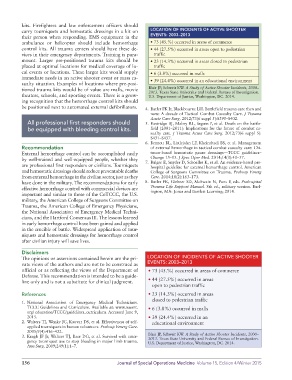
          carry tourniquets and hemostatic dressings in a kit on   LOCATION OF INCIDENTS OF ACTIVE SHOOTER
          their person when responding. EMS equipment in the   EVENTS: 2003–2013
          ambulance or helicopter should include hemorrhage    • 73 (45.%) occurred in areas of commerce
          control kits. All trauma centers should have these de-  •  44 (27.5%) occurred in areas open to pedestrian
          vices in their emergency departments. Training is para-  traffic
          mount. Larger pre-positioned trauma kits should be   •  23 (14.3%) occurred in areas closed to pedestrian
          placed at optimal locations for medical coverage of lo-  traffic
          cal events or locations. These larger kits would supply   • 6 (3.8%) occurred in malls
          immediate needs in an active shooter event or mass ca-  • 39 (24.4%) occurred in an educational environment
          sualty situation. Examples of locations where pre-posi-
          tioned trauma kits would be of value are malls, movie   Blair JP, Schweit KW. A Study of Active Shooter Incidents, 2000–
                                                              2013. Texas State University and Federal Bureau of Investigation.
          theaters, schools, and sporting events. There is a grow-  U.S. Department of Justice, Washington, DC. 2014.
          ing recognition that the hemorrhage control kits should
          be positioned next to automated external defibrillators.   4.  Butler FK Jr, Blackbourne LH. Battlefield trauma care then and
                                                               now: A decade of Tactical Combat Casualty Care. J Trauma
                                                               Acute Care Surg. 2012;73(6 suppl 5):S395–S402.
            All professional first responders should         5.  Eastridge BJ, Mabry RL, Seguin P, et al. Death on the battle-
            be equipped with bleeding control kits.            field (2001–2011): Implications for the future of combat ca-
                                                               sualty care. J Trauma Acute Care Surg. 2012;73(6 suppl 5):
                                                               S431–S437.
                                                             6.  Bennett BL, Littlejohn LF, Kheirabadi BS, et al. Management
          Recommendation                                       of external hemorrhage in tactical combat casualty care: Chi-
          External hemorrhage control can be accomplished easily   tosan-based hemostatic gauze dressings—TCCC guidelines–
                                                               Change 13–05. J Spec Oper Med. 2014;14(3):40–57.
          by well-trained and well-equipped people, whether they   7.  Bulger E, Snyder D, Schoelles K, et al. An evidence-based pre-
          are professional first responders or civilians. Tourniquets   hospital guideline for external hemorrhage control. American
          and hemostatic dressings should reduce preventable deaths   College of Surgeons Committee on Trauma.  Prehosp Emerg
          from external hemorrhage in the civilian sector, just as they   Care. 2014;18(2):163–173.
          have done in the military. The recommendations for early   8.  Butler FK, Giebner SD, McSwain N, Pons P, eds. Prehospital
          effective hemorrhage control with commercial devices are   Trauma Life Support Manual. 8th ed., military version. Burl-
                                                               ington, MA: Jones and Bartlett Learning; 2014.
          important and similar to those of the CoTCCC, the U.S.
          military, the American College of Surgeons Committee on
          Trauma, the American College of Emergency Physicians,
          the National Association of Emergency Medical Techni-
          cians, and the Hartford Consensus III. The lessons learned
          in early hemorrhage control have been gained and applied
          in the crucible of battle. Widespread application of tour-
          niquets and hemostatic dressings for hemorrhage control
          after civilian injury will save lives.

          Disclaimers
          The opinions or assertions contained herein are the pri-  LOCATION OF INCIDENTS OF ACTIVE SHOOTER
          vate views of the authors and are not to be construed as   EVENTS: 2003–2013
          official or as reflecting the views of the Department of   • 73 (45.%) occurred in areas of commerce
          Defense. This recommendation is intended to be a guide-
          line only and is not a substitute for clinical judgment.  •  44 (27.5%) occurred in areas
                                                                open to pedestrian traffic
          References                                          •  23 (14.3%) occurred in areas
                                                                closed to pedestrian traffic
          1.  National Association of Emergency Medical Technicians.
            TCCC Guidelines and Curriculum. Available at: www.naemt.  • 6 (3.8%) occurred in malls
            org/ education/TCCC/guidelines_curriculum. Accessed June 9,
            2015.                                             •  39 (24.4%) occurred in an
          2.  Walters TJ, Wenke JC, Kauvar DS, et al. Effectiveness of self-  educational environment
            applied tourniquets in human volunteers. Prehosp Emerg Care.
            2005;9(4):416–422.
          3.  Kragh JF Jr, Walters TJ, Baer DG, et al. Survival with emer-  Blair JP, Schweit KW. A Study of Active Shooter Incidents, 2000–
                                                              2013. Texas State University and Federal Bureau of Investigation.
            gency tourniquet use to stop bleeding in major limb trauma.   U.S. Department of Justice, Washington, DC. 2014.
            Ann Surg. 2009;249(1):1–7.


          156                                    Journal of Special Operations Medicine  Volume 15, Edition 4/Winter 2015

