


Page 153 - Journal of Special Operations Medicine - Winter 2015
P. 153
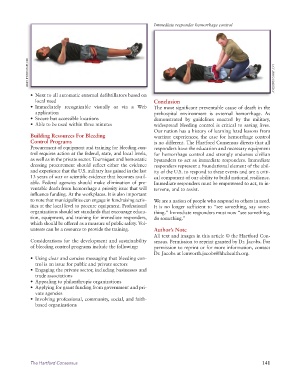
Immediate responder hemorrhage control


 ROUNDTABLE ON BYSTANDERS: OUR NATION’S IMMEDIATE RESPONDERS


             JAMES BROOKS HART, CMI                                                                               JAMES BROOKS HART, CMI


              •  Next to all automatic external defibrillators based on
                local need                                       Conclusion
              •  Immediately recognizable visually or via a Web   The most significant preventable cause of death in the
                  application                                    prehospital environment is external hemorrhage. As
              •  Secure but accessible locations                 demonstrated  by  guidelines  enacted  by the  military,
              •  Able to be used within three minutes            widespread bleeding control is critical to saving lives.
                                                                 Our nation has a history of learning hard lessons from
              Building Resources For Bleeding                    wartime experiences; the case for hemorrhage control
              Control Programs                                   is no different. The Hartford Consensus directs that all
              Procurement of equipment and training for bleeding con-  responders have the education and necessary equipment
              trol requires action at the federal, state, and local levels,   for hemorrhage control and strongly endorses civilian
              as well as in the private sector. Tourniquet and hemostatic   bystanders to act as immediate responders. Immediate
              dressing  procurement should  reflect  either  the evidence   responders represent a foundational element of the abil-
              and experience that the U.S. military has gained in the last   ity of the U.S. to respond to these events and are a criti-
              13 years of war or scientific evidence that becomes avail-  cal component of our ability to build national resilience.
              able.  Federal  agencies  should  make  elimination  of  pre-  Immediate responders must be empowered to act, to in-
              ventable death from hemorrhage a priority issue that will   tervene, and to assist.
              influence funding. At the workplaces. It is also important
              to note that municipalities can engage in fundraising activ-  We are a nation of people who respond to others in need.
              ities at the local level to procure equipment. Professional   It is no longer sufficient to “see something, say some-
              organizations should set standards that encourage educa-  thing.” Immediate responders must now “see something,
              tion, equipment, and training for immediate responders,   do something.”
              which should be offered as a measure of public safety. Vol-
              unteers can be a resource to provide the training.  Author’s Note
                                                                 All text and images in this article © the Hartford Con-
              Considerations for the development and sustainability   sensus. Permission to reprint granted by Dr. Jacobs. For
              of bleeding control programs include the following:  permission to reprint or for more information, contact
                                                                 Dr. Jacobs at lenworth.jacobs@hhchealth.org.
              •  Using clear and concise messaging that bleeding con-
                trol is an issue for public and private sectors
              •  Engaging the private sector, including businesses and
                trade associations
              •  Appealing to philanthropic organizations
              •  Applying for grant funding from government and pri-
                vate agencies
              •  Involving professional, community, social, and faith-
                based organizations


              The Hartford Consensus                                                                         141

