


Page 151 - Journal of Special Operations Medicine - Winter 2015
P. 151
The Hartford Consensus III recognizes the vital role that   training must be efficient and cost-effective. Ultimately,
              immediate responders play in responding to mass-casu-  integrated training exercises must be conducted that in-
 THE HARTFORD CONSENSUS III: IMPLEMENTATION OF BLEEDING CONTROL  alty events. They make major contributions to improv-  clude all levels of responders.
              ing survival from these incidents. However, the Hartford
              Consensus III does not advocate that members of the   Specific educational content for immediate responders
              public enter areas of direct threat or imminent danger.  should include:

              Good Samaritan laws have been effective in empower-  •  Actions to ensure personal safety
              ing the public to become involved in the immediate re-  •  Appropriate interactions with law enforcement, EMS/
              sponse to a victim of cardiac arrest or choking by the   fire/rescue, and medical personnel
              initiation of cardiopulmonary resuscitation and the   •  How to identify bleeding as a threat to life
              Heimlich maneuver, respectively. The Hartford Consen-  •  Use of hands to apply direct pressure
              sus recommends that these legal protections be extended   •  Proper use of safe and effective hemostatic dressings
              to include the provision of bleeding control.      •  Proper use of effective tourniquets
                                                                 •  Use of improvised tourniquets as a last resort
              Professional first responders
              Professional  first  responders  include  law  enforcement   For professional first responders, educational content
              and EMS/fire/rescue. As indicated by THREAT, law en-  should include:
              forcement must suppress the source of wounding if the
              shooter is still active and then, because they are usually   •  Actions to ensure personal safety
              the initial first responders on the scene, must act to con-  •  Coordination and integration of all responders
              trol external hemorrhage. Victims with life-threatening   •  Communication among all responders
              external bleeding must be treated immediately at the   •  Appropriate interactions with immediate responders
              point of wounding. All responders should be educated   •  Application of THREAT principles
              and have the necessary equipment to provide effective   •  Proper use of direct pressure
              external hemorrhage control. Continued emphasis must   •  Proper use of safe and effective hemostatic dressings
              be on the integration of the immediate responders, law   •  Proper use of effective tourniquets
              enforcement, and EMS/ fire/rescue to optimize rapid pa-
              tient assessment, treatment, and transport to definitive   It is appropriate to use existing national organizations
              care at the nearest appropriate hospital.          to widely disseminate the principles embodied in these
                                                                 education initiatives.
              Building Educational Capabilities
              Education in hemorrhage control can take many forms
              and should be offered using various modalities. Estab-
              lished education programs for individuals, communities,
              and professional responders can be modified to include
              effective external hemorrhage control techniques. The
              Bleeding Control for the Injured (B-Con) course offered
              by the National Association of Emergency Medical
              Technicians is an example of a newly created program
              that is appropriate for training individuals who have                                               JAMES BROOKS HART, CMI
              little or no medical background. Other methods such
              as public service announcements, slogans, advertising,
              and entertainment media should be used to convey the
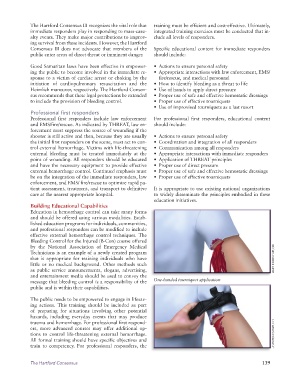
              message that bleeding control is a responsibility of the   One-handed tourniquet application
              public and is within their capabilities.

              The public needs to be empowered to engage in lifesav-
              ing actions. This training should be included as part
              of preparing for situations involving other potential
              hazards, including everyday events that may produce
              trauma and hemorrhage. For professional first respond-
              ers, more advanced courses may offer additional op-
              tions to control life-threatening external hemorrhage.                                              JAMES BROOKS HART, CMI
              All formal training should have specific objectives and
              train to competency. For professional responders, the


              The Hartford Consensus                                                                         139

