


Page 102 - Journal of Special Operations Medicine - Winter 2015
P. 102
dietary and supplemental protein because they believe   of approximately half the healthy population.  The
                                                                                                       13
          that the benefits of protein on muscle mass and, ulti-  RDA of protein (0.8g/kg BM) is intended to meet pro-
          mately, strength and performance, are endless.  There   tein requirements for about 98% of healthy people.
                                                                                                            13
                                                  7–9
          is also concern  that habitual consumption  of high-   The acceptable macronutrient distribution range for
          protein  diets,  even  in  healthy  adults,  adversely  affects   protein is 10% to 35% of total energy intake and is
          bone mineralization and kidney function, and may in-  the range of protein intake recommended to reduce the
          crease the likelihood of developing cardiovascular dis-  risk of developing a chronic condition due to under-
          ease, diabetes, and cancer. 10–12  Such beliefs and concerns   and overconsumption.  Military nutrition recommen-
                                                                                 13
          are often scientifically unfounded and serve only to con-  dations for protein are consistent with the IOM RDA
          fuse a population inundated with mixed messages re-  and military and sports nutrition recommendations for
          garding the optimal formulation of a healthy diet.  periods of increased metabolic demand (e.g., endurance
                                                             and  resistive-type  exercise,  underfeeding,  and  energy
          This purpose of this review is to provide the basics of   deficit). Recommendations are detailed in Army Regu-
          the US military dietary protein requirements. Similari-  lation (AR) 40-25/Navy Bureau of Medicine Instruction
          ties are discussed between US military policy and dietary   (BUMEDINST) 10110.6/Air Force Instruction (AFI) 44-
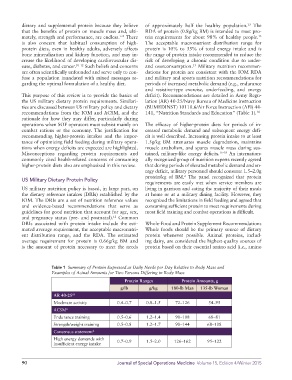
          recommendations from the IOM and ACSM, and the     141, “Nutrition Standards and Education” (Table 1). 14
          rationale for how they may differ, particularly during
          operations when SOF operators must subsist mainly on   The efficacy of higher-protein diets for periods of in-
          combat rations or the economy. The justification for   creased metabolic demand and subsequent energy defi-
          recommending higher-protein intakes and the impor-  cit is well described. Increasing protein intake to at least
          tance of optimizing field feeding during military opera-  1.5g/kg BM attenuates muscle degradation, maintains
          tions when energy deficits are expected are highlighted.   muscle anabolism, and spares muscle mass during sus-
          Misconceptions regarding protein requirements and   tained, military-like energy deficits. 15–18  An internation-
          commonly cited health-related concerns of consuming   ally recognized group of nutrition experts recently agreed
          higher-protein diets also are emphasized in this review.  that during periods of elevated metabolic demand and en-
                                                             ergy deficit, military personnel should consume 1.5–2.0g
                                                             protein/kg of BM.  The panel recognized that protein
                                                                             2
          US Military Dietary Protein Policy
                                                             requirements are easily met when service members are
          US military nutrition policy is based, in large part, on   living in garrison and eating the majority of their meals
          the dietary reference intakes (DRIs) established by the   at home or at a military dining facility. However, they
          IOM. The DRIs are a set of nutrition reference values   recognized the limitations in field feeding and agreed that
          and   evidence-based  recommendations  that  serve  as   consuming sufficient protein to meet requirements during
          guidelines for good nutrition that account for age, sex,   most field training and combat operations is difficult.
          and pregnancy status (pre- and postnatal).  Common
                                                13
          DRIs associated with protein intake include the esti-  Whole-Food and Protein Supplement Recommendations
          mated average requirement, the acceptable macronutri-  Whole foods should be the primary source of dietary
          ent distribution range, and the RDA. The estimated   protein whenever possible. Animal proteins, includ-
          average requirement for protein is 0.66g/kg BM and   ing dairy, are considered the highest-quality sources of
          is the  amount of protein necessary  to meet  the needs     protein based on their essential amino acid (i.e., amino


                      Table 1  Summary of Protein Expressed as Daily Needs per Day Relative to Body Mass and
                      Examples of Actual Amounts for Two Persons Differing in Body Mass
                                                     Protein Ranges         Protein Amounts, g
                                                   g/lb        g/kg     180-lb Man  135-lb Woman
                       AR 40-25 14
                       Moderate activity         0.4–0.7     0.8–1.5     72–126        54–95
                       ACSM 6
                       Endurance training        0.5–0.6     1.2–1.4     90–108        68–81
                       Strength/weight training  0.5–0.8     1.2–1.7     90–144        68–108
                       Consensus statement 2
                       High energy demands with   0.7–0.9    1.5–2.0     126–162       95–122
                       insufficient energy intake


          90                                     Journal of Special Operations Medicine  Volume 15, Edition 4/Winter 2015

