


Page 97 - Journal of Special Operations Medicine - Winter 2015
P. 97
postoperatively. Li and Hamill report a catastrophic   of neuromuscular tone; therefore, the suspect is almost
              globe disruption from a Taser probe in a 47-year-old   always going to fall. If this fall is from an elevated po-
              woman with an injury penetrating through the central   sition or onto a dangerous surface, secondary injuries
              cornea.  The injury resulted in a stellate corneal lac-  can be expected to occur. Both the tactician and clini-
                    8
              eration, which was repaired with a final visual acuity   cian need to be aware of this possibility. In addition,
              of light perception without projection. In general, any   sparks from a CEW could ignite flammable liquids or
              Taser probe injury near the orbits should raise the suspi-  gases (including the alcohol-based carrier agent from
              cion of a penetrating ocular injury and removal should   early-generation w-chloroacetophenone [CN], o-chlo-
              be performed in an operating room under general an-  robenzylidene malononitrile [CS], or oleoresin capsicum
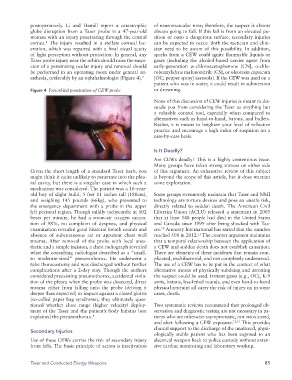
              esthesia, preferably by an ophthalmologist (Figure 4). 7  [OC; pepper spray] aerosols). If the CEW was used on a
                                                                 patient who was in water, it could result in submersion
              Figure 4  Periorbital penetration of CEW probe     or drowning.

                                                                 None of this discussion of CEW injuries is meant to dis-
                                                                 suade you from considering the Taser as anything but
                                                                 a valuable control tool, especially when compared to
                                                                 alternatives such as hand-to-hand, batons, and bullets.
                                                                 Rather, it is meant to heighten your level of reflective
                                                                 practice and encourage a high index of suspicion on a
                                                                 case-by-case basis.


                                                                 Is It Deadly?
                                                                 Are CEWs deadly? This is a highly contentious issue.
                                                                 Many groups have taken strong stances on either side
              Given the short length of a standard Taser barb, you   of this argument. An exhaustive review of this subject
              might think it quite unlikely to penetrate into the pleu-  is beyond the scope of this article, but it does warrant
              ral cavity, but there is a singular case in which such a   some exploration.
              mechanism was considered. The patient was a 16-year-
              old boy of slight build, 5 feet 11 inches tall (180cm),   Some groups strenuously maintain that Taser and NMI
              and weighing 145 pounds (66kg), who presented to   technology are torture devices and pose an unsafe risk,
              the emergency department with a probe in the upper   directly  related  to  sudden  death.  The  American  Civil
              left pectoral region. Though mildly tachycardic at 102   Liberties Union (ACLU) released a statement in 2005
              beats per minute, he had a room-air oxygen satura-  that at least 148 people had died in the United States
              tion of 98%, no complaint of dyspnea, and physical   and Canada since 1999 after being shocked with Tas-
              examination revealed good bilateral breath sounds and   ers.  Amnesty International has stated that the number
                                                                    10
              absence of subcutaneous air or apparent chest wall   reached 500 in 2012.  The counter argument maintains
                                                                                   11
              trauma. After removal of the probe with local anes-  that a temporal relationship between the application of
              thetic and a simple incision, a chest radiograph revealed   a CEW and sudden death does not establish causation.
              what the consulting radiologist described as a “small-   There are elements of these incidents that remain com-
              to moderate-sized” pneumothorax. He underwent a    plicated, multifactorial, and not completely understood.
              tube thoracostomy and was discharged without further   The use of a CEW has to be put in the context of what
              complications after a 2-day stay. Though the authors   alternative means of physically subduing and arresting
              considered preexisting pneumothorax, accidental viola-  the suspect could be used. Irritant gases (e.g., OC), K-9
              tion of the pleura when the probe was dissected, direct   units, batons, less-lethal rounds, and even hand-to-hand
              trauma either from falling onto the probe (driving it   physical restraint all carry the risk of injury or, in some
              deeper than expected) or impact against a closed glottis   cases, death.
              (so-called paper bag syndrome), they ultimately ques-
              tioned whether close range (higher velocity) deploy-  Two systematic reviews recommend that prolonged ob-
              ment of the Taser and the patient’s body habitus best   servation and diagnostic testing are not necessary in pa-
              explained the pneumothorax. 9                      tients who are otherwise asymptomatic, not intoxicated,
                                                                 and alert following a CEW exposure. 12,13  This provides
                                                                 clinical support to the discharge of the unaltered, physi-
              Secondary Injuries
                                                                 ologically stable patient who has been exposed to an
              Use of these CEWs carries the risk of secondary injury   electrical weapon back to police custody without exten-
              from falls. The basic principle of action is inactivation   sive cardiac monitoring and laboratory workup.


              Taser and Conducted Energy Weapons                                                              85

