


Page 103 - Journal of Special Operations Medicine - Winter 2015
P. 103
acids that the body cannot synthesize on its own) com-  preparing and consuming a meal. This generally oc-
              position, and  digestive  and absorptive  properties.    curs during sustained training and combat operations
                                                            19
              Some plant-based proteins are also considered high-  when SOF are subsisting primarily on combat rations
              quality, although it is important to recognize that many   or the economy. Consuming supplemental protein may
              plant-based proteins provide lower amounts of the es-  be an effective measure to maintain adequate protein
              sential amino acids compared to animal proteins.   intake during operational scenarios. If supplements are
                                                                 used, they should provide sufficient, but not excessive,
              Combining protein sources (i.e., animal and plant   amounts of protein (e.g., 20–25g) to maximally stimu-
              or various plant proteins together) in a healthy, well-   late muscle protein synthesis. Protein supplements are
              balanced diet generally provides adequate amounts of   often combined with carbohydrate to fuel endurance ex-
              the essential amino acids. The amount of protein con-  ercise metabolism and, to a lesser amount, fat, which also
              sumed at each meal and the timing of those meals also   provides energy and improves palatability. This energy-
              influence the effectiveness of dietary protein on skele-  dense formulation is preferred during sustained military
              tal muscle. Distributing daily protein intake as evenly   operations. SOF that use supplemental protein during
              as possible across meals and snacks will help stimulate   periods of relatively low metabolic demand should rec-
              muscle protein synthesis (i.e., build muscle) to a greater   ognize that consuming supplements without modifying
              extent than a more traditional, skewed dietary pattern   total dietary intake may contribute to weight gain. 24,25
              of protein intake, where 60% or more of daily protein
              intake is consumed during one meal (typically dinner). 20  Whey, casein, and soy are among the most common
                                                                 commercial protein supplements. Whey and casein (i.e.,
              Recent studies suggest that consuming a protein- containing   the two main proteins found in milk) are considered
              snack before bed may also assist with the maintenance of   high quality based on their essential amino acid contents
              muscle mass by stimulating muscle protein synthesis and   and the rate at which they are digested and absorbed.
              sparing existing muscle from being degraded to maintain   Whey protein is considered a fast protein because it is
              blood glucose while sleeping.  The amount of protein   digested and absorbed quickly, stimulating a robust,
                                       21
              that muscle can effectively use to stimulate muscle pro-  short-lived (about 2 hours) increase in muscle protein
              tein synthesis appears to be 0.25–0.3g/kg of BM per meal,   synthesis. Casein is a slowly digested and absorbed pro-
              which, for the average man, is about 20–25g per meal. 22,23    tein that results in a lower but more sustained muscle
              Consuming protein beyond 0.25–0.3g/kg of BM provides   protein synthetic response than whey. For these reasons,
              no additional anabolic stimulus; the additional protein is   whey protein is often recommended to promote muscle
              either used for fuel during periods of high metabolic de-  recovery (i.e., synthesis of new and repair of existing
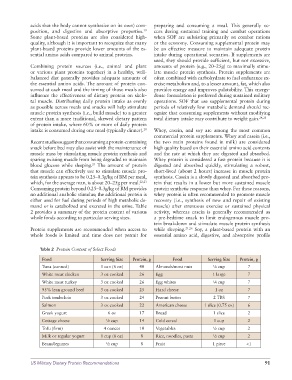
              mand or is  catabolized and excreted in the urine. Table   muscle) after strenuous exercise or sustained physical
              2 provides a summary of the protein content of various   activity,  whereas  casein  is  generally  recommended  as
              whole foods according to particular serving sizes.  a pre-bedtime  snack to limit endogenous  muscle pro-
                                                                 tein breakdown and stimulate muscle protein synthesis
              Protein supplements are recommended when access to   while sleeping. 21,26  Soy, a plant-based protein with an
              whole  foods  is  limited  and  time  does  not  permit  for   essential amino acid, digestive, and absorptive profile


                  Table 2  Protein Content of Select Foods
                  Food                     Serving Size  Protein, g     Food           Serving Size  Protein, g
                  Tuna (canned)            1 can (6 oz)    40    Almonds/most nuts       ¼ cup         7
                  White meat chicken       3 oz cooked     26    Egg                     1 large       7
                  White meat turkey        3 oz cooked     26    Egg whites              ¼ cup         7
                  95% lean ground beef     3 oz cooked     25    Hard cheese              1 oz         7
                  Pork tenderloin          3 oz cooked     24    Peanut butter           2 TBS         7
                  Salmon                   3 oz cooked     22    American cheese     1 slice (0.75 oz)  6
                  Greek yogurt                6 oz         17    Bread                   1 slice       2
                  Cottage cheese             ½ cup         14    Cold cereal             1 cup         2
                  Tofu (firm)               4 ounces       10    Vegetables              ½ cup         2
                  Milk or regular yogurt   1 cup (8 oz)    8     Rice, noodles, pasta    ½ cup         2
                  Beans/legumes              ½ cup         8     Fruit                   1 piece       <1


              US Military Dietary Protein Recommendations                                                     91

