


Page 136 - Journal of Special Operations Medicine - Spring 2015
P. 136
a b
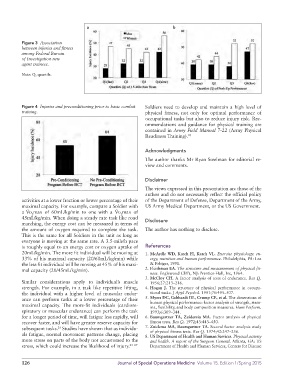
Figure 3 Association
between injuries and fitness
among Federal Bureau
of Investigation new
agent trainees.
Note: Q, quartile.
Figure 4 Injuries and preconditioning prior to basic combat Soldiers need to develop and maintain a high level of
training. physical fitness, not only for optimal performance of
occupational tasks but also to reduce injury risk. Rec
ommendations and guidance for physical training are
contained in Army Field Manual 7-22 (Army Physical
Readiness Training). 28
Acknowledgments
The author thanks Mr Ryan Steelman for editorial re
view and comments.
Disclaimer
The views expressed in this presentation are those of the
author and do not necessarily reflect the official policy
activities at a lower fraction or lower percentage of their of the Department of Defense, Department of the Army,
maximal capacity. For example, compare a Soldier with US Army Medical Department, or the US Government.
.
.
a Vo max of 60mL/kg/min to one with a Vo max of
2
2
45mL/kg/min. When doing a steady rate task like road Disclosure
marching, the energy cost can be measured in terms of
the amount of oxygen required to complete the task. The author has nothing to disclose.
This is the same for all Soldiers in the unit as long as
everyone is moving at the same rate. A 3.5mile/h pace
is roughly equal to an energy cost or oxygen uptake of References
20mL/kg/min. The more fit individual will be moving at 1. McArdle WD, Katch FI, Katch VL. Exercise physiology: en-
33% of his maximal capacity (20/60mL/kg/min) while ergy, nutrition and human performance. Philadelphia, PA: Lea
the less fit individual will be moving at 45% of his maxi & Febiger, 1991.
mal capacity (20/45mL/kg/min). 2. Fleishman EA. The structure and measurement of physical fit-
ness. Englewood Cliffs, NJ: PrenticeHall, Inc, 1964.
3. McCloy CH. A factor analysis of tests of endurance. Res Q.
Similar considerations apply to individual’s muscle 1956;27:213–216.
strength. For example, in a task like repetitive lifting, 4. Hogan J. The structure of physical performance in occupa
the individual with a higher level of muscular endur tional tasks. J Appl Psychol. 1991;76:495–507.
ance can perform tasks at a lower percentage of their 5. Myers DC, Gebhardt DL, Crump CE, et al. The dimensions of
maximal capacity. The morefit individuals (cardiore human physical performance: factor analysis of strength, stam
ina, flexibility, and body composition measures. Hum Perform.
spiratory or muscular endurance) can perform the task 1993;6:309–344.
for a longer period of time, will fatigue less rapidly, will 6. Baumgartner TA, Zuidemia MA. Factor analysis of physical
recover faster, and will have greater reserve capacity for fitness tests. Res Q. 1972;43:443–450.
subsequent tasks. Studies have shown that as individu 7. Zuidema MA, Baumgartner TA. Second factor analysis study
24
of physical fitness tests. Res Q. 1974;42:247–256.
als fatigue, normal movement patterns change, placing 8. US Department of Health and Human Services. Physical activity
more stress on parts of the body not accustomed to the and health. A report of the Surgeon General. Atlanta, GA: US
stress, which could increase the likelihood of injury. 25–27 Department of Health and Human Services, Centers for Disease
126 Journal of Special Operations Medicine Volume 15, Edition 1/Spring 2015

