


Page 98 - Journal of Special Operations Medicine - Fall 2014
P. 98
An Ongoing Series


                                            Erythema Multiforme


                                   Charles A. Sola, MD; Trisha Clarke Beute, MD


          ABSTRACT
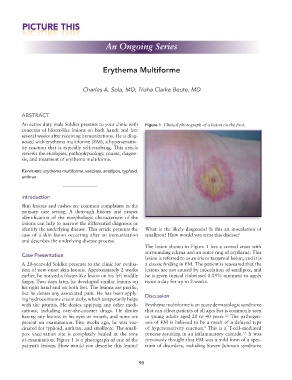
          An active duty male Soldier presents to your clinic with   Figure 1  Clinical photograph of a lesion on the foot.
          concerns of blister-like lesions on both hands and feet
          several weeks after receiving immunizations. He is diag-
          nosed with erythema multiforme (EM), a hypersensitiv-
          ity reaction that is typically self-resolving. This article
          reviews the etiologies, pathophysiology, course, diagno-
          sis, and treatment of erythema multiforme.

          Keywords: erythema multiforme, vaccines, smallpox, typhoid,
          anthrax


          Introduction
          Skin lesions and rashes are common complaints in the
          primary care setting. A thorough history and proper
          identification of the morphologic characteristis of the
          lesions can help to narrow the differential diagnosis or
          identify the underlying disease. This article presents the   What is the likely diagnosis? Is this an inoculation of
          case of a skin lesion occurring after an immunization   smallpox? How would you treat this disease?
          and describes the underlying disease process.
                                                             The lesion shown in Figure 1 has a central crust with
                                                             surrounding edema and an outer ring of erythema. This
          Case Presentation
                                                             lesion is referred to as an iris or targetoid lesion, and it is
          A 20-year-old Soldier presents to the clinic for evalua-  a classic finding in EM. The patient is reassured that the
          tion of new-onset skin lesions. Approximately 2 weeks   lesions are not caused by inoculation of smallpox, and
          earlier, he noticed a blister-like lesion on his left middle   he is given topical clobetasol 0.05% ointment to apply
          finger. Two days later, he developed similar lesions on   twice a day for up to 2 weeks.
          his right hand and on both feet. The lesions are puritic,
          but he denies any associated pain. He has been apply-
          ing hydrocortisone cream daily, which temporarily helps   Discussion
          with the pruritis. He denies applying any other medi-  Erythema multiforme is an acute dermatologic syndrome
          cations, including over-the-counter drugs. He denies   that can affect patients of all ages but is commonly seen
          having any lesions in his eyes or mouth, and none are   in young adults aged 20 to 40 years.  The pathogen-
                                                                                              1,2
          present on examination. Five weeks ago, he was vac-  esis of EM is believed to be a result of a delayed type
                                                                                     2
          cinated for typhoid, anthrax, and smallpox. The small-  of hypersensitivity reaction.  This is a T-cell–mediated
          pox  vaccination  site  is  completely  healed  at  the  time   process resulting in an inflammatory cascade.  It was
                                                                                                     1,3
          of examination. Figure 1 is a photograph of one of the   previously thought that EM was a mild form of a spec-
          patient’s lesions. How would you describe this lesion?   trum of disorders, including Steven-Johnson syndrome


                                                          90

