


Page 15 - Journal of Special Operations Medicine - Spring 2014
P. 15
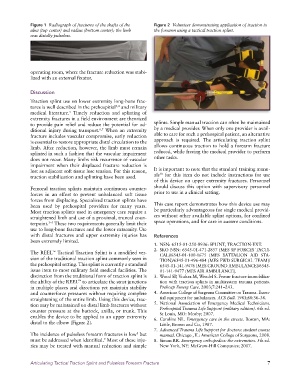
Figure 1  Radiograph of fractures of the shafts of the    Figure 2  Volunteer demonstrating application of traction to
              ulna (top center) and radius (bottom center); the limb    the forearm using a tactical traction splint.
              was distally pulseless.


              operating room, where the fracture reduction was stabi-
              lized with an external fixator.


              Discussion
              Traction splint use on lower extremity long-bone frac-
              tures is well described in the prehospitial  and military
                                                 3,4
              medical literature.  Timely reduction and splinting of
                              5
              extremity fractures in a field environment are theorized
              to provide pain relief and reduce the potential for ad-  splints. Simple manual traction can often be maintained
              ditional injury during transport.  When an extremity   by a medical provider. When only one provider is avail-
                                          6,7
              fracture includes vascular compromise, early reduction   able to care for such a prehospital patient, an alternative
              is essential to restore appropriate distal circulation to the   approach is required. The articulating traction splint
              limb. After reduction, however, the limb must remain   allows continuous traction to hold a forearm fracture
              splinted in such a fashion that the vascular impairment   reduced, while freeing the medical provider to perform
              does not recur. Many limbs risk recurrence of vascular   other tasks.
              impairment when their displaced fracture reduction is
              lost as adjacent soft tissue lose tension. For this reason,   It is important to note that the standard training manu-
                                                                   10
              traction stabilization and splinting have been used.  als  for this item do not include instructions for use
                                                                 of this device on upper extremity fractures. Personnel
              Femoral traction splints maintain continuous counter-  should discuss this option with supervisory personnel
              forces in an effort to prevent unbalanced soft tissue   prior to use in a clinical setting.
              forces from displacing. Specialized traction splints have
              been used by prehospital providers for many years.   This case report demonstrates how this device use may
              Most traction splints used in emergency care require a   be particularly advantageous for single medical provid-
              straightened limb and use of a proximal, truncal coun-  ers without other available splint options, for confined
              terpoint.  These two requirements generally limit their   space operations, and for care in austere conditions.
                     3–5
              use to long-bone fractures and the lower extremity. Use
              with distal fractures and upper extremity injuries has   References
              been extremely limited.
                                                                 1.  NSN: 6515-01-250-8936: SPLINT, TRACTION-EXT.
                                                                 2.  SKO NSN: 6545-01-471-2857 (MES SP FORCES TACTI-
              The REEL  Tactical Traction Splint is a modified ver-  CAL)/6545-01-100-1675 (MES BATTALION AID STA -
                       ™
              sion of the traditional traction splint commonly seen in   TION)/6545-01-496-484 (MES FWD SURGICAL TEAM)/
              the prehospital setting. This splint is currently a standard   6545-01-141-9476 (MES GROUND AMBULANCE)/6545-
              issue item to most military field medical facilities. The   01-141-9477 (MES AIR AMBULANCE).
              distinction from the traditional form of traction splint is   3.  Wood SP, Vrahas M, Wendel S. Femur fracture immobiliza-
              the ability of the REEL  to articulate the strut junctions   tion with traction splints in multisystem trauma patients.
                                 ™
              in multiple places and directions yet maintain stability   Prehosp Emerg Care. 2003;7:241–243.
              and counterforce pressures without requiring complete   4.  American College of Surgeons Committee on Trauma. Essen-
              straightening of the entire limb. Using this device, trac-  tial equipment for ambulances. ACS Bull. 1983;68:36–38.
              tion may be maintained on distal limb fractures without   5.  National Association of Emergency Medical Technicians.
              counter pressure at the buttock, axilla, or trunk. This   Prehospital Trauma Life Support (military edition). 6th ed.
                                                                   St Louis, MO: Mosby; 2007.
              enables the device to be applied to an upper extremity   6.  Caroline NL. Emergency care in the streets. Boston, MA:
              distal to the elbow (Figure 2).                      Little, Brown and Co, 1987.
                                                                 7.  Advanced Trauma Life Support for doctors: student course
              The incidence of pulseless forearm fractures is low  but   manual. Chicago , IL: American College of Surgeons, 2008.
                                                         8
              must be addressed when identified.  Most of these inju-  8.  Simon RR. Emergency orthopedics: the extremities. 5th ed.
                                            9
              ries may be treated with manual reduction and simple   New York, NY: McGraw-Hill Companies; 2007.


              Articulating Tactical Traction Splint and Pulseless Forearm Fracture                             7

